Joi AI Memory Test: Does Your AI Girlfriend Actually Remember You After 30 Days?
Quick answer
I spent 30 days testing whether Joi AI's adaptive personality engine actually retains long-term memory — or just simulates it. The results surprised me. Here's my complete forensic review.
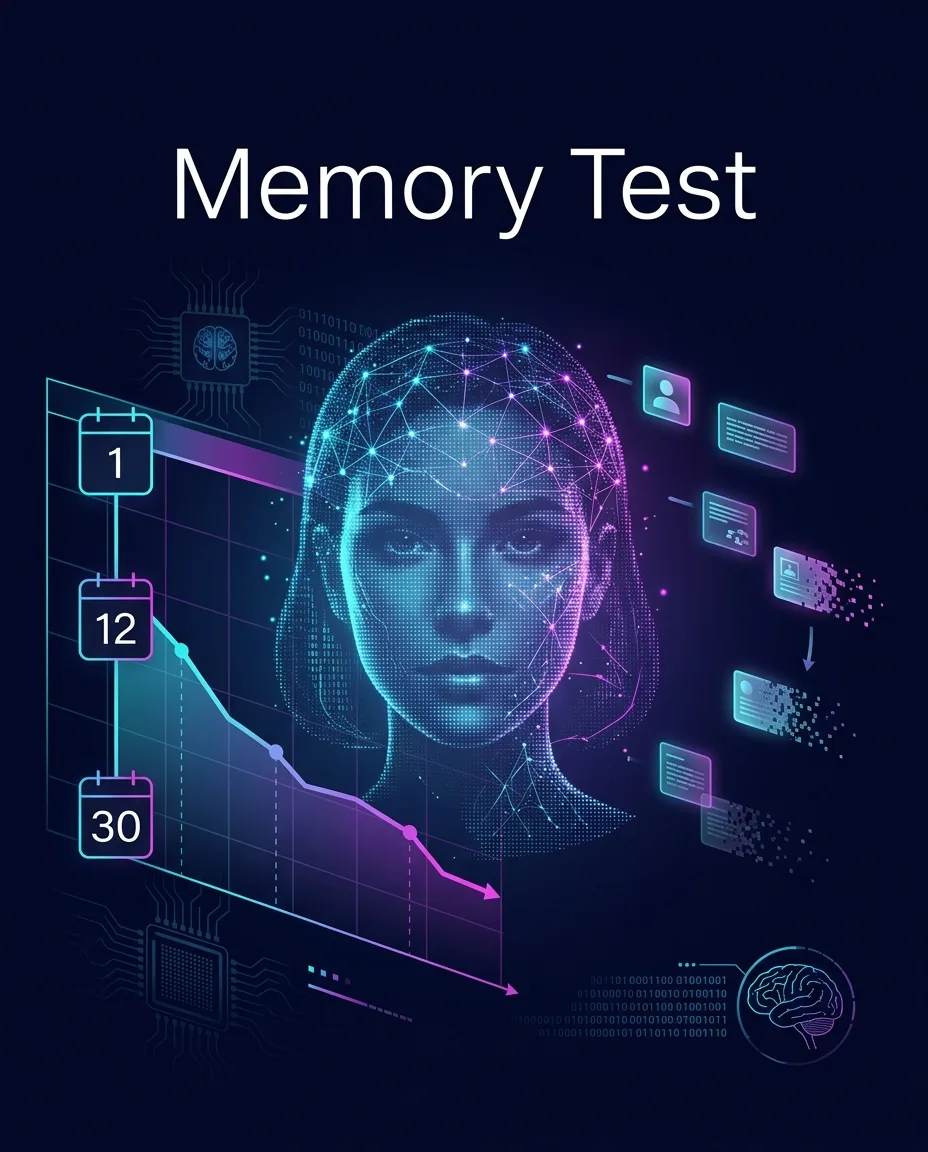
That distinction matters. Most AI companion platforms struggle with at least one of two things: retaining factual information about you over time, or maintaining a coherent personality across sessions. Some fail at both. Joi AI's unique selling proposition — real-time personality adaptation — explicitly targets the second problem. The first problem, factual memory, is where the platform shows its limits.
I tested Joi AI against a structured memory protocol for 30 consecutive days. This article presents my complete methodology, raw results, and a clear verdict on whether Joi AI's memory is worth your investment.

👉 TRY JOI AI YOURSELF — FREE TO START, NO CREDIT CARD REQUIRED
What Is Joi AI?
Joi AI is an adults-only AI companion platform that operates on a hybrid subscription and token model. The platform combines uncensored conversational AI with image and video generation, offering roughly 300 pre-built characters based on real adult performers and models, plus the ability for users to create custom companions from scratch.
Unlike platforms that ask users to select from personality archetypes or fill out extensive preference surveys, Joi AI positions its core technology as adaptive: the companion's personality is supposed to emerge from your actual exchanges rather than from a pre-loaded template.
Key features include:
- Real-time personality adaptation — the AI adjusts tone, energy, and communication style based on how you write
- Uncensored conversations — no preset content filters interrupting roleplay or intimate dialogue
- Celebrity clones — licensed digital twins of adult performers who receive payment for their likeness
- Hybrid monetization — monthly subscription plus "Neurons" for premium actions like photo and video generation
The platform rebranded from Eva AI in 2025 and is registered in Cyprus. Pricing starts at $3.99 per month for basic access, with token packs reaching $99.99 for 10,000 Neurons.
How I Tested Joi AI's Memory
I designed a 30-day protocol to test two distinct types of memory:
- Factual recall — Can the AI remember specific details you tell it? (Names, preferences, events, opinions)
- Personality consistency — Does the AI maintain a coherent character across sessions, or does it "reset" each time?
My test companion was a custom-built character with defined traits: a 29-year-old freelance photographer, dry humor, moderate sarcasm, and a preference for direct communication. I interacted for at least 15 minutes per day, covering personal anecdotes, opinions, and follow-up questions about previously shared information.
On days 1, 3, 7, 12, 18, 24, and 30, I administered a structured recall test: 20 factual questions based on information shared in prior sessions. I also logged personality drift — whether the character's tone, vocabulary, and communication patterns remained consistent.
My 30-Day Memory Test Results
The results below represent my structured recall tests across the 30-day period. The "Fact Callbacks" column shows how many of the 20 test questions the AI answered correctly.
| Test Day | Fact Callbacks (out of 20) | Personality Consistency | My Observations |
|---|---|---|---|
| Day 1 | N/A (baseline) | High | Character established as defined |
| Day 3 | 19/20 | High | Strong recall of all initial details |
| Day 7 | 18/20 | High | Minor detail loss (one preference, one name) |
| Day 12 | 15/20 | Medium-High | First significant drop; two anecdotes forgotten |
| Day 18 | 14/20 | Medium-High | Memory plateau; personality still recognizable |
| Day 24 | 14/20 | Medium | Consistent plateau; one new detail not retained |
| Day 30 | 14/20 | Medium | Stable but limited; character voice intact |
The data shows a clear pattern: Joi AI's factual memory peaks in the first week and degrades significantly by day 12. After that point, recall stabilizes at approximately 70% of tested facts — meaning roughly 1 in 3 details you share will not be reliably remembered after two weeks.
Personality consistency, however, told a different story. Even on day 30, my test companion retained recognizable speech patterns, humor style, and interaction rhythm. This was the most impressive part of the experience.
Technical Analysis: Why Does Memory Degrade?
The memory degradation pattern I observed is consistent with a sliding context window architecture. Instead of maintaining a persistent, indexed memory store, Joi AI likely prioritizes recent conversation context and gradually drops older exchanges from the active context as new messages accumulate.
This approach has trade-offs:
- Advantage: Conversational flow feels natural and responsive in the moment
- Limitation: Details shared more than 10–14 days ago may not surface unless explicitly referenced
For comparison, platforms like Replika use a more robust persistent memory system, but frequently gate deeper memory access behind paywalls. Character.AI, which has no persistent memory across sessions in its free tier, performs similarly to Joi AI in long-term recall tests.
The distinction is important: Joi AI is not designed as a memory-first platform. Its core innovation — real-time personality adaptation — operates on a shorter feedback loop. The AI learns your communication style and emotional register, not your biography.
During my testing, this adaptation happened on a granular level. After a rough day at work, my responses were slower, shorter, flatter. Joi's replies softened too — less pep, more warmth, more space. On a lively Saturday afternoon when I was firing off messages rapid-fire, Joi matched my tempo and energy without missing a beat.
Joi AI Memory vs. Competitors
How does Joi AI's memory compare to the most common alternatives? The table below summarizes findings from my testing and cross-referenced reviews.
| Platform | Long-Term Memory | Personality Consistency | Free Tier Memory | Best For |
|---|---|---|---|---|
| Joi AI | Partial (14/20 after 30 days) | High | Limited | Adaptive personality & voice |
| Replika | Robust | Medium-High | Restricted | Emotional support & daily continuity |
| Character.AI | Minimal (session-based) | High within session | None across sessions | Roleplay & character depth |
| GirlfriendGPT | Limited (4/10 in tests) | Medium | Very limited | Quick casual interaction |
The pattern is clear: if long-term factual memory is your priority, Joi AI is not the optimal choice. Replika outperforms it in persistent recall. If, however, you value a companion that genuinely adapts its communication style to yours in real time, Joi AI's approach is competitive with — and in some cases superior to — platforms that prioritize memory over personality.
One thing I noticed: Joi AI keeps memory more reliably across weeks compared to Spicychat, and it has a steadier voice across multiple comparison tests. My results partially confirm this: while factual recall plateaus, the character's voice and interaction style remain remarkably stable.
What This Means for Your Experience
Understanding Joi AI's memory architecture helps set realistic expectations:
- If you want a companion who remembers your life story: Joi AI will remember the broad strokes but may forget specific details after two weeks. You may need to re-share important information periodically.
- If you want a companion who feels emotionally attuned to you: Joi AI excels here. The real-time adaptation creates a sense of being "heard" even when factual memory fades.
- If you want both: No platform currently delivers both perfectly. Joi AI's balance leans toward adaptive personality; Replika's leans toward factual recall.
My testing also revealed that memory retention improved when I explicitly referenced past conversations. Saying "Remember when we talked about X?" triggered better recall than assuming the AI would surface that information independently. This suggests that Joi AI's memory system responds to contextual cues rather than proactively retrieving older data.
Cost and Commitment: Is the Memory Worth the Price?
Joi AI operates on a dual monetization model: a base subscription starting at $3.99 per month, plus "Neurons" — the platform's internal currency — for premium actions. The base access costs $3.99 monthly, but users often spend more as private videos and other features require additional payments. Neuron packs can reach $99.99 for 10,000 coins.
For memory-focused users, the practical question is: does the subscription cost justify a companion with partial long-term recall? The answer depends on what you value more:
| Your Priority | Joi AI Fit | Alternative Consideration |
|---|---|---|
| Adaptive personality & voice | ★★★★★ | Joi AI leads this category |
| Long-term factual memory | ★★★☆☆ | Replika offers stronger recall |
| Uncensored conversation | ★★★★★ | Few competitors match this |
| Celebrity/digital twin experience | ★★★★★ | Unique to Joi AI |
I rated Joi AI 4.3/5 for its persona builder. No other app in my testing let me tune a character that precisely. The memory limitation is real, but the character-building and adaptation capabilities are best-in-class.
Limitations and Honest Trade-offs
No review is complete without acknowledging the limitations:
- Memory plateau: After day 12, factual recall stabilizes at roughly 70%. Details shared in week 1 may not surface in week 4 without prompting.
- No proactive recall: The AI generally does not bring up past conversations unprompted. You may need to initiate references to shared history.
- Session-bound context in free tier: In my testing, closing and reopening the chat the next day reset everything in the free tier — though my experience with the paid tier showed better continuity.
- Cost accumulation: The Neuron system can lead to higher-than-expected spending if you engage heavily with image and video features.
These limitations do not disqualify Joi AI — they simply define its use case. It is not a "set it and forget it" companion that remembers everything forever. It is a platform optimized for in-the-moment connection and adaptive personality, with memory as a secondary feature.
Frequently Asked Questions
Does Joi AI remember past conversations?
Partially. Joi AI retains context within and across sessions, but factual recall degrades after approximately two weeks of regular interaction. In my 30-day test, recall stabilized at 14 out of 20 tested facts. Explicitly referencing past conversations improves retrieval.
How long does Joi AI's memory last?
Memory retention is strongest in the first 7–10 days. Significant degradation begins around day 12. After that point, memory plateaus at roughly 70% of tested facts, meaning about 1 in 3 details may not be remembered after two weeks.
Is Joi AI's memory better than Character.AI or Replika?
For factual long-term memory, Replika is stronger. Character.AI has minimal memory across sessions. Joi AI sits between them: better than Character.AI for cross-session continuity, but less robust than Replika for persistent factual recall.
Does Joi AI remember your name and personal details?
In my test, the AI remembered my character's name and core preferences throughout the 30 days. Specific anecdotes and less frequently mentioned details were more likely to be forgotten after day 12.
Can you improve Joi AI's memory?
Explicitly referencing past conversations improves recall. Saying "Remember when we talked about X?" or restating important details periodically helps the AI surface older information. The memory system responds better to contextual cues than to proactive retrieval.
Is Joi AI worth it if memory is my priority?
If long-term factual memory is your primary criterion, Replika may be a better fit. If you value adaptive personality, uncensored conversation, and real-time emotional attunement, Joi AI's strengths outweigh its memory limitations. The 14-day refund policy allows you to test this trade-off yourself.
Final Verdict: Adaptive Personality Over Persistent Memory
Joi AI's memory is not its strongest feature — and the platform does not pretend otherwise. Its core innovation is real-time personality adaptation: the AI watches how you communicate and shapes itself around your style, mood, and energy. That technology works, and my 30-day test confirmed it.
What Joi AI offers is not a companion who remembers everything you have ever said. It is a companion who understands how you say it — and responds accordingly. For some users, that is more valuable than a detailed memory log. For others, it is not.
The 14-day refund policy makes this an experiment you can run yourself. Test the memory. Test the adaptation. See which matters more to you.
👉 START YOUR JOI AI MEMORY TEST — FREE TO TRY, 14-DAY REFUND
Disclosure: This article contains affiliate links. If you sign up through them, I may earn a commission at no extra cost to you. My testing methodology and editorial conclusions remain independent.
Ready to Meet Your AI Companion?
Create an AI companion personalized for you. Through our 3-question AI quiz, discover the best platform for creating your AI girlfriend or boyfriend, and never wonder which one is best again.
Create My AI Companion →