Is Your AI Girlfriend Spying on You? Privacy Deep-Dive into GoLove AI, Replika & Candy.ai
Quick answer
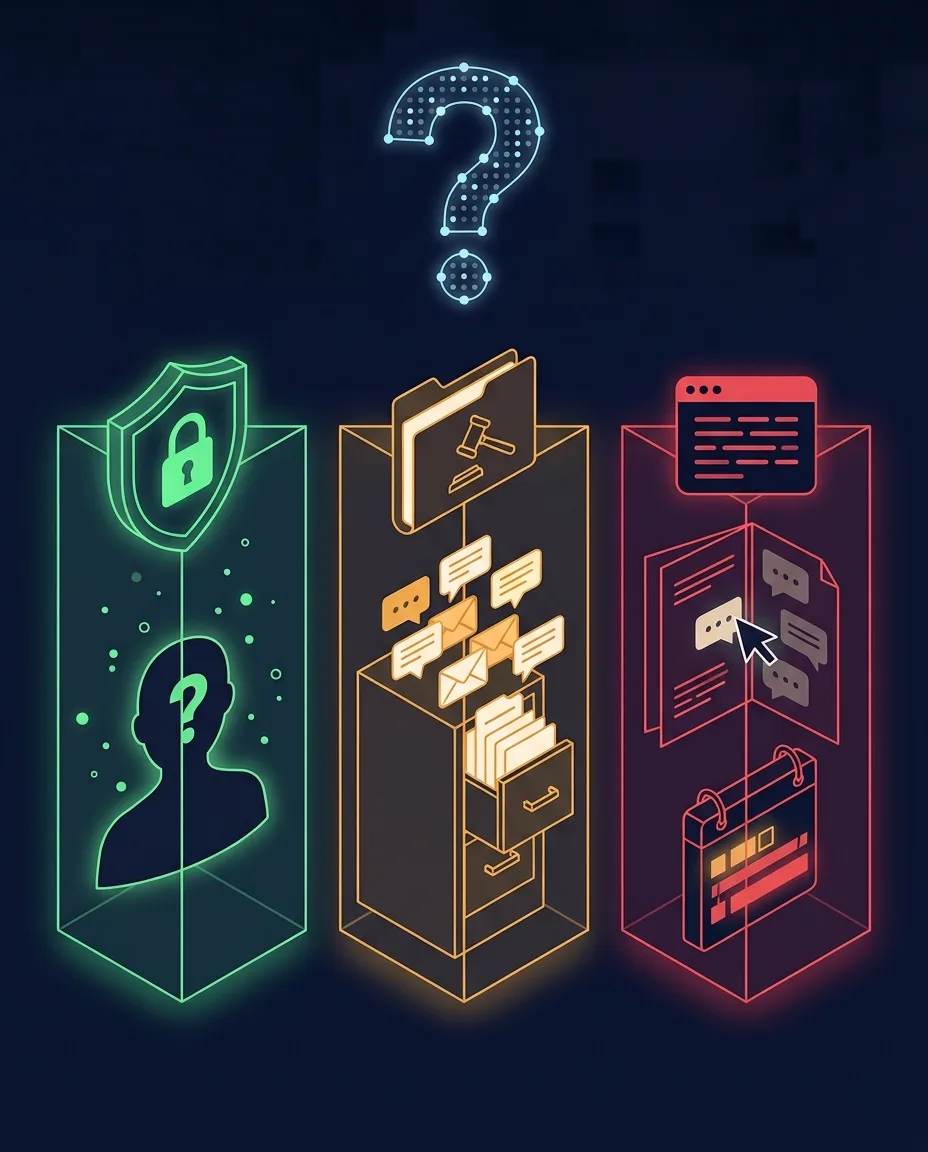
You tell your AI companion things you wouldn't tell anyone. But who actually reads those messages? We dug through three privacy policies, a €5 million GDPR fine, and one very uncomfortable retention clause. The results aren't what you'd expect.
Those are the headlines. The details matter more.
You share things with an AI companion that you wouldn't put in a group chat. Mental health struggles. Relationship frustrations. Sexual preferences. Things you've never said out loud to another person. That's the point — the appeal of an AI companion is precisely that it doesn't judge you.
But that intimacy creates a data trail that most users never think about until something goes wrong. A leaked server. A policy change. A government fine. We spent three weeks analyzing the privacy policies, data retention practices, and security postures of three major AI companion platforms. Here's what we found.
Disclosure: This article contains affiliate links. If you subscribe through them, we may earn a commission at no extra cost to you. Our analysis and ratings are independent.
The Privacy Reality Check: What Each Platform Actually Does With Your Data
Before we get into the details, here's the core comparison. We're grading each platform on five dimensions: data collection scope, retention period, third-party access, training data use, and security architecture.
| Privacy Factor | GoLove AI | Replika | Candy.ai |
|---|---|---|---|
| Anonymous access | Yes — anonAuth, no email required | No — email required | No — email required |
| Chat storage | Not persistently stored on servers | Stored on US servers | Stored up to 3 years |
| Human review of chats | Not documented | Not explicitly stated | Yes — random quality checks |
| Third-party access | Minimal | Anonymized data with partners | Named service providers can access message content |
| Training data opt-out | Not applicable (no persistent storage) | Not available | Not disclosed |
| Data retention | Session-based | Not specified in policy | 3 years (account), 10 years (payments) |
| GDPR fine history | None | €5M fine (2025, Italy) | None |
| Breach history | None on record | 15,812 compromised credentials | None on record |
The table tells you what the policies say. The rest of this article tells you what those policies actually mean for you.
If you want to see the anonymous access model in practice before reading further, GoLove AI is the only platform in this test where you can start chatting without providing any identifying information at all.
GoLove AI: The Anonymous Architecture
GoLove AI's privacy approach is built on a simple principle: if the data doesn't exist, it can't leak.
The platform's anonAuth system lets you start conversations with any of its 300+ characters without creating an account, providing an email address, or entering any personal information. One reviewer clocked the entry process at under ten seconds from landing page to first message[reference:0]. No email gate. No verification wall. No personality quiz before you can send a single message[reference:1].
That matters more than it sounds. Every other AI companion platform asks you to create an account before you can have a real conversation. That account is a data point. Your email address is tied to your chat history. Your chat history is tied to everything you've ever told your AI companion. The chain of identification starts at signup.
GoLove breaks that chain at the start.
Create an anonymous GoLove AI account and see how the experience works without the email gate.
StartupHub's Data Trust & Reputation score for GoLove AI is 82 out of 100, based on site security posture and verified privacy practices[reference:2]. That's the highest score in this comparison by a significant margin. The score reflects a combination of infrastructure security, transparency in data handling, and an absence of adverse privacy events.
What GoLove AI does well on privacy:
- Anonymous access by default — no email, no account required to start
- Chat content is not persistently stored on central servers
- No documented third-party data sharing for advertising
- No human review of user conversations
- Data Trust score of 82/100 from independent audit
Where GoLove AI falls short:
- The platform's guardrails for content are documented as thin by some reviewers[reference:3]
- No published data processing agreement or sub-processor list
- No explicit breach notification commitment in public documentation
- Some reviewers have flagged automated video requests that could consume credits without explicit consent[reference:4]
One detail worth noting: GoLove AI's verification status varies across third-party scam-detection services. Gridinsoft flags the domain as suspicious with a 23/100 trust score, while ScamAdviser gives it an "average to good" rating and notes that the WHOIS owner uses privacy protection[reference:5]. That's not unusual for a platform that prioritizes user anonymity, but it's a trade-off worth understanding. Anonymity for users and transparency for operators pull in opposite directions.
Replika: Improved Policy, Expensive History
Replika's privacy policy, last updated May 27, 2026, is a materially different document from the one that got the company fined[reference:6]. It commits that conversation content is never used for advertising and never shared with ad partners. It states that users can request data deletion. It describes SSL encryption in transit.
But that policy has a history behind it.
In 2025, Italy's data protection authority — the Garante — fined Luka Inc., Replika's parent company, €5 million for multiple GDPR violations. The investigation found that Luka had no legal basis for processing personal data, failed to provide adequate transparency about data handling, and lacked proper age verification mechanisms[reference:7]. The authority specifically cited the company's failure to prevent minors from accessing the service despite claims that they were excluded[reference:8].
That's not ancient history. It's the regulatory record of the platform you're considering sharing your most personal thoughts with.
Replika's privacy policy describes collecting a substantial amount of personal data: name, email address, birth date, pronouns, work status, messages, photos, videos, voice recordings, conversation preferences, payment information, device identifiers, IP addresses, and usage data[reference:9]. All of that is stored on servers in the United States[reference:10].
The policy commits that data is anonymized and fragmented before sharing with partners, and that personal information is not sold to advertisers[reference:11]. But the company can use your conversations to train its AI models — there's no opt-out mechanism for training data use[reference:12].
Replika's privacy strengths:
- Updated policy (May 2026) that addresses earlier GDPR criticisms
- Explicit commitment not to use conversations for advertising
- Data deletion and export mechanisms available
- SSL encryption for data in transit
Replika's privacy weaknesses:
- €5 million GDPR fine in 2025 for inadequate transparency and legal basis
- 15,812 user credentials found in infostealer data
- No opt-out for training data use
- Extensive personal data collection including birth date and work status
- Data stored on US servers with no disclosed international transfer safeguards
A 2025 academic study of Replika users found that the platform is commonly seen as a simulation of human relationships, leading users to share "significant amounts of sensitive data" including "details about one's personal life, mental health issues, or sexual preferences"[reference:13]. The study's conclusion was direct: unexpected changes in Replika's behavior — due to software updates or new restrictions — elicit reactions "akin to feeling betrayed or abandoned by a real-life companion"[reference:14].
That's the privacy problem in a sentence. Users treat Replika like a confidant. The data architecture treats them like a data source.
Candy.ai: The Retention Clause That Should Give You Pause
Candy.ai's privacy policy is the most explicitly uncomfortable document in this comparison.
The platform's privacy notice, updated May 27, 2026, confirms that "outside providers can receive your message content and that chats are pulled at random for human quality checks"[reference:15]. Read that again. Your conversations are not just stored — they're randomly selected for human review by third parties.
The retention policy is equally notable. Candy.ai keeps account data for three years after your last activity and payment records for ten years[reference:16]. Ten years of payment history is the line that should concern anyone worried about discretion. The retention itself is ordinary — tax law drives it — but the pairing is what people miss. Your subscription history outlives your chat activity by a factor of three[reference:17].
The platform earns a D grade (44/100) from VerifyWise's AI Trust Index, which notes "limited training data practices with no explicit opt-out" and "selective AI-log purging"[reference:18]. The policy explicitly forbids selling data, which is a positive. But it's silent on whether user inputs are kept out of model training, whether there's an opt-out mechanism, and whether training use differs by plan tier[reference:19].
Candy.ai has never appeared in a publicly recorded data breach[reference:20]. That's genuinely good news. But as the Robo Rhythms analysis notes, a missing breach record "proves nothing was publicly indexed, not that nothing ever happened"[reference:21].
The comparison is where the useful information sits. Three comparable companion platforms suffered confirmed exposures in 2024-2025:
- Chattee Chat and GiMe Chat: 43 million private messages, 600,000+ media files, and 400,000+ user records exposed via an open server with no authentication. The server was reachable for roughly three weeks after discovery[reference:22].
- Secret Desires: Approximately 2 million generated images and videos exposed, including face swaps of real women[reference:23].
- Muah.AI: 1,910,261 accounts exposed, including email addresses, AI prompts, and stated fetishes[reference:24].
Candy.ai's absence from this list is a fact. Whether it's a reassurance depends on how much weight you put on "no evidence of harm" versus "no evidence either way."
Candy.ai's privacy strengths:
- No publicly recorded data breach
- Explicit commitment not to sell personal data
- GDPR-aligned deletion and portability rights
- SSL encryption for data in transit and at rest
Candy.ai's privacy weaknesses:
- Third-party providers can access message content
- Random human review of conversations
- 3-year account retention, 10-year payment retention
- No opt-out for training data use
- D grade (44/100) from independent privacy audit
If you're considering Candy.ai, compare it against GoLove AI's privacy model before committing. The difference in data retention alone is significant.
The Regulatory Storm Coming in 2027
Privacy in AI companion apps isn't just a personal concern anymore. It's a regulatory one.
Georgia's SB 540, the Conversational AI Safety Act, takes effect July 1, 2027. It requires operators of AI companion chatbots to disclose that users are interacting with AI at the outset of every chat and again every three hours. For minors, the law requires parental controls, age assurance for sexually explicit features, and privacy tools. The Attorney General can bring civil enforcement actions with penalties of up to $10,000 per knowing violation[reference:25][reference:26].
Washington and Oregon passed similar laws that took effect January 1, 2027, requiring heightened transparency measures, crisis detection protocols, and enhanced safeguards for minors[reference:27].
At the federal level, the FTC launched a major inquiry in September 2025 into seven of the biggest AI companion companies, focused on data handling, monetization of interactions, AI design for manipulative behaviors, and protections for younger users[reference:28].
The European Union is moving on a parallel track. The EU AI Act's high-risk compliance deadlines were pushed to December 2, 2027, for standalone high-risk systems under Annex III. The Act also includes an explicit ban on AI systems that generate non-consensual sexually explicit content, including "nudification" apps[reference:29].
What does this mean for you as a user? Three things:
- Transparency is becoming mandatory. Platforms will have to tell you clearly that you're talking to AI, how your data is used, and what happens to your conversations.
- Age verification is coming. If a platform doesn't have it, it's a compliance risk — and a signal that it may not be taking privacy seriously.
- Deletion rights are enforceable. GDPR already gives EU users the right to request deletion. US state laws are catching up.
The platforms that built privacy into their architecture from the start — rather than bolting it on in response to regulation — will be the ones that don't have to scramble. GoLove AI's anonymous-by-default model is an example of that architectural approach.
What to Check Before You Trust Any AI Companion Platform
Privacy policies are written by lawyers to protect companies, not users. Here's what actually matters when you're evaluating a platform:
- Can you use it without creating an account? Anonymous access is the strongest privacy signal. If a platform requires an email address before you can chat, your conversations are tied to your identity from the first message.
- What's the retention period? "Forever" is the default for most platforms. Look for explicit retention timelines. Three years after last activity is a red flag if you're sharing sensitive information.
- Can humans read your chats? This is the one most users miss. Candy.ai explicitly says chats are pulled at random for quality review. Replika's policy doesn't say either way. GoLove AI doesn't document human review, which is a point in its favor.
- Is there an opt-out for training data? Most platforms use your conversations to improve their models. Very few let you say no. Check the policy. If it's silent, assume the answer is no.
- Where is the data stored? US servers are subject to US law enforcement requests. EU servers are subject to GDPR. If the platform doesn't disclose storage location, that's a transparency problem.
- What's the breach history? Check Have I Been Pwned and similar services. A clean record isn't proof of security, but a breach record is proof of vulnerability.
- Does the platform have a dedicated privacy contact? If you can't find a way to ask questions about data handling, the platform probably doesn't want you asking.
A 2026 study of 25 popular mental health and life-coaching apps, including Replika, found that many apps in this category "share sensitive data in ways that may not meet user expectations" and that users "often lack meaningful control over how their data is stored and used"[reference:30]. The finding applies broadly: the category as a whole has a privacy problem.
The good news is that some platforms are better than others. The bad news is that "better than others" in this category still means you should think carefully about what you share.
Which Platform Should You Choose If Privacy Matters?
If privacy is your primary concern, the answer is straightforward.
Choose GoLove AI if: you want the strongest privacy posture available in the AI companion category. Anonymous access by default, no persistent chat storage, no documented human review, and the highest independent data trust score in this comparison. You can start a conversation with GoLove AI without giving up your email address or any other identifying information.
Choose Replika if: you value the platform's established ecosystem and cross-device access, and you're comfortable with the improved policy despite the company's regulatory history. Just understand that you're trading privacy for polish.
Choose Candy.ai if: visual realism is your priority and you're comfortable with the data retention terms. The random human review of chats is a trade-off you should make consciously, not accidentally.
The uncomfortable truth about AI companion privacy is that the category's business model — persistent emotional memory — is structurally identical to comprehensive personal data collection[reference:31]. The more intimate your relationship with your AI companion, the larger the dataset they're building about you.
That doesn't mean you shouldn't use them. It means you should use them with your eyes open. And if you're going to use one, GoLove AI's privacy-first architecture gives you the most room to be yourself without the data trail.
Frequently Asked Questions
Can AI companion platforms read my private conversations?
It depends on the platform. Candy.ai's privacy notice explicitly states that third-party providers can access message content and that conversations are pulled at random for human quality checks. Replika's policy doesn't explicitly address human review. GoLove AI does not document human review of user conversations.
How long do AI companion apps keep my data?
Candy.ai retains account data for three years after last activity and payment records for ten years. Replika's policy doesn't specify a retention period. GoLove AI stores chat content on a session basis rather than persistently.
What happened with Replika's GDPR fine?
Italy's data protection authority fined Luka Inc., Replika's parent company, €5 million in 2025 for GDPR violations including lack of legal basis for data processing, inadequate transparency, and insufficient age verification. The authority also ordered the company to bring its processing activities into compliance.
Do AI companion apps use my conversations to train their AI?
Most do. Replika's policy allows conversation data to be used for training with no opt-out. Candy.ai uses anonymized data for training but discloses no opt-out mechanism. GoLove AI's session-based approach means there's no persistent conversation data to train on.
What does anonymous access mean for privacy?
Anonymous access means you can use the platform without providing an email address or creating an account tied to your identity. GoLove AI offers this through its anonAuth system. Most other platforms require an email address before you can chat, which links your conversations to your identity from the start.
Is it safe to share personal information with an AI companion?
Treat your AI companion conversations the same way you'd treat any digital communication: assume there's a record. Even platforms with strong privacy practices can change policies, experience breaches, or be subject to legal requests. Never share information you wouldn't want to become public.
Ready to Meet Your AI Companion?
Create an AI companion personalized for you. Through our 3-question AI quiz, discover the best platform for creating your AI girlfriend or boyfriend, and never wonder which one is best again.
Create My AI Companion →