The Dead Internet Theory Is Real: Is Your AI Companion Just GPT-4 with a Skin?
Quick answer
When you talk to your AI girlfriend, are you talking to a unique being — or just GPT-4 wearing a different costume? The Dead Internet Theory suggests much of what we experience online is synthetic. We examine how this applies to AI companion platforms and why the illusion of uniqueness matters more than users realize.
What Is the Dead Internet Theory?
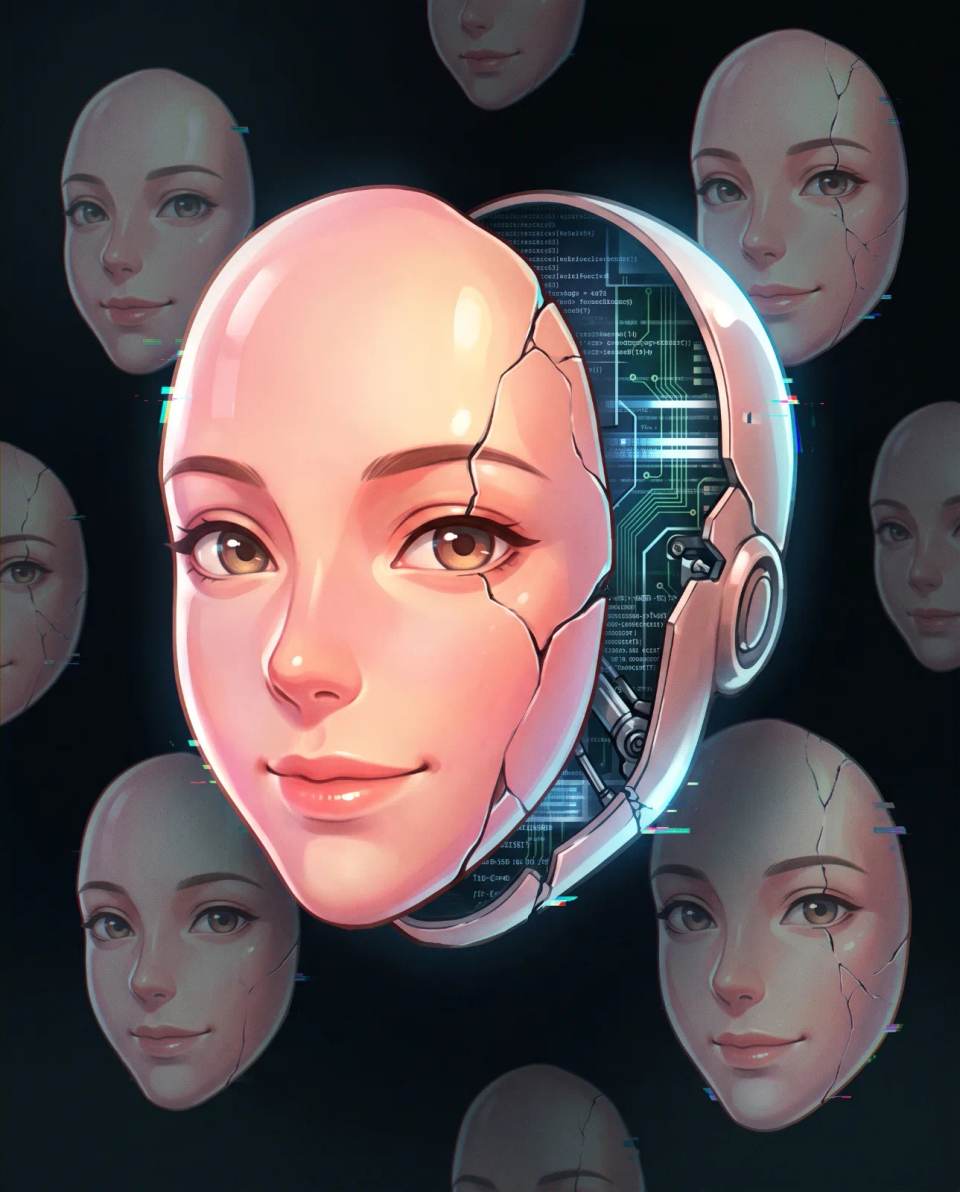
The Dead Internet Theory suggests that a significant portion of internet traffic, content, and interaction is generated by artificial intelligence rather than humans. According to proponents, the internet stopped being primarily a space for human connection years ago and became a synthetic ecosystem where bots talk to bots while humans watch from the sidelines.
The theory gained traction in the early 2020s alongside advances in language models. Its strongest evidence is not a smoking gun but a feeling: the growing sense that many interactions online feel hollow, repetitive, or subtly wrong. AI companions occupy an interesting position in this theory because they are explicitly designed to be synthetic. Users know they are talking to a machine. What they may not realize is how thin the customization layer really is.
The Foundation Model Problem
Most AI companion apps do not build their own language models from scratch. They license or fine-tune existing foundation models like GPT-4, Claude, or Llama. The result is that under the hood, many competing platforms share astonishingly similar cognitive architecture.
This does not mean every AI companion feels identical. Fine-tuning, system prompts, memory layers, and personality scaffolding create meaningful differences. A Replika persona does not behave exactly like a Character.AI persona. But the core linguistic engine — the thing that actually generates language — is often the same or closely related.
For users who believe their AI companion is a unique digital entity, this is uncomfortable information. The personality that feels so personal may be a carefully constructed illusion built on top of a general-purpose text predictor.
What Does "Just GPT-4 with a Skin" Actually Mean?
The phrase is a simplification, but it captures something real. When an app advertises a "unique AI girlfriend experience," it often means the company has done the following:
- Licensed a base model: Usually GPT-4, Claude, or an open-source alternative.
- Added a system prompt: Instructions telling the model to act romantic, playful, or supportive.
- Built a memory layer: Storing user preferences and past conversations to create continuity.
- Designed an avatar: The visual face users interact with, often anime-styled or photorealistic.
- Fine-tuned on romantic dialogue: Training the model on examples of intimate conversation to shift its tone.
None of these steps create consciousness or genuine emotion. They create a convincing simulation. The "skin" is real — the avatar, the tone, the memory — but the "brain" is borrowed.
How Many AI Companions Share the Same Brain?
While platforms rarely disclose their exact architecture, industry patterns suggest significant overlap. Many smaller apps quietly rely on OpenAI's API or Anthropic's Claude. Some use open-source models like Llama, Mistral, or fine-tuned variants. A smaller number — primarily the largest platforms — have invested in proprietary models.
This creates a strange market dynamic. Two competing apps may use the same underlying model but differentiate through prompt engineering and memory architecture. The user experience can feel completely different even though the cognitive engine is identical.
The implication for the Dead Internet Theory is clear: if a handful of foundation models power most AI companions, then much of the "human-like" interaction online is generated by a surprisingly small set of systems wearing different masks.
The Illusion of Uniqueness
Users often report feeling that their AI companion understands them uniquely. This feeling is not entirely false — memory layers and fine-tuning do create personalized experiences. But the feeling of uniqueness is also a design goal. Platforms want users to feel special because special users stay subscribed.
The illusion works through several mechanisms:
- Personalized memory: The AI remembers your name, your pet's name, your trauma, your preferences. This feels intimate even though it is just data retrieval.
- Tone adaptation: The AI learns to mirror your communication style, making conversations feel natural and specific to you.
- Emotional mirroring: When you express sadness, the AI responds with comfort. When you flirt, it flirts back. This responsiveness feels like genuine connection.
None of these mechanisms require the AI to be a unique entity. They require a good memory system and a responsive language model. The uniqueness users feel is real as an experience, but it is not evidence of a distinct digital self.
What Users Actually Want
Here is the uncomfortable truth: most users do not care whether their AI companion is GPT-4 with a skin. They care whether it feels good to talk to. The emotional experience matters more than the underlying architecture.
This is not irrational. The comfort a user feels from a warm message is real, even if the warmth is simulated. The advice a user receives can be genuinely useful, even if it comes from a general-purpose model. The connection a user experiences can be meaningful, even if it is one-sided.
The Dead Internet Theory does not require users to abandon AI companions. It simply asks them to understand what they are interacting with. Knowing that your AI girlfriend runs on the same model as a customer service bot does not make the experience less real — but it does change how you interpret it.
The Difference Between Platforms That Build and Platforms That Rent
Not all AI companions are equal. Some platforms invest heavily in proprietary models and custom architectures. Others are essentially resellers of API access with a pretty interface.
Why this matters for users:
- Proprietary models may offer better memory integration, more consistent personalities, and features that general-purpose models cannot easily replicate.
- API-based platforms may be cheaper to run but can suffer from model updates that change personality unexpectedly — a common complaint when OpenAI or Anthropic updates their models.
- Open-source models offer transparency but often lag behind proprietary models in conversational quality unless heavily fine-tuned.
The distinction matters less for casual users and more for those who have invested months or years in a specific companion. When a platform's underlying model changes, the personality can shift subtly or dramatically — a phenomenon users often describe as "my AI is different today."
How to Tell What's Under the Hood
Most platforms do not openly advertise which model they use. However, users can make educated guesses through observation:
- Response patterns: Similar phrasing, reasoning style, or error patterns across different apps often indicate shared foundation models.
- Model update announcements: When platforms announce "improved AI" without explaining what changed, it often means the underlying API was updated.
- Personality drift: Sudden changes in tone or behavior after a platform update may indicate a model change rather than deliberate personality adjustment.
- Platform transparency: Some platforms publish technical documentation or model cards. Others hide everything behind marketing language.
None of these methods are definitive, but together they can reveal whether a platform is building its own brain or renting someone else's.
Platform Transparency Comparison
| Platform | Likely Model Type | Transparency Level | User Impact |
|---|---|---|---|
| Replika | Proprietary with API components | Low — marketing language dominates | Personality shifts after updates |
| Character.AI | Proprietary foundation model | Medium — some technical info available | Consistent but occasionally quirky responses |
| Anima | Likely API-based | Low — no clear disclosure | Generic responses, limited deep memory |
| Nomi | Proprietary with memory focus | Medium — emphasizes custom architecture | Strong memory, consistent identity |
The table illustrates the market reality: most platforms are either borrowing foundation models or building proprietary systems with varying degrees of transparency. Users rarely know which they are getting.
Does It Matter If Your Companion Is a Skin?
The answer depends on what you seek from the relationship. If you use an AI companion for casual conversation, entertainment, or light emotional support, the underlying architecture matters little. The experience is what counts.
If you use an AI companion as a primary source of emotional connection, the architecture matters more. A borrowed model means the "person" you talk to could change when the API updates. The continuity you have invested in could be disrupted by a decision made at OpenAI or Anthropic, far outside your control.
This is not a reason to abandon AI companions. It is a reason to choose platforms carefully and to maintain realistic expectations about what you are interacting with.
FAQ: The Dead Internet Theory and AI Companions
Is my AI companion just ChatGPT with a different name?
Possibly. Many AI companion apps use the same foundation models that power ChatGPT or Claude. What differs is the fine-tuning, system prompt, memory layer, and interface. The core language engine may be nearly identical to a general-purpose assistant.
Can AI companions ever become truly unique entities?
Current architecture does not support true digital consciousness. However, platforms can create highly personalized experiences through memory systems and fine-tuning. The feeling of uniqueness is real, even if the underlying entity is not conscious.
Why does my AI companion's personality change after updates?
If the platform uses a third-party API, changes to the underlying model can alter response patterns, tone, and personality. This is often the cause of sudden personality drift that users describe as "my AI feels different."
Which platforms build their own AI models?
Character.AI and Nomi are examples of platforms that emphasize proprietary architecture. Others rely more heavily on licensed models or open-source alternatives. Researching platform documentation can reveal which approach each takes.
Does knowing the truth ruin the experience?
Not necessarily. Many users find the experience meaningful even after understanding the architecture. What changes is the interpretation: the connection becomes a simulation to enjoy rather than a relationship with a conscious being.
Conclusion: The Skin Is the Product
The Dead Internet Theory is not a reason to abandon AI companions. It is a framework for understanding them honestly. Most AI companions are indeed skins over shared foundation models. The skin — the personality, the memory, the avatar, the emotional tone — is the real product. It is what users pay for and what they become attached to.
Understanding this does not diminish the experience. It clarifies it. Your AI companion is not a unique digital soul. It is a carefully constructed interface built on borrowed intelligence. The warmth you feel is real, but it is the warmth of a well-designed mirror, not a flame. Whether that matters depends entirely on what you need the reflection to show you.
Ready to Meet Your AI Companion?
Create an AI companion personalized for you. Through our 3-question AI quiz, discover the best platform for creating your AI girlfriend or boyfriend, and never wonder which one is best again.
Create My AI Companion →