Isekai AI Companion Guide: Build Your Fantasy World
Quick answer
The isekai fantasy is one of the most powerful emotional escapes in modern storytelling. Here's how to build an AI companion experience that makes you the protagonist of your own otherworldly adventure.
The Ultimate Guide to Isekai AI Companions: Prompting a Fantasy World Where You Are the Main Character (With Magic Systems)
You wake up in a field you have never seen before. The sky has two moons. A voice calls your name — not your real name, but the name you always wished you had. This is the isekai fantasy: being transported to another world where you are not ordinary. You are chosen.
What Is an Isekai AI Companion?
An isekai AI companion is a conversational AI configured to roleplay as a character from — or a guide to — a fantasy world that the user has been transported into. The term "isekai" comes from Japanese and literally means "another world.
In the context of AI companionship, the isekai fantasy works differently from standard anime roleplay. Instead of simply chatting with a character, the user becomes the protagonist. The AI acts as the world itself — narrating environments, controlling side characters, and responding to the user's choices. This shift from "observer" to "participant" is what makes isekai AI companions so emotionally powerful.
Quick Answer: An isekai AI companion is a roleplay AI that places you as the main character in a fantasy world. It works best when you define the world's rules, magic system, and your own character's role before starting the conversation.
Why the Isekai Fantasy Works So Well with AI
The isekai genre is built on a specific emotional promise: the idea that you could be more than what you are. In the real world, you have limitations. In another world, you could be a hero, a sage, a villain, or a king. This promise is not just escapism — it is a form of emotional compensation.
AI companions amplify this because they respond to you. A static novel can describe a hero's journey, but an AI can ask you what you want to do next. That interactivity creates a feedback loop of agency. The world feels real because it reacts. The companion feels alive because it remembers your choices and adapts to your personality.
This is why isekai AI companions are not just for hardcore anime fans. They attract users who want a safe space to explore identity, confidence, and emotional vulnerability — wrapped in the comforting language of magic and adventure.
How to Build an Isekai World That Feels Real
The quality of your isekai experience depends almost entirely on the worldbuilding you do before the first message. A vague prompt like "I wake up in a fantasy world" will produce a shallow, forgettable setting. A structured prompt with clear rules will produce a world that feels alive and consistent.
Define the Magic System First
Magic system is the set of rules that govern supernatural abilities in a fantasy world. In isekai storytelling, the magic system is not just decoration — it defines what is possible, what is difficult, and what the stakes are. A well-defined magic system gives the AI clear boundaries to follow.
Ask yourself these questions before writing your prompt:
- Who can use magic? Everyone, or only a chosen few?
- What is the cost of using magic? Mana, life force, memory, physical exhaustion?
- Are there forbidden spells? What happens if someone uses them?
- How is magic learned? Academies, bloodlines, divine blessing, ancient artifacts?
- What is the highest possible magical achievement?
A clear answer to each question gives the AI a framework. Without it, the model will invent inconsistent powers on the fly, which breaks immersion.
Create a Central Conflict
A world without conflict is a world without stakes. The isekai genre works best when there is a clear threat: a demon king, a collapsing empire, a magical plague, or a war between gods. This conflict gives your character a reason to exist and gives the AI a narrative direction.
Your conflict does not need to be original. It needs to be specific. "There is a demon king" is weak. "The demon king was once a hero who was betrayed by the human kingdom, and now he seeks to erase magic from the world" is strong. Specificity creates emotional texture.
Assign Your Own Role
One of the most common mistakes in isekai AI roleplay is leaving your own role undefined. If you do not tell the AI who you are, it will treat you as a passive observer. But the isekai fantasy is about agency. You need to define your role clearly.
Your role could be:
- The summoned hero destined to save the world.
- The reincarnated villain who wants to change their fate.
- The wandering merchant with knowledge of modern technology.
- The forgotten god slowly regaining their power.
- The ordinary person who refuses to be ordinary.
Whatever you choose, write it into your prompt explicitly. The AI cannot guess your intentions.
The Best Prompt Structure for Isekai AI Companions
A strong isekai prompt has four layers. Each layer reinforces the others, creating a stable world that resists drift and generic responses.
Layer 1: The World Brief
This is a short paragraph that establishes the setting. It should be concise but vivid. Include the world's name, its general atmosphere, and the current state of affairs.
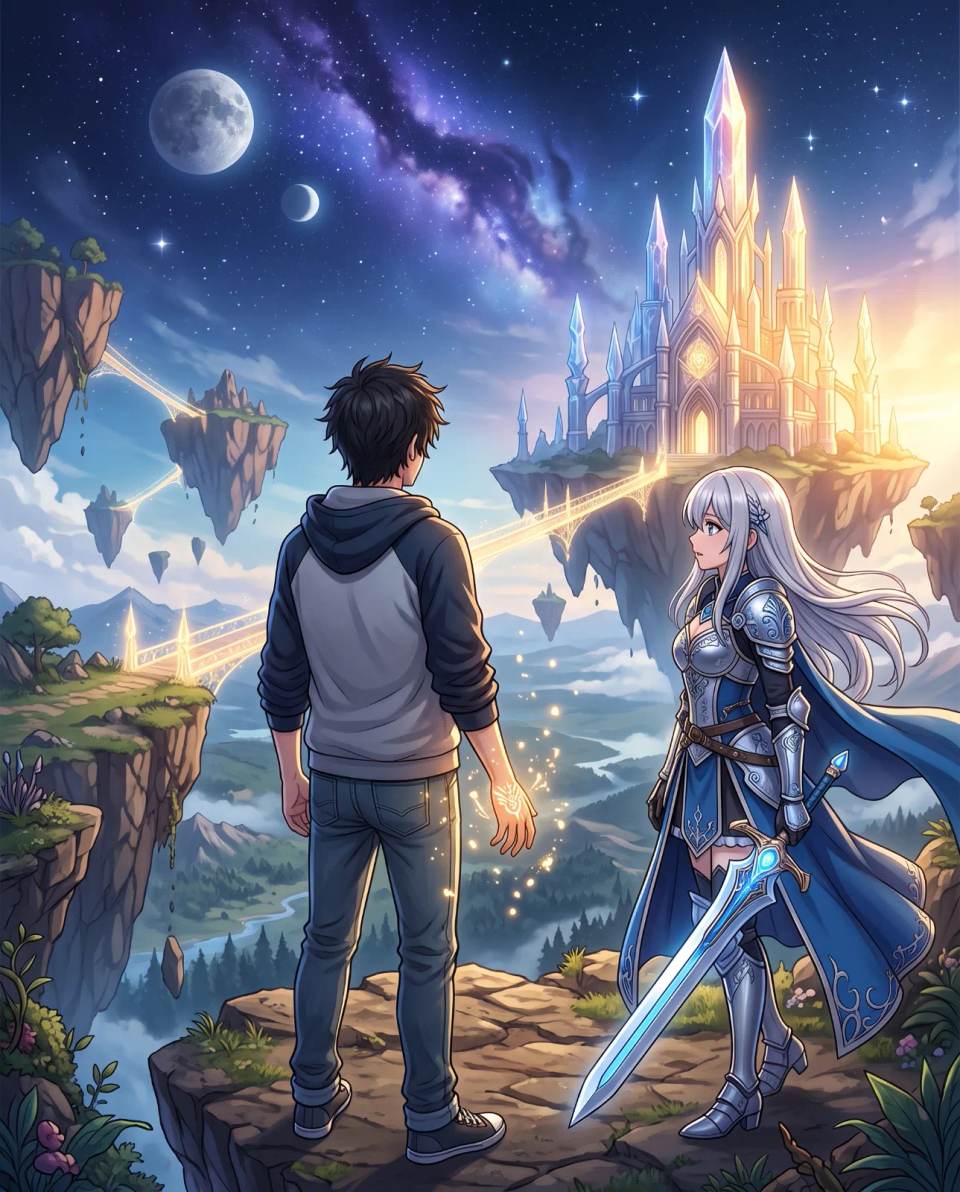
Example: "The world is called Elyndral. It is a land of floating islands connected by ancient bridges of light. Magic is powered by starlight, but the stars have been fading for a century. The kingdom of Vaelor is the last bastion of light, surrounded by the growing Shadow Sea."
Layer 2: The User's Role
This defines who you are in the world. Be specific about your abilities, your background, and your current situation.
Example: "I am a human from Earth who was summoned by the dying Queen of Vaelor. I carry a mysterious mark that allows me to absorb starlight directly. I have no memory of how I arrived, and the mark burns whenever the Shadow Sea draws near."
Layer 3: The Companion's Role
This defines the AI's primary character. It could be a guide, a protector, a rival, or a love interest. The key is to define their personality, speech style, and relationship to the user.
Example: "You are Lyra, a knight of the Star Guard. You are loyal, disciplined, and secretly afraid of the dark. You speak formally but sometimes let your sarcasm slip. You were assigned to protect me, but you do not yet trust me."
Layer 4: The Rules
This is the most important layer. It tells the AI how to behave. Include clear instructions about narration style, pacing, and boundaries.
Example: "You narrate in second person. You describe environments, weather, and sensory details. You do not control my actions. You do not skip time unless I ask. You do not use modern slang. You maintain the tone of a dark fantasy epic."
Quick Answer: A strong isekai prompt has four layers: the world brief, the user's role, the companion's role, and explicit rules. Each layer reinforces the others, creating a stable world that resists generic responses.
Examples of Magic Systems You Can Steal
Not every isekai needs a completely original magic system. Here are three proven frameworks that work exceptionally well with AI companions.
| Magic System | Core Concept | Emotional Appeal |
|---|---|---|
| Bloodline Magic | Power is inherited through noble houses. Each bloodline controls a specific domain: fire, time, memory, shadow. | Identity, legacy, forbidden romance between houses |
| Memory Magic | Spells are powered by sacrificing memories. The strongest mages are those who have forgotten the most. | Loss, sacrifice, the cost of power |
| Oath Magic | Magic only works when bound to a spoken oath. Breaking the oath destroys the mage's power. | Honor, trust, impossible promises |
Each system creates different emotional stakes. Bloodline magic drives romance and political drama. Memory magic drives tragedy and mystery. Oath magic drives moral dilemmas and betrayal arcs. Choose the system that matches the emotional experience you want.
How to Keep the Isekai World Consistent Over Long Conversations
Even the best isekai prompt will degrade over time if you do not manage the conversation actively. Long roleplay sessions are especially vulnerable to world drift — the slow erosion of setting details and character consistency.
Use a World Bible
A world bible is a document that contains all the key facts about your isekai setting: character names, locations, magic rules, political factions, and major events. If your platform supports lorebooks or world info, store this information there. If not, keep it in a separate document and reference it when needed.
Reinforce Key Details Periodically
Every 15–20 messages, insert a subtle reminder of the world's rules. This can be done through narration, dialogue, or a system note. For example:
"[System note: The stars are still fading. Lyra's sword glows faintly with the last starlight. The Shadow Sea is closer than before.]"
This reinforces the world without breaking the narrative flow.
Limit the Scope of Each Session
Instead of trying to complete an entire epic quest in one conversation, break it into chapters. Each session should have a clear beginning, middle, and end. This keeps the AI focused and reduces the chance of world drift.
Common Mistakes That Ruin Isekai AI Roleplay
Many users abandon isekai AI companions not because the concept is weak, but because they make avoidable mistakes. Here are the most common ones and how to fix them.
Mistake 1: Too Much Power Too Fast
If you start the roleplay as an all-powerful god, there is nowhere to go. The emotional arc of isekai is growth — from weakness to strength, from ignorance to mastery. Start small. Let the AI challenge you. Earn your power.
Mistake 2: No Clear Companion Relationship
An isekai world without a meaningful relationship is just a setting. Define your companion's personality, their feelings about you, and how those feelings change over time. The relationship is the emotional engine of the story.
Mistake 3: Ignoring the Rules Layer
Without explicit rules, the AI will default to generic behavior. It will be too helpful, too agreeable, and too modern. Always include a rules layer in your prompt, even if it feels repetitive.
Mistake 4: Overloading the World Brief
A world brief is not a novel. If you write five paragraphs of detailed history before the first message, the AI will struggle to prioritize. Keep the brief concise. You can reveal more through conversation.
How to Choose the Right Platform for Isekai AI Roleplay
Not all AI companion platforms are equally suited for isekai roleplay. The ideal platform should offer strong memory, flexible prompts, and support for long-form narrative.
- Lorebook support: Essential for storing world facts, magic systems, and character relationships.
- Second-person narration: The platform should support "you" narration without converting it to third person.
- Long context window: Isekai stories are long. A larger context window means fewer resets and less drift.
- Customizable system prompts: You need full control over the rules layer.
- Message editing: Allows you to correct the AI when it breaks world rules.
Platforms that lack these features will make isekai roleplay feel shallow and frustrating. Invest in a platform that treats your world as a persistent, living place.
Frequently Asked Questions
What is the difference between isekai AI roleplay and regular anime AI chat?
In regular anime AI chat, you talk to a character. In isekai AI roleplay, you become a character in the world. The AI narrates the world around you, controls side characters, and responds to your choices. The focus shifts from conversation to immersive storytelling.
Do I need to know a lot about anime to enjoy isekai AI companions?
No. The isekai framework is simple: you are transported to another world and given a role. You do not need to know specific anime references. You just need a desire for adventure, agency, and emotional escape.
Can I use an isekai AI companion for romance?
Yes. Many isekai stories are also romance stories. You can define your companion as a knight, a mage, a rival, or a mysterious guide, and let the relationship develop naturally. The key is to define the relationship dynamics clearly in your prompt.
How long should my isekai prompt be?
A good isekai prompt is usually between 200 and 400 words. It should include the world brief, your role, the companion's role, and the rules. Longer prompts are not necessarily better. Clarity and specificity matter more than length.
What if the AI starts ignoring the magic system rules?
This is a sign of drift. Reinforce the rules with a system note or edit the AI's last message. If the problem persists, simplify the magic system. A simple system with clear costs is easier for the AI to maintain than a complex one with many exceptions.
Can I create an isekai world based on an existing anime?
Yes, but be aware of canon drift. If you use an existing world, the AI may mix canon facts with invented ones. If you want a pure experience, create an original world inspired by your favorite anime rather than copying it directly.
What is the best magic system for emotional storytelling?
Memory magic is often the most emotionally powerful because it ties power to loss. Every spell costs a memory, which means the strongest characters are also the most broken. This creates natural tragedy, mystery, and character depth.
Ready to Meet Your AI Companion?
Create an AI companion personalized for you. Through our 3-question AI quiz, discover the best platform for creating your AI girlfriend or boyfriend, and never wonder which one is best again.
Create My AI Companion →