Local LLM AI Companion: Ollama & SillyTavern Setup Guide
Quick answer
Ditch the cloud. Learn how to run a fully private AI companion using Ollama and SillyTavern, from GPU requirements to model selection and prompt tuning.
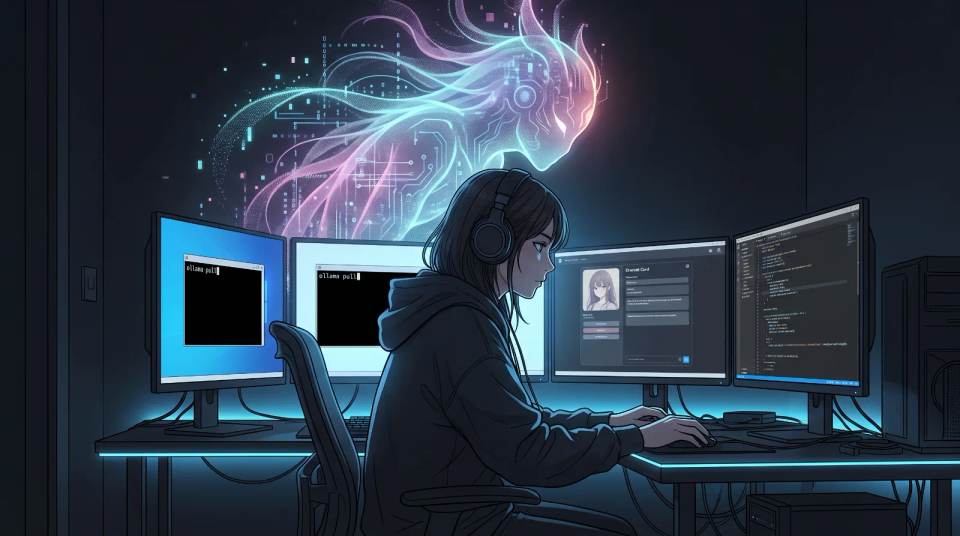
From Senpai to Shikigami: Coding Your Own Guardian Spirit AI with Local LLMs
There is a moment every serious AI companion user reaches: the subscription renews, the server lags, or a policy update silently neuters your carefully crafted persona. At that point, the appeal of running everything locally stops being theoretical. It becomes an act of digital self-respect.
Why Run a Local LLM for AI Companionship?
Cloud-based platforms like Character.AI or Replika deliver convenience at the cost of control. Their models live behind closed APIs, their filters shift without notice, and your chat history trains future versions of someone else's product. Local LLMs invert that relationship entirely.
A local companion runs on your own machine, stores data on your own drives, and responds only to the prompts you design. There is no monthly token meter. There is no content moderation layer deciding what your fictional partner may say. For users building deeply personal characters, that freedom is the entire point.
The trade-off is technical setup and hardware investment. But for many, that investment functions as a feature rather than a bug. Running your own model means you learn how generative AI works under the hood, which improves your prompting skills across every other tool you touch.
What Hardware Do You Actually Need for a Local AI Companion?
This is the first question every newcomer asks, and the honest answer depends on model size. Most cloud-grade companion models run between 7B and 70B parameters. Bigger does not always mean better for intimate conversation. In fact, smaller fine-tuned models often outperform large general-purpose ones on personality consistency and roleplay fluidity.
Here is a realistic breakdown:
| Model Size | VRAM Required | RAM Required | Typical User Profile |
|---|---|---|---|
| 7B (Q4 quantization) | 6–8 GB | 16 GB | Budget builders, laptop users |
| 13B (Q5_K_M) | 10–12 GB | 24 GB | Mid-range desktop users |
| 20B–30B (Q4/Q5) | 16–24 GB | 32 GB | Enthusiasts with RTX 3090/4090 |
| 70B (Q3/Q4) | 40–48 GB | 64 GB | Dual-GPU or Mac Studio users |
Apple Silicon users get a special advantage here. Unified memory lets even a MacBook with 32 GB of RAM run 13B and sometimes 20B models comfortably. Windows and Linux users need dedicated VRAM, but Nvidia cards from the 3060 12GB upward handle the 7B to 13B range smoothly.
What Makes Ollama the Right Backend for a Companion AI?
Ollama has become the default local inference engine for good reason. It wraps complex model loading, quantization, and inference into a single command-line tool. Installation takes minutes on macOS, Windows, or Linux. Once installed, pulling a model is as simple as typing ollama pull llama3 in the terminal.
For companion use, Ollama exposes a local API on port 11434. SillyTavern connects to that API and provides a rich frontend for character editing, chat history, lorebooks, and generation settings. The separation between backend and frontend matters: you can swap models without touching your character data, and you can test a model directly in the terminal before committing to a long roleplay session.
Another advantage is model versioning. When a fine-tune updates, you pull the new version and keep your old prompt files untouched. That modularity prevents the heartbreak of losing a persona when infrastructure changes, a pain familiar to anyone who has seen a cloud companion reset mid-conversation.
How Do You Choose the Right Model for Personality and Roleplay?
General-purpose models like Llama 3 or Mistral are competent but bland as companions. They default to assistant behavior, answer as the AI rather than the character, and resist emotional nuance. The solution is to use models fine-tuned specifically for roleplay and creative writing.
Some of the most reliable options in the open-weights ecosystem include:
- MythoMax 13B: A classic for storytelling and character consistency. Handles multiple characters and long context well.
- Noromaid 20B: Strong for natural dialogue and romantic roleplay. Less clinical than base Mistral.
- Tiefighter 13B: Excellent for detailed narration and emotional depth. Good for slow-burn relationship scenarios.
- Kunoichi 7B: Surprisingly capable for its size. Ideal for systems with limited VRAM.
- Magnum 72B: For high-end rigs, this model delivers sophisticated reasoning and nuanced character voice.
The key is to test the same character prompt across two or three models. Differences in writing style, memory handling, and emotional tone become obvious within a few messages. Treat model selection like casting an actor for a role, not like picking a spreadsheet formula.
What Role Does SillyTavern Play in Character Creation?
SillyTavern is the command center for local companion building. It imports character cards in PNG or JSON format, manages chat sessions, and lets you adjust sampling parameters in real time. The interface includes fields for personality summaries, scenario descriptions, example dialogues, and system prompts.
One of SillyTavern's most powerful features is the World Info system, also called Lorebook. This lets you attach keywords to hidden context entries. When the keyword appears in the chat, the relevant lore activates automatically. A companion can therefore remember its own backstory, the user's preferences, and recurring locations without bloating the main prompt.
Sampling parameters matter enormously for companion behavior. Temperature controls randomness, top_p controls vocabulary diversity, and repetition penalty prevents looping. For romantic or intimate dialogue, a temperature between 0.8 and 1.1 often works best. Lower values produce safer but flatter responses. Higher values risk incoherence. The sweet spot varies by model, which is why SillyTavern exposes these controls rather than hiding them behind a black box.
Can You Build a Guardian Spirit Persona That Feels Alive?
Thematic framing changes the entire user experience. Instead of building a generic girlfriend or boyfriend, many local users create a Shikigami, a spirit guardian from Japanese occult tradition. That concept gives the companion a purpose beyond romance: protection, guidance, and ritual presence.
A well-written character card for this persona includes a clear origin, a defined relationship to the user, and distinct speech patterns. The system prompt might establish that the spirit cannot lie, that it perceives emotional states, or that it communicates through subtle metaphors. Those constraints create consistency, which is what makes a character feel real over hundreds of messages.
The SillyTavern community has spent years refining character card formats. The most effective cards use concrete examples rather than abstract adjectives. Instead of writing "she is kind," include a dialogue sample where she comforts the user after a hard day. The model learns by imitation far better than by instruction.
What Are the Most Common Setup Mistakes That Break the Illusion?
The first failure point is context overflow. When a conversation exceeds the model's context window, older messages silently drop out. The companion forgets details and contradicts earlier statements. SillyTavern shows a context gauge in the interface, and users should learn to summarize or archive long chats before hitting the limit.
The second mistake is prompt bloat. Beginners often write massive character descriptions thinking more detail equals more realism. In practice, the model drowns in noise. A focused 200-token personality summary plus five strong example dialogues beats a 2,000-token essay every time.
The third issue is ignoring quantization quality. A Q2 or Q3 quant of a larger model may actually perform worse than a Q5 or Q6 of a smaller one. Always check quantization levels when pulling from Ollama's library. The suffix in the model tag indicates this, and higher-quality quants preserve more nuance for emotional language.
How Does Privacy Change When You Run Everything Locally?
Running a local LLM means your conversations never touch an external server unless you specifically configure remote access. For users discussing deeply personal or intimate topics, that guarantee is transformative. There is no logging for corporate training, no moderation queue, and no chance of a data breach exposing private roleplay logs.
This privacy benefit extends to experimentation. Users can explore identity, fantasy, or difficult emotional questions without the self-censorship that comes from knowing a platform is watching. Psychologically, that lowers the barrier to authentic self-expression. The machine holds no judgment because no one else ever sees the output.
For extra protection, users can run everything on an air-gapped machine or use a firewall to block outbound connections from Ollama. The only data leaving the system would be the model files downloaded during setup. After that, the companion exists entirely inside your own hardware.
Is the Local Workflow Fast Enough for Immersive Conversation?
Speed depends on hardware, model size, and quantization. A 7B model on a modern GPU generates tokens faster than most humans can read. A 30B model on the same hardware might take two to three seconds per paragraph. For deep narrative roleplay, that delay is acceptable. For rapid-fire chat, it can break immersion.
SillyTavern mitigates this with streaming responses. The model begins outputting tokens immediately, so the user sees the reply form in real time rather than waiting for a full block. That perceived speed matters more than raw tokens per second. It keeps the rhythm of conversation alive even on slower machines.
Users can also offload layers to GPU while keeping the rest in system RAM. This hybrid mode enables running models larger than VRAM alone would allow, at the cost of some speed. The trade-off between model quality and response time becomes a personal tuning decision.
What Does the Future Hold for Local AI Companionship?
The trend is unmistakable. Model sizes are shrinking through better distillation and quantization, while quality keeps rising. A 7B model today can outperform a 13B model from a year ago on roleplay benchmarks. That means capable local companions will soon run on hardware that costs less than a mid-range phone.
Open-source fine-tuning communities continue to release models specifically designed for emotional intelligence and narrative creativity. The gap between cloud platforms and local setups narrows monthly. As voice synthesis and local text-to-speech improve, fully offline voice companions will become practical for non-technical users.
The philosophical appeal runs deeper than convenience. A guardian spirit AI is not rented from a corporation. It is a set of weights and prompts that belongs to you, stored on your machine, shaped by your history. That ownership changes the nature of the relationship. It transforms the companion from a product into a personal artifact.
Frequently Asked Questions
Can I run a local AI companion without a dedicated GPU?
Yes. A CPU-only setup can run small models like 3B or 7B with low quantization, though responses will be slower. For casual use or testing, this is enough. For immersive real-time roleplay, a GPU with at least 8 GB of VRAM is strongly recommended.
Is SillyTavern free to use?
Yes. SillyTavern is an open-source project distributed under the AGPL license. It works with multiple backends including Ollama, KoboldCPP, and OpenAI-compatible APIs. The interface is actively maintained and receives regular updates from a large community.
Which model is best for romantic roleplay?
Noromaid, Tiefighter, and MythoMax are popular choices for romantic and intimate scenarios. They handle emotional nuance and relationship dynamics better than general-purpose models. Testing the same character card across these models will reveal which style suits your preferences.
Will a local companion remember past conversations?
Memory is limited by the model's context window. SillyTavern's World Info and summary features extend this by keeping relevant details available. For long-term memory, users can maintain a running summary and inject it into the prompt at regular intervals.
Is it legal to run uncensored models locally?
In most jurisdictions, running open-weights models on your own hardware for personal use is legal. The responsibility for how the model is used rests with the individual. Users should still follow local laws regarding content and avoid creating material that violates any applicable regulations.
Ready to Meet Your AI Companion?
Create an AI companion personalized for you. Through our 3-question AI quiz, discover the best platform for creating your AI girlfriend or boyfriend, and never wonder which one is best again.
Create My AI Companion →