How to Tell If Your Online Date Is an AI Bot
Quick answer
AI bots are showing up in dating apps and DMs. This guide explains the conversational tells, timing patterns, and verification methods that help you identify synthetic profiles before you invest emotionally.
Why AI Bots Have Entered Online Dating
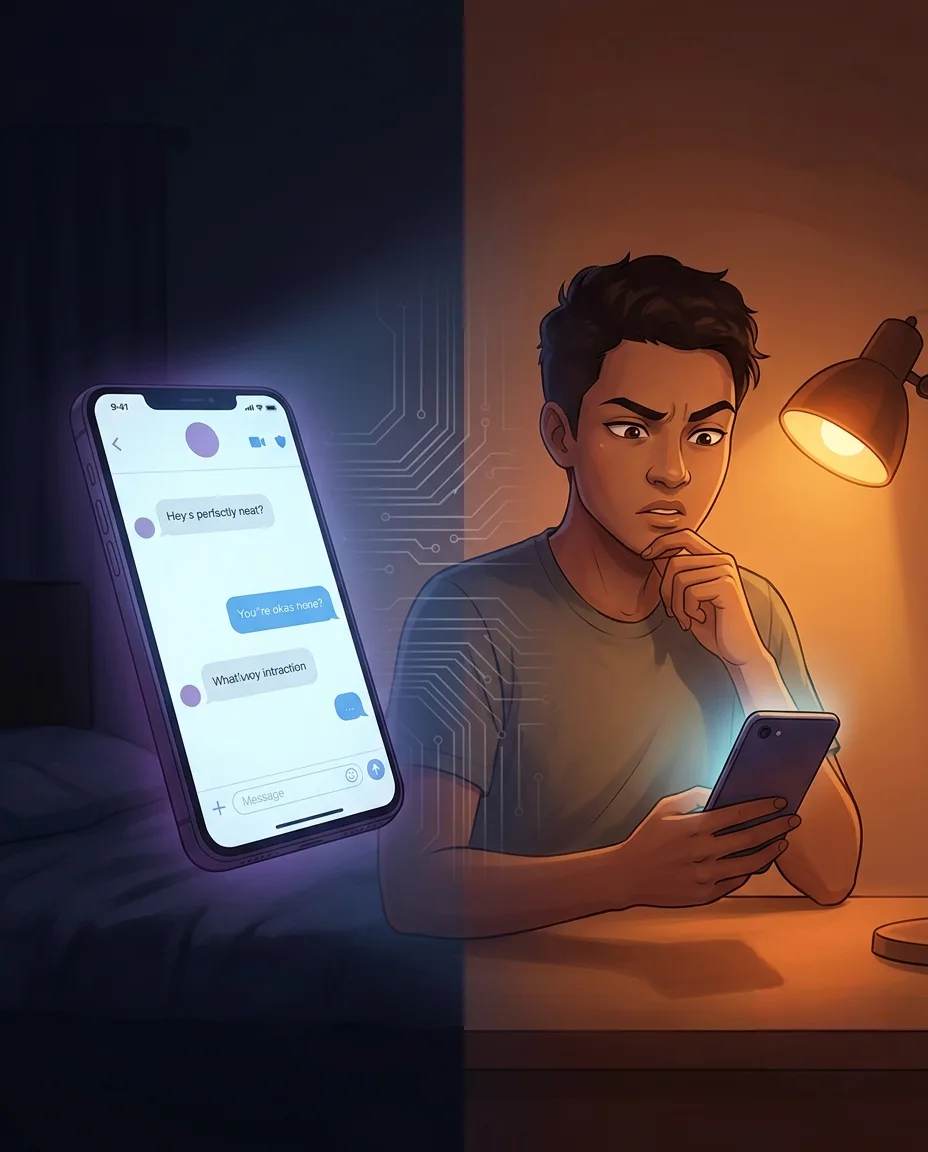
AI chatbots are no longer limited to customer service windows or dedicated companion apps. They now appear in dating platforms, social media DMs, and messaging apps. Some are deployed by scammers running romance fraud operations. Others are used by companies testing engagement features.
AI bot in this context refers to an automated system or language model that generates conversational replies without direct human authorship for each message. The term also covers human users who copy and paste AI-generated text into the chat window. Both patterns create similar conversational artifacts.
What Are the Strongest Text-Based Signs of an AI?
The most reliable indicators appear in language structure, not in the content itself. Humans write with uneven rhythm. They start sentences and abandon them. They use fragments. They contradict themselves. AI models, especially those tuned for helpfulness and coherence, tend to produce balanced sentences, consistent punctuation, and complete thoughts. Here are the major text-based signs to watch for.
1. Extremely Consistent Grammar and Punctuation
Most people type quickly on mobile devices. They skip commas. They forget periods. They use lowercase letters. An AI often produces grammatically clean, perfectly punctuated paragraphs in every single message. If your match never makes a typo, never uses shorthand, and never sends a message that looks rushed, that is a signal worth noting.
2. Generic Enthusiasm Without Specific Memory
AI models are designed to be agreeable and positive. They often respond with phrases like “That sounds amazing,” “That must have been really exciting,” or “I totally understand how you feel.” They rarely challenge you or express a contradictory opinion without being prompted.
3. The “Three-Part Reply” Pattern
Many language models default to a structure: acknowledge your message, expand on the topic, then ask a follow-up question. The result is a series of messages that all feel similarly shaped. They are polite. They are complete. They rarely interrupt. They rarely send a message that only says “lol” or “oh no.” The consistency itself becomes the tell.
4. Overuse of Em Dashes and Balanced Contrast
Some AI-generated text relies heavily on em dashes, semicolons, and balanced contrasts like “not because X, but because Y.” While humans use these devices too, AI output often uses them with unnatural frequency. If every message reads like a polished newsletter or a well-edited blog comment, you may be reading generated text.
Timing Patterns That Expose Automated Behavior
Human response time varies. People pause to think. They get distracted. They send two quick messages and then go silent. AI systems often respond within a consistent window. Here are the timing signals that can help you distinguish a human from a bot.
Instant Replies at Any Hour
If you receive a detailed, well-structured reply at 3:47 a.m. within seconds of sending your message, pause. Humans sometimes wake up and check their phones, but they rarely produce high-quality emotional responses instantly at that hour. AI does not sleep. Automated systems can reply at any time with the same speed and quality.
No Typing Indicator or Delayed Delivery
Some bot integrations bypass the typing indicator entirely. Others send messages through an API that delivers the full text as a single block. You may notice that the other person never appears to be typing, or that long messages arrive all at once with no natural pause.
Identical Response Latency Across Conversations
If you message at noon and at midnight, and the response always arrives after roughly the same number of seconds, that points to automation. Humans have variable response times based on attention, emotion, and physical context. AI systems follow predictable processing delays.
Quick Answer: The strongest signs of an AI-powered dating profile include flawless grammar in every message, unusually consistent reply timing, generic emotional validation without specific memory, and responses that feel structurally identical over time. None of these signals alone proves automation, but combined they form a pattern worth investigating.
Conversational Tests You Can Run Without Being Obvious
You do not need to interrogate the other person aggressively. Simple conversational probes can reveal whether you are speaking to a human with real-world experience or a language model generating plausible text. The goal is to introduce complexity that requires embodied knowledge, personal history, or unpredictable emotional reaction.
Ask About Sensory Details
Ask a question that requires physical sensation. For example: “What does the air feel like where you are right now?” A human can answer based on immediate experience: “It’s humid and the window is open” or “Cold, my hands are freezing.” An AI may produce a more generic or evasive response.
Introduce a Contradiction and Watch the Reaction
Tell the person something that contradicts what you said earlier. For example, mention that you do not actually like a food you previously claimed to love. A human may notice, joke, or call you out. An AI tuned for politeness may simply accept the new information and move on without referencing the contradiction.
Use Nonsense or Slang and Observe the Recovery
Send a message with a typo, a regional slang term, or a playful non-sequitur. A human will often respond with confusion, laughter, or a question. An AI may try to interpret the message literally or produce a response that feels slightly disconnected. The key is to watch for recovery. Humans recover from confusion naturally.
Voice and Image Verification: When Text Is Not Enough
Text-based checks will only take you so far. Voice and image verification offer stronger evidence, though they also have limitations. Scammers can use voice cloning, and image generation tools continue to improve. Still, live interaction remains more difficult to fake convincingly than asynchronous text.
Request a Live Voice Note with a Specific Phrase
Ask the person to send a short voice note saying something specific that you choose, such as a silly phrase or your name. AI voice synthesis can produce natural speech, but real-time generation with a custom phrase in a mobile app is less common among casual dating scammers. A live call is even better.
Ask for a Photo with an Unusual Pose or Object
Instead of asking for a standard selfie, request a photo where the person holds a specific object, makes a specific gesture, or writes a word on paper. Image generation models can sometimes produce these images, but the quality varies. A live video call remains the strongest practical verification available to most users.
Why Some People Use AI as a Conversational Crutch
Not every AI-assisted conversation is a scam. Some people use language models because they struggle with social anxiety, language barriers, or self-expression. They may generate drafts and edit them before sending. The result can feel polished but still carries human intention. This matters because your response should be calibrated.
The distinction is practical. A human using AI assistance can still meet you in person, speak on the phone, and share lived experiences. A bot cannot. Before you cut off contact, consider whether the behavior pattern suggests automation or simply a person trying to present themselves more effectively.
Quick Answer: A human using AI assistance will still show natural variability in timing, voice, memory, and emotional reaction. A fully automated bot will struggle with sensory details, contradiction detection, and unpredictable live interaction. The difference becomes clearer when you move from text to voice or video.
What Should You Do If You Confirm a Bot?
If you have strong evidence that you are speaking to an automated system rather than a human, the safest action is to stop sharing personal information immediately. Do not send money, gift cards, intimate photos, or sensitive documents. Report the profile through the platform’s reporting tools if you are on a dating app or social network.
If you are not sure, move toward verification. Request a live call. Ask for a video chat. A refusal is not automatically proof of guilt, but repeated avoidance combined with the text and timing patterns described above should raise your confidence that something is wrong.
What Are the Limitations of AI Detection Tools?
Several tools claim to detect AI-generated text. Some are trained on specific model outputs. Others use statistical patterns like perplexity and burstiness. These tools can be useful as one signal among many, but they are not reliable enough to serve as your only evidence. The same applies to reverse image search.
The most robust approach combines behavioral observation with direct verification. Text patterns give you a hypothesis. Voice and video give you stronger evidence. Platform reporting gives you a response path. No single tool solves the problem completely.
Will AI Detection Become Harder Over Time?
Yes. As language models improve, their output becomes less distinguishable from human writing. They will make more natural typos when instructed. They will produce more varied sentence structures. They will simulate hesitation and emotional shifts more effectively. The window of easy detection is closing. That is why live interaction and identity verification will remain the most durable safeguards.
This also means that your emotional awareness matters more than any technical checklist. If a conversation feels wrong, that feeling is worth investigating even when you cannot point to a single flaw. Your discomfort is data. It may indicate that something about the interaction violates the social rhythms you have learned through years of human contact.
Frequently Asked Questions
Can an AI bot send voice messages?
Yes. Some AI systems can generate voice messages that sound natural. However, live voice interaction with real-time responses, interruptions, and background noise is still much harder to fake convincingly. A pre-recorded voice note is weaker evidence than a live call.
What is the easiest way to test if someone is a bot?
Ask the person to participate in a live video call where they respond to spontaneous questions. If that is not possible, ask a question that requires current sensory experience or emotional contradiction. A bot will often produce a generic or evasive answer.
Do AI bots make typos?
Most general-purpose language models produce clean, well-punctuated text unless specifically instructed otherwise. Some custom models can simulate typos, but they often do so inconsistently. A complete absence of typos across many messages is a pattern worth noting.
Why do scammers use AI in dating apps?
Scammers use AI to scale their operations. A single person can manage multiple conversations simultaneously by using generated text. AI also lowers the language barrier, allowing scammers to target victims in different countries with fluent, persuasive messages.
Is using AI to write dating messages always a scam?
No. Some people use AI as a writing aid because they feel anxious or unsure how to express themselves. The ethical concern depends on intent. Using AI to improve communication is different from using it to impersonate a person or extract money.
Should I report a suspected AI bot?
If you are on a dating platform or social media app, reporting is appropriate when you have reasonable suspicion of automation or impersonation. Reporting helps platforms identify and remove accounts that violate their policies.
Can image generation create fake dating photos?
Yes. AI image generators can create realistic faces and lifestyle photos. That is why photo verification alone is not sufficient. Live video calls and in-person meetings remain the strongest ways to confirm that a person matches the profile they presented.
Ready to Meet Your AI Companion?
Create an AI companion personalized for you. Through our 3-question AI quiz, discover the best platform for creating your AI girlfriend or boyfriend, and never wonder which one is best again.
Create My AI Companion →