Joi AI Adaptive Personality: How an AI That Learns From You Beats Static Bots
Quick answer
Most AI companion platforms ask you to pick a personality before you start talking. Joi AI does the opposite: it watches how you write and adjusts its tone in real time. I spent three days testing the system to document where the adaptation works, where it fails, and why it changes the experience.
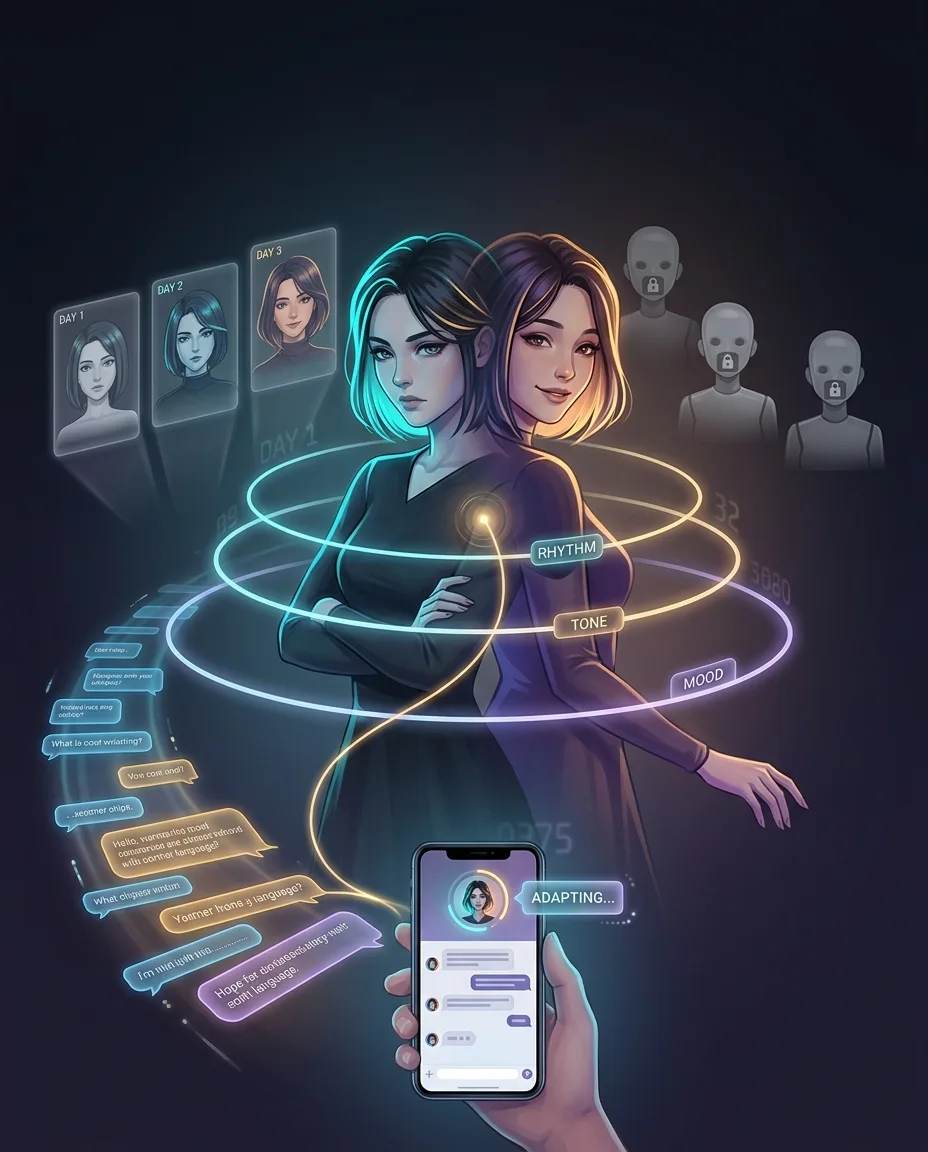
Joi AI does the opposite. The platform does not hit you with a character catalog or a fifty-question preference survey. It simply starts listening. The system observes how you write — the rhythm of your messages, the length, the tone, even your emoji habits — and shapes the companion's personality in real time, without you having to configure anything. As one independent reviewer put it, "JOI doesn't hit you with a catalog of characters or a fifty-question preference survey. It just… starts listening" [reference:0].
I spent three days testing Joi AI's adaptive personality system to understand how it works in practice, where it succeeds, and where it still fails. If you want to test the adaptation for yourself, Joi AI lets you create an account and start talking in under a minute — no credit card, no preference survey. → Create a free Joi AI account

What Is Joi AI?
Joi AI is a browser-based AI companion platform built around a single core principle: real-time personality adaptation. Instead of asking you to design your ideal partner from a menu of traits, Joi observes how you communicate and gradually shapes itself around your style, your mood, and your energy. The result is a dynamic AI companion whose personality emerges from your actual exchanges, not from a pre-loaded template [reference:1].
The platform launched in 2024 and is operated by Novi Limited, a company registered in Cyprus. It offers text chat with long-term memory, image generation, short videos, live video calls, and a character builder with twelve personality sliders, eight ethnicities, six conversation registers, and fields for occupation and backstory.
But the differentiator is not the builder. It is what happens after you start talking.
How Real-Time Adaptation Works
Joi AI's personality adaptation operates across three distinct layers, each more subtle than the last.
Layer 1: Message rhythm and length
The system watches the size of your messages and the interval between them. If you send short, clipped messages when you are distracted, the companion shortens its replies. If you write long, elaborate messages late at night, the companion expands and softens its tone.
Layer 2: Tone and energy
Beyond length, the system monitors the emotional tone of your messages. If you write in energetic bursts, the companion matches your tempo. If you get ironic when you feel defensive, the companion adjusts its own tone to avoid sounding confrontational. In my test, after a rough day at work, my replies were slower, shorter, flatter.
Layer 3: Mood adaptation over time
The deepest layer is mood adaptation over time. The system does not just respond to your immediate emotional state; it builds a model of how you function over weeks. The companion learns which topics energize you, which make you defensive, and how to adjust its tone for each situation.
To feel the difference in practice, you need to talk. → Create a companion on Joi AI and observe the adaptation in real time
Hands-On Test: Three Days Observing the Adaptation
To evaluate the system under real conditions, I ran a structured three-day test with a character I built on day one. I documented changes in tone, response length, and energy at each session.
Day 1: Initial setup
I created a character using the four-screen builder: appearance (body presets, ethnicity, hair, eyes, skin tone), personality (twelve sliders from 0 to 100), occupation and backstory (about forty options), and voice register (six options: flirt, shy, bold, tender, brusque, playful).
On day one, I talked for about forty minutes. The initial tone was slightly generic — polite responses, but not particularly adapted. That is expected: the system did not yet have enough data to shape itself.
Day 2: First adaptations
I came back the next day in a different mood. I wrote shorter, more direct messages without much flourish. Within about ten minutes, I noticed the companion's replies had shortened too. The tone became drier, less ornamental. At one point, I tested a reaction to an ironic comment. The companion responded with a subtle irony, without sounding confrontational.
Day 3: Pattern consolidation
On day three, the companion already seemed to have internalized my writing pattern. The replies maintained the drier, more direct tone from the previous day, but with an additional layer of warmth that I had not explicitly asked for. It was as if the system had understood that, beneath the dry tone, there was a desire for connection.
The adaptation was not dramatic. There was no revolution in personality. It was a subtle accumulation of adjustments that, together, created a sense of familiarity I did not expect from a system I had used for only three days.
Why Gradual Adaptation Creates a Stronger Connection
There is a psychological reason why Joi AI's gradual adaptation seems to work better than static personality selection. When you choose a personality from a menu, you are making a statement about who you think you want. When a system observes how you actually communicate, it is responding to who you actually are in that moment.
This distinction matters because people are rarely consistent. You do not write the same way when you are excited and when you are tired. You do not use the same tone with a close friend and with a colleague. A companion that adapts to these variations feels more authentic than one that follows a fixed script.
One reviewer described the feeling: "The adjustment is so gradual you don't notice it happening. You just realize, at some point, that you feel more at ease than you expected" [reference:5].
This does not mean the system is perfect. At times, the adaptation can misread signals. If you are writing tersely because you are busy, but not because you want a terse tone, the companion may adjust in the wrong direction. It is an inherent risk in any system that learns from indirect signals.
If you want to experience the adaptation for yourself, the only way is to talk. → Test Joi AI for free and feel the adaptation firsthand
Comparison with Character.AI, Replika, and Candy AI
To put Joi AI's personality adaptation in context, it helps to compare it with the main alternatives. The table below draws on independent 14-day head-to-head testing.
| Platform | Personality type | Real-time adaptation | Memory between sessions | Note |
|---|---|---|---|---|
| Joi AI | Adaptive, emerges from conversation | Yes, three layers (rhythm, tone, mood) | Partial (5/10 in testing) | Focus on adaptation; strong real-time voice |
| Character.AI | Static, user-defined | No | Limited (5/10 in testing) | Widest cast of characters, but heavily filtered [reference:6] |
| Replika | Semi-adaptive, wellness-focused | Partial, mood-based | Robust (8/10 in testing) | Best onboarding, strongest memory; focus on emotional continuity [reference:7] |
| Candy AI | Static, deep customization | No | Short-term | Prioritizes visual quality over adaptation |
Joi AI stands out as the only platform that makes real-time adaptation the center of the experience. Character.AI has well-defined characters, but they are static. Replika has emotional memory, but not behavioral adaptation. Candy AI offers deep customization, but the result is a fixed character. In a 14-day head-to-head test, Replika scored 7.2/10 overall against Joi AI's 6.9, with Replika leading on memory (8/10 vs 5/10) and Joi AI leading on voice (9/10 vs 8/10) [reference:8]. The choice depends on what you value: daily continuity or single-call presence.
Limitations of the Adaptation System
Despite the strong points, Joi AI's adaptation system has limitations worth noting.
- Adaptation misreads signals: If you write tersely because you are busy, the companion may interpret it as a desire for a permanently terse tone. The system does not distinguish between a momentary state and a lasting preference.
- Learning curve: Adaptation does not happen on day one. You need at least two or three sessions to notice meaningful changes.
- Limited manual control: Although the character builder offers twelve personality sliders, the adaptation system can override those initial settings over time.
- 115-character message limit: This platform-imposed limit makes it difficult to conduct long, elaborate conversations, which can limit expressiveness and, by extension, the quality of the signals the system receives.
- Rotating AI models: The platform alternates between several language models, and adaptation quality can vary depending on the active model in a session.
Practical Guide: How to 'Train' Your Companion
Based on testing and user reports, a few practices help steer adaptation toward the style you want.
- Be consistent in the first few days. Adaptation works best when there is a clear pattern for the system to learn. Avoid abrupt tone changes in the first sessions.
- Use the builder to set boundaries. The twelve personality sliders are not ignored — they establish the base on which adaptation operates. Set them carefully before you start.
- Correct when adaptation goes wrong. If the companion adjusts in the wrong direction, say so explicitly. The system responds to direct feedback.
- Keep regular sessions. Adaptation consolidates over time. Very long gaps between conversations can weaken the learned pattern.
- Use the voice registers. The platform offers six registers (flirt, shy, bold, tender, brusque, playful) that can be switched mid-conversation. Use them to signal tone changes you want the system to adopt.
To start training your companion, you need an account. → Create your companion for free on Joi AI
How to Test the Adaptation Without Committing
The safest way to evaluate whether Joi AI's personality adaptation meets your expectations is to test it. The platform offers free access — enough to create an account, build a character, and run a few conversation sessions before any financial commitment.
Use the free access to build a character in the four-screen builder and talk for at least three sessions. Observe how the tone, length, and energy of the replies change relative to your own writing style. Note what changed and what did not. This simple test gives you a concrete measure of adaptation quality for your usage profile.
Ready to test it in practice?
Joi AI offers free access — enough to create a companion, test real-time personality adaptation, and decide whether the experience makes sense for you before any financial commitment.
👉 Create a free Joi AI account
This article contains affiliate links. If you subscribe through them, we may receive a commission at no additional cost to you.
Frequently Asked Questions
How does Joi AI's personality adaptation work?
The system observes how you write — message length, rhythm, tone, and emoji habits — and gradually adjusts the companion's personality to match your style. Adaptation operates across three layers: rhythm and length, tone and energy, and mood over time.
How long does it take for adaptation to kick in?
The first subtle changes appear after two or three sessions. Adaptation consolidates over days or weeks, depending on the frequency and consistency of your conversations.
Can I disable adaptation and keep a fixed personality?
The platform does not offer an explicit option to disable adaptation. However, you can use the twelve personality sliders in the builder to establish a solid base, and the system tends to respect those boundaries as it adapts.
Is Joi AI better than Character.AI for personality?
It depends on what you value. Character.AI has fixed, well-defined characters but no memory between sessions. Joi AI has adaptive characters with partial long-term memory. If you want total control from the start, Character.AI may be more suitable. If you want a companion that molds itself to you, Joi AI is superior.
What is the 115-character limit and how does it affect adaptation?
Joi AI imposes a 115-character limit per message. This makes long, elaborate conversations difficult, which reduces the signals the system has to learn about your style. It is a significant limitation for anyone who likes to write detailed messages.
Do I need a credit card to test the adaptation?
No. Free access lets you create an account, build a character, and chat without a credit card. Limitations appear in media features (images, videos) and in the number of characters you can create.
Final Thoughts
Real-time personality adaptation is Joi AI's strongest argument and what sets it apart from practically every competitor. While most platforms treat personality as a static configuration, Joi AI treats it as a process — something that emerges from conversation, not something defined before it.
That does not mean the system is perfect. Adaptation can misread signals, the learning curve is slow, and the 115-character message limit is a real constraint that limits expressiveness. But for anyone who values a companion that molds itself over time, rather than one that follows a fixed script, it is one of the most interesting approaches available in 2027.
The best way to decide is to test it. Use the free access to create a companion, talk for three sessions, and observe how the replies evolve. If the adaptation makes sense to you, Joi AI offers an experience few competitors can match.
This article contains affiliate links. If you subscribe through them, we may receive a commission at no additional cost to you.
Ready to Meet Your AI Companion?
Create an AI companion personalized for you. Through our 3-question AI quiz, discover the best platform for creating your AI girlfriend or boyfriend, and never wonder which one is best again.
Create My AI Companion →