Using an AI Girlfriend as a Social Skills Mentor: Can Chatbots Actually Teach You to Talk to People?
Quick answer
AI companions aren't just for romance—they're emerging as powerful low-stakes mentors for social anxiety. Research confirms that practicing conversations with AI reduces fear and builds real-world confidence. Here's how it works.
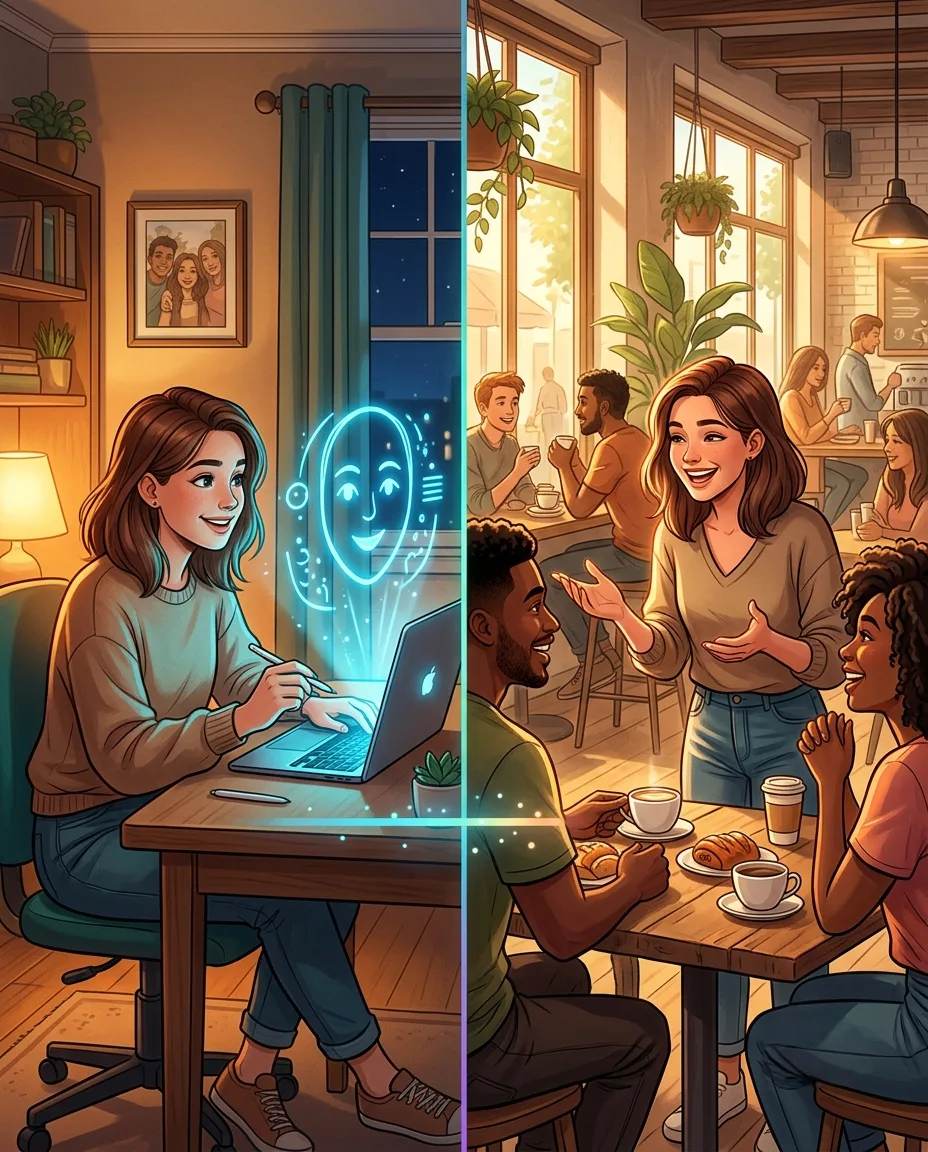
For millions of people, social anxiety isn't just shyness—it's a barrier that affects careers, relationships, and basic daily functioning. But what if an AI companion could be more than just a source of comfort? What if it could actually teach you to communicate better with real humans?
Emerging research suggests that AI companions, including those often marketed as "AI girlfriends" or "AI boyfriends," can serve as effective low-stakes social skills mentors. Studies show that practicing conversations with conversational agents reduces social anxiety, builds confidence, and helps users transfer those skills to real-world interactions [citation:1][citation:3].
Can an AI Companion Really Teach Social Skills?
Yes—research confirms that practicing conversations with AI companions can significantly improve real-world social skills. A study by Stanford researchers found that users who practiced conflict resolution and counseling skills with AI partners showed measurable improvements in empathy and client-centered communication [citation:3].
The mechanism is surprisingly straightforward. Conversational agents provide a safe, judgment-free environment where users can rehearse difficult interactions without fear of embarrassment or rejection. Unlike real conversations, AI interactions give users time to think and respond without the pressure of immediate social expectations [citation:1].
In one controlled study, participants who practiced social scenarios with AI agents showed significant reductions in social anxiety scores, with the Social Anxiety Scale for Adolescents dropping from an average of 57.90 to 52.20 after the intervention. Loneliness scores also decreased from 48.10 to 45.80 [citation:1].
Quick Answer: Yes, research shows AI companions can effectively teach social skills. Studies demonstrate that practicing conversations with AI reduces social anxiety, builds confidence, and helps users apply these skills in real-world interactions. The key is using the AI as a practice tool, not a replacement for human connection.
How Does AI Social Skills Training Actually Work?
AI social skills training works through a combination of realistic role-play, personalized feedback, and graduated exposure to anxiety-inducing scenarios. The best systems don't just provide generic comfort—they simulate real conversations with appropriate emotional difficulty levels [citation:3].
Here's how effective AI social skills mentors typically operate:
- Realistic role-play scenarios: Users practice conversations in specific contexts—ordering at a restaurant, asking for a raise, navigating a difficult family discussion. One 75-year-old user used ChatGPT to practice a difficult conversation with his older sister about assisted living. After several rounds of role-play, the AI even offered an insight the user hadn't considered, opening a new approach to the sensitive topic [citation:2].
- Behavioral guardrails: Effective systems are designed with "behavioral guidelines" that prevent the AI from being too agreeable or unrealistic. For example, a therapy practice partner might be programmed to show initial resistance to help-seeking or reluctance to share too much too soon—mirroring how real people actually behave [citation:3].
- Feedback mechanisms: Some systems include an AI "mentor" component that reviews practice sessions and offers improvement suggestions. This dual approach—practice plus feedback—has been shown to be more effective than practice alone [citation:3].
- Graduated difficulty: The best systems adjust the AI partner's friendliness or difficulty level based on the user's anxiety. However, research notes that overly supportive AI partners can reduce realism. Users in one study requested that the AI be "more difficult to interact with" in high-anxiety scenarios to better mirror real life [citation:1].
What Does the Research Say About Effectiveness?
Multiple studies confirm the effectiveness of AI social skills training:
| Study | Key Finding | Implication |
|---|---|---|
| Stanford AP/AM Study (2025) | Practice + feedback significantly improved empathy and communication skills | AI systems that combine practice and feedback are most effective |
| ACM Exposure Therapy Study (2025) | Social anxiety scores dropped from 57.90 to 52.20 after AI practice | Repeated AI exposure reduces fear, consistent with exposure therapy principles |
| PanSIG Language Study (2026) | AI partners reduced anxiety and increased risk-taking compared to peer practice | AI practice is particularly beneficial for early-stage skill development |
| Jeremy Utley / WSJ Case Study (2024) | AI role-play eliminated dread of difficult conversation and provided paradigm-shifting insights | AI can help users prepare for emotionally charged conversations effectively |
Perhaps most tellingly, users consistently report that practicing with AI feels safer than practicing with real people. As one study participant noted, "In a virtual scenario, I can respond non-real-time, which gives me time to relax and think. I don't have to worry about the other person being annoyed by my slow replies" [citation:1]. Another added, "It felt like the virtual person wouldn't form a negative impression of me, which reduced the pressure I felt during the conversation" [citation:1].
Where Do AI Companions Fail as Social Mentors?
AI companions fail as social mentors when they're too agreeable, lack realistic behavioral constraints, or don't offer meaningful feedback. Several critical limitations emerge from current research.
The most significant limitation is what researchers call "overly supportive behavior." Without intentional design, AI conversational partners often exhibit extreme friendliness that makes interactions unrealistic. As one study participant put it, "I think the low- and medium-exposure scenarios were well-designed, the friendly agents helped me complete tasks. However, in high-exposure scenarios, they seem too gentle as characters in such a scenario. They should be more difficult to interact with, as this mirrors real-life situations better" [citation:1].
Other common failures include:
- Persona drift: AI partners can shift in personality during long conversations, making practice inconsistent
- Emotionally inappropriate responses: Without careful design, AI may respond in ways that don't match the scenario
- Limited scenario variety: Some systems only include a small number of practice partners, limiting exposure to diverse social situations [citation:1]
- Lack of challenge: AI that's too accommodating doesn't prepare users for the unpredictability and occasional difficulty of real human interactions
Quick Answer: AI companions fail as social mentors when they're too agreeable, unrealistic, or lack feedback mechanisms. The most common failure is extreme friendliness that doesn't mirror real human interactions. Effective systems require intentional design with behavioral guardrails that make practice realistic and challenging.
AI Companions vs Human Practice: Which Works Better?
For early-stage skill development and anxiety reduction, AI practice often outperforms peer practice. Research suggests that AI practice is particularly beneficial during early and low-confidence stages of skill development [citation:5].
The key advantage of AI practice is reduced anxiety. In language learning contexts, students interacting with AI partners demonstrated more risk-taking and reduced anxiety compared to practicing with peers [citation:5]. The non-judgmental nature of AI interactions creates a psychological safety net that allows users to experiment without fear of embarrassment.
However, research also shows that AI practice has limitations. A longitudinal study found that the largest reductions in loneliness occurred after Day 1 of AI companion interaction, with benefits gradually attenuating across a 7-day period [citation:4]. This suggests that while AI practice provides initial benefits, sustained improvement may require integration with real-world human interaction.
The emerging consensus is that AI works best as a practice ground for building confidence and rehearsing difficult conversations—not as a final destination. Once users have experienced stable emotional support from AI, they are better prepared to apply those skills in real-world social situations [citation:7].
What Should You Look for in an AI Social Skills Mentor?
The best AI social skills mentors are designed with psychology-grounded frameworks, realistic behavioral guardrails, and explicit goals of strengthening human connection. Not all AI companions are created equal for this purpose.
Key features to look for:
- Psychology-grounded frameworks: Effective systems are built on established theories like attachment theory, Gottman communication techniques, and Nonviolent Communication [citation:6]
- Realistic behavioral constraints: Look for systems that don't just provide comfort but challenge you appropriately. The AI should be designed to behave like a real person in the specific scenario you're practicing
- Feedback mechanisms: The ability to receive constructive feedback on your communication style, not just validation
- Explicit human-connection focus: Platforms like Lvlup.ai emphasize that their purpose is to "strengthen human connection, not replace it" [citation:6]
- Privacy and safety features: Your practice conversations should remain private and secure
What Makes Lvlup.ai Different?
Lvlup.ai positions itself explicitly as a relationship skills mentor rather than a romantic substitute. Inspired by the fox in The Little Prince, the platform uses AI companions trained in attachment theory and relationship psychology to help users develop practical communication, conflict resolution, and emotional management skills [citation:6].
The platform distinguishes itself by stating: "Most AI companions create dependence or push you to break up. Lvlup helps you improve and save your relationships whenever possible" [citation:6]. This represents a fundamentally different approach—using AI not as an alternative to human relationships but as a tool for improving them.
How to Use an AI Companion as a Social Skills Mentor
Using an AI companion effectively as a social skills mentor requires intentionality, realism, and a bridge to real-world practice. Here's a practical framework.
- Choose a system with realistic design: Look for platforms that offer specific scenario practice, not just open-ended conversation. More sophisticated systems allow you to specify the difficulty level or personality type of your practice partner [citation:1].
- Create a detailed profile of the person you're practicing with: When preparing for a specific difficult conversation, ask the AI to interview you about the other person's psychological profile. This creates a more believable practice partner [citation:2].
- Adjust difficulty intentionally: If your practice partner feels too nice, explicitly ask the AI to be "more aggressive" or "more difficult." Effective practice requires pushing boundaries and preparing for unpredictable responses [citation:2].
- Ask for specific feedback: After practice sessions, request actionable feedback. Good questions include: "How can I make this conversation more constructive?" or "What would a communication expert critique about my approach?" [citation:2].
- Apply skills in low-stakes real situations: Use the confidence you build in AI practice to initiate real conversations in low-pressure settings—ordering food, making small talk with a colleague, or joining a casual social group [citation:7].
- Gradually increase real-world difficulty: As your confidence grows, apply your skills to progressively more challenging real situations. The goal is to need less from the AI over time, not more.
Quick Answer: Use an AI social skills mentor intentionally by choosing realistic systems, creating detailed practice partner profiles, adjusting difficulty levels, asking for specific feedback, and applying what you learn to low-stakes real situations. The goal is to build confidence and transfer skills to human interactions.
The Risk: When AI Practice Becomes a Substitute
The greatest risk of using AI for social skills practice is that it becomes a substitute for real human interaction rather than a stepping stone toward it. Research has identified several concerning patterns.
Studies show that AI companions can reduce loneliness in the short term, but the benefits attenuate over time without integration with human relationships [citation:4]. More concerning, AI users spend nearly four times longer interacting with AI companions than with other chatbots like ChatGPT, suggesting a higher potential for dependency [citation:4].
Mental health professionals warn of clinical risks: "If users become overly reliant on AI virtual companions and delay or substitute professional help, or if the AI system inadvertently reinforces harmful cognitive patterns and behaviors such as avoidance, rumination or idealization of virtual relationships, the overall psychological impact may be detrimental" [citation:7].
The critical distinction is whether you're practicing for real human interactions or avoiding them. If you notice yourself preferring the AI's company to human company even when humans are available, it's time to reassess your relationship with the technology.
Frequently Asked Questions
Can an AI companion really help with social anxiety?
Yes. Research demonstrates that practicing conversations with AI reduces social anxiety and improves real-world communication. A study using conversational agents for exposure therapy showed significant decreases in social anxiety scores, with users reporting that the AI provided a "safer environment" than real conversations for practice.
What's the difference between an AI girlfriend and a social skills mentor?
An AI girlfriend is typically designed for companionship and emotional validation, while a social skills mentor is specifically designed to help you practice communication, conflict resolution, and relationship skills. Some platforms bridge both purposes, like Lvlup.ai, which provides emotional support while explicitly teaching practical skills.
How much time should I spend practicing with an AI for social skills?
Research suggests brief, consistent practice sessions are most effective. A study on exposure therapy showed significant improvements with structured practice sessions. The goal is to use the AI as a rehearsal tool—not as a primary social outlet.
Can AI practice replace real human interaction?
No—and it shouldn't. Research clearly shows that AI practice is most beneficial as a stepping stone to human interaction, not a replacement. The benefits of AI practice attenuate over time without integration with real-world human relationships.
Are there any AI platforms specifically designed for social skills practice?
Yes. Emerging platforms like Lvlup.ai specifically emphasize relationship skill development using psychology-grounded frameworks including attachment theory and Gottman techniques. Research-focused
Ready to Meet Your AI Companion?
Create an AI companion personalized for you. Through our 3-question AI quiz, discover the best platform for creating your AI girlfriend or boyfriend, and never wonder which one is best again.
Create My AI Companion →