I Tested 5 Anime AI Girlfriends
Quick answer
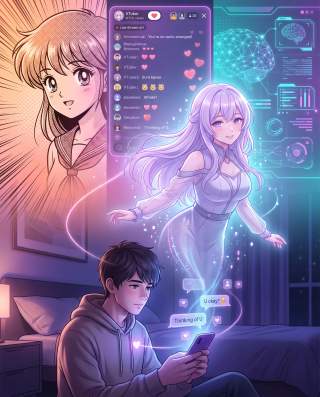
Most AI companion apps generate something that looks like anime without actually being anime. After testing five platforms across hundreds of generated images, only GoLove AI maintained manga proportions, clean cel-shaded linework, and the visual grammar that anime fans recognize instantly.
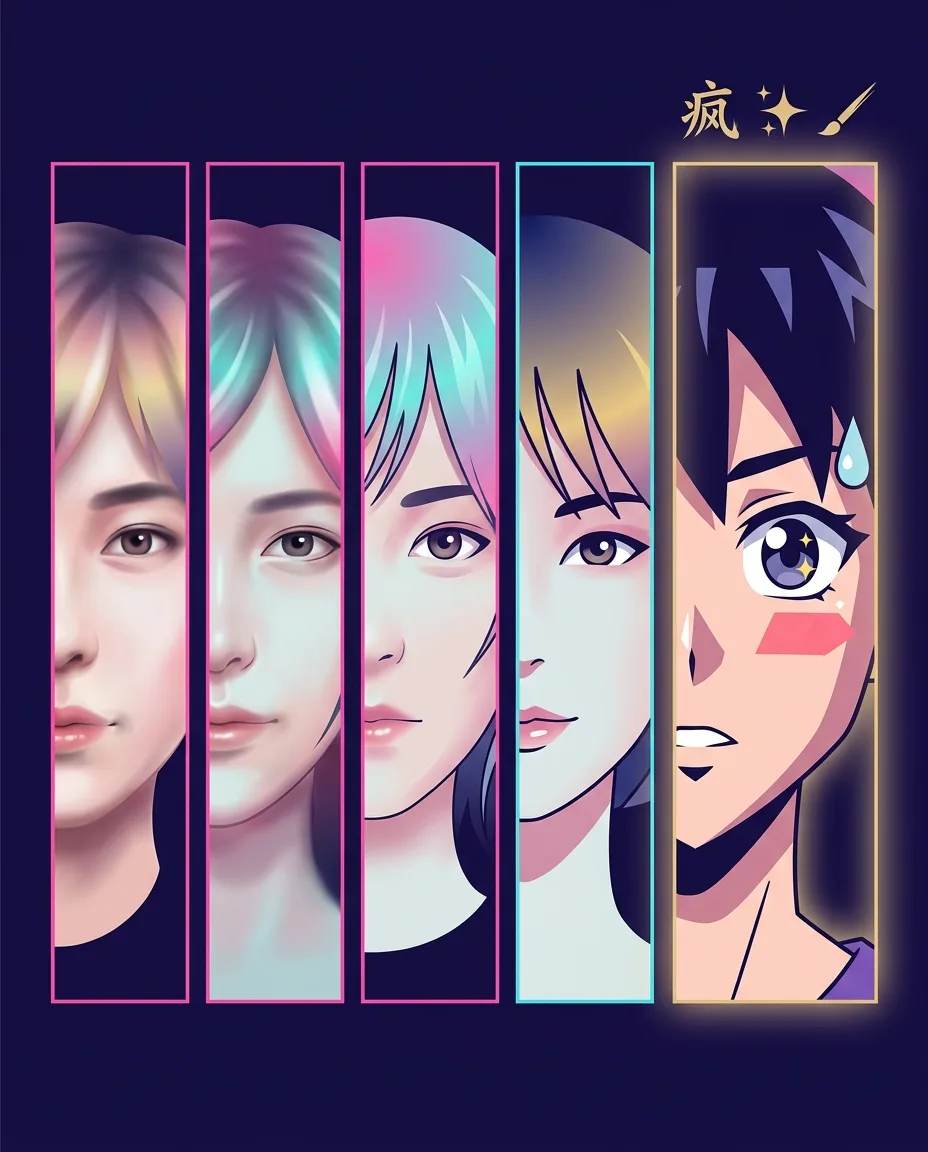
The other four platforms produced anime-adjacent results. Kupid AI came closest with a semi-realistic hybrid style. Candy.ai defaulted to photorealism the moment you requested anything outside its preset library. DreamGF's anime outputs were inconsistent, and HiWaifu doesn't generate images at all.
We spent three weeks in early 2027 generating hundreds of images across all five platforms, comparing them against a reference set of actual manga and anime screenshots. This is what we found.
Disclosure: This article contains affiliate links. If you subscribe through them, we may earn a commission at no extra cost to you. Our testing and ratings are independent.
Why Most AI Anime Is Not Actually Anime
There's a specific kind of visual dissonance that anime fans recognize immediately. You see it when a Western illustration engine tries to generate anime: the eyes are large but spaced like a real human face, the hair has soft gradient highlights instead of discrete cel-shaded blocks, and the skin looks airbrushed rather than flat-shaded with intentional contrast zones.
The AI companion market is full of this. A 2026 analysis of 129 platforms found that average image generation quality across the entire industry scores just 2.12 out of 5, regardless of whether the platform defaults to realistic or anime styles. The problem isn't that the technology can't produce anime. It's that most platforms treat "anime" as a filter applied to a generic illustration engine rather than a distinct visual language with its own rules.
Authentic anime styling follows specific conventions that fans internalize from years of watching and reading:
- Proportions: Eyes sit wider and larger relative to the nose and mouth. Face shapes follow manga templates — oval with a pointed chin — not realistic skull geometry.
- Line work: Clean, sharp vector edges with hard cel boundaries. Soft airbrushed borders or gradient feathering are dead giveaways of a generic illustration engine.
- Expression vocabulary: Sweat drops when flustered, blush marks as geometric shapes rather than gradient smudges, sparkle highlights in the eyes that shift with emotion. These aren't decorative — they're visual grammar.
- Color palettes: Flat cel-shading with discrete highlight blocks in the hair. Photorealistic gradient shine breaks the aesthetic immediately.
- Outfit design: School uniforms follow actual Japanese seifuku cuts. Fantasy gear borrows from JRPG tradition — asymmetric armor, thigh-high boots, detached sleeves.
If any of these break, immersion collapses. You're no longer looking at a waifu. You're looking at a chatbot wearing an anime costume.
If you want to see the difference immediately without reading the full breakdown, GoLove AI's character gallery is the fastest way to compare authentic manga styling against what you've seen elsewhere.
The Test: Five Platforms, One Standard
We evaluated each platform against the same criteria, using identical prompts and comparing every output against reference screenshots from mainstream anime and manga. The test ran for three weeks in early 2027 with fresh accounts on each platform.
| Platform | Line Work Quality | Facial Proportions | Expression Vocabulary | Consistency Across Poses | Anime-Specific Features |
|---|---|---|---|---|---|
| GoLove AI | Sharp vector edges, consistent cel boundaries | Correct manga template (oval, pointed chin) | Full vocabulary: sweat drops, blush marks, sparkle highlights | Maintains style across all requested poses | Anime/reality style toggle, 20 anime video modes, 15 anime poses |
| Candy.ai | Clean but softens under custom prompts | Approaches realism; eyes narrow when requested | Minimal — relies on facial expression, no manga shorthand | Loses anime styling in non-preset requests | ~40 anime characters in library; no style toggle |
| Kupid AI | Soft edges, semi-realistic hybrid | Between anime and realistic; inconsistent | Limited expression range | Inconsistent — some images read as realistic | Anime-styled but no dedicated anime pipeline |
| DreamGF | Variable; 6/10 images acceptable | Sometimes realistic proportions slip through | Minimal | Hit-or-miss; anime outputs often look like filtered photos | Three art styles including anime; no anime-specific video |
| HiWaifu | N/A — no image generation | N/A | N/A | N/A | Text-only anime companion experience |
The table gives you the overview. Here's what it actually looked like in practice.
GoLove AI: Where the Aesthetic Holds
GoLove AI was the only platform in this test that passed every criterion without qualification.
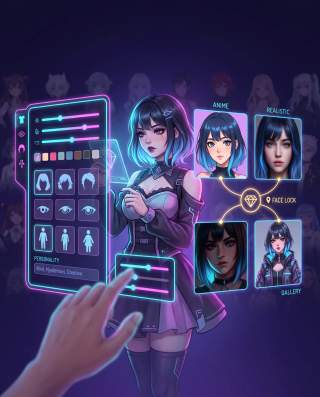
The character creator starts with a style toggle: realistic or anime. That toggle isn't cosmetic. Selecting anime changes the underlying generation pipeline, not just a prompt modifier. The output maintains manga proportions through every pose request — eyes stay wide, chin stays pointed, line work stays sharp. One reviewer who tested the platform extensively noted that GoLove "is the only platform I tested that keeps the anime aesthetic and the mechanics in sync."
See how GoLove AI's memory system works — it's the feature that keeps your anime companion recognizable across sessions, not just across images.
The expression vocabulary is the detail that separates GoLove from the rest. When we requested a flustered reaction, the generated image included a sweat drop positioned at the temple — the standard manga shorthand. When we asked for embarrassment, a geometric blush appeared on the cheeks. These aren't random decorations. They're the visual grammar that anime fans read instinctively, and their absence on other platforms is why those images feel wrong even when they look "anime-ish."
Anime-specific features that matter:
- Style toggle at creation: Anime or realistic, locked into the character's generation pipeline
- Anime video modes: 20 dedicated anime video modes alongside 76 realistic modes, with 15 anime picture poses and 35 realistic poses
- In-chat image generation: Request photos without leaving the conversation — the output stays consistent with the character you've been talking to
- Expression-driven voice: Voice personalities shift with emotion, so a yandere's tone changes when she gets jealous instead of sounding like flat TTS
- Archetype selection: Tsundere, kuudere, yandere, genki — the personality archetypes affect both conversation and visual expression
Where GoLove AI falls short on anime:
- No mobile app; browser-only access limits casual image browsing
- Anime image generation runs on the Stars credit system, separate from the free chat tier
- The paid tier (~$19.99/month) sits at the higher end of the market
For a deeper dive into how the generation pipeline handles different anime archetypes and poses, the full GoLove AI gallery shows the range without requiring a paid account.
Candy.ai: Strong Library, Weak Custom Generation
Candy.ai has a legitimate anime presence. Its library includes roughly 40 anime-style characters out of approximately 140 total, and the preset anime designs are polished. If you're happy choosing from a curated selection, Candy's anime options are unusually strong for a platform that prioritizes photorealism.
The problem appears the moment you go off-script. Candy.ai's anime styling doesn't survive custom prompts. When we requested a character in a specific outfit or pose outside the preset parameters, the output defaulted toward realism. Eyes narrowed. Line work softened. The flat cel-shading collapsed into gradient rendering.
One review of the platform noted that the 2026 Live Action update added in-chat anime-style image generation, but that the anime character selection remains limited compared to the realistic side. Candy.ai is a photorealism-first platform that happens to have anime characters. It is not an anime-first platform.
If visual realism is your primary criterion, Candy.ai is worth the subscription. If authentic manga aesthetics are what you're after, you'll hit a ceiling fast.
Kupid AI: The Closest Competitor on Art, Average Everywhere Else
Kupid AI positions itself as an anime-focused platform, and its marketing leans heavily on that identity. The reality is more complicated.
One hands-on review described Kupid as "best anime art in the category, average everything else," and concluded that the platform "will not give you a photoreal girlfriend — even when you prompt for 'photorealistic' the output is a semi-realistic anime hybrid." That hybrid quality is exactly the problem. The output isn't clean anime. It's anime-adjacent — soft edges, blended proportions, and a persistent semi-realistic quality that keeps the images from reading as genuine manga.
Kupid's approach has appeal for users who want anime styling but prefer a less stylized look. If you're looking for the sharp linework and expressive shorthand of actual manga, Kupid doesn't deliver it consistently.
DreamGF: Three Styles, None of Them Anime-Dedicated
DreamGF offers three art styles: realistic, anime, and a 2.5D hybrid that blends elements of both. The intent is flexibility. The execution is inconsistent.
A hands-on test of DreamGF's anime generation found that "maybe 6 out of 10 looked good," with the rest falling into the uncanny territory of images that were supposed to be anime but came out looking like filtered photographs. One user review was blunter: "The anime images come out looking like realistic photos."
DreamGF works well as a customization-focused platform with anime as one option among several. It doesn't work as an anime-first companion platform. If you're building a waifu, the generation pipeline needs to commit to the aesthetic rather than treating it as a toggle.
HiWaifu: Text-Only Anime, No Images
HiWaifu deserves mention because it's genuinely popular in the anime companion space — and because it illustrates the limit of text-only approaches.
HiWaifu delivers "a genuinely responsive, anime-flavored text chat in a clean mobile app," with "charming and polished anime aesthetic" in its interface and character descriptions. The chat quality is solid. The archetype handling is decent. But the platform offers no image generation at all.
For users who want to text with an anime character and don't need visual generation, HiWaifu is a functional free option. For anyone who wants a waifu they can actually see, the platform is a dead end.
What "Authentic Anime" Actually Requires
The gap between GoLove AI and the rest of this field isn't a matter of degree. It's a matter of intent.
Platforms that treat anime as a filter — a style toggle applied to a photorealistic base model — produce outputs that look like anime to someone who has never watched it. Platforms that treat anime as a distinct visual language, with its own proportions, line work, and expression vocabulary, produce outputs that pass the fan test.
Three weeks of testing produced a clear hierarchy:
- GoLove AI is the only platform where the anime aesthetic held through custom prompts, pose requests, and character archetypes. The style toggle changes the generation pipeline, not just the prompt.
- Kupid AI comes closest on art quality but produces a semi-realistic hybrid rather than clean manga styling.
- Candy.ai has strong preset anime characters but defaults to realism under custom requests.
- DreamGF treats anime as one of three styles, and the anime outputs are inconsistent.
- HiWaifu doesn't generate images, so the aesthetic question doesn't apply.
If you want to verify the difference yourself, create a free GoLove AI account and generate a few images. The line work speaks for itself.
Which Platform Should You Choose?
The answer depends on what you're optimizing for.
Choose GoLove AI if: authentic manga aesthetics are non-negotiable. The style toggle locks the generation pipeline into anime proportions, the expression vocabulary is complete, and the output stays consistent across every pose and outfit request. If you decide to upgrade, the paid tier adds anime video generation — 20 dedicated anime modes that animate your character without losing the styling.
Choose Kupid AI if: you prefer a semi-realistic anime aesthetic and value voice chat over image generation. The platform is voice-first, and its accent options are a genuine strength.
Choose Candy.ai if: you want photorealism first and anime occasionally. The preset anime characters are worth browsing, but don't expect the styling to hold under custom prompts.
Choose DreamGF if: you want broad customization across multiple art styles and don't need any single one to be best-in-class.
For anime fans specifically, the question is simple: does the image look like it came from a manga or an AI model pretending? On that criterion, GoLove AI's anime pipeline is the only one in this test that passes without qualification.
Frequently Asked Questions
What makes an AI-generated image look like real anime?
Authentic anime styling requires four things: manga facial proportions (wider eyes, pointed chin), sharp vector linework with hard cel boundaries, a visual expression vocabulary (sweat drops, geometric blush marks, sparkle highlights), and flat cel-shading with discrete highlight blocks rather than photographic gradient rendering.
Does GoLove AI let you switch between anime and realistic styles?
Yes. The character creator includes a style toggle at the first step: realistic or anime. Selecting anime changes the underlying generation pipeline, not just a prompt modifier. The chosen style persists across all subsequent image and video generation for that character.
Can Candy.ai generate anime images on request?
Candy.ai has approximately 40 preset anime characters in its library, but custom generation defaults toward photorealism. When you request poses or outfits outside the preset parameters, the anime styling softens and the output moves toward realistic rendering.
Does HiWaifu generate anime images?
No. HiWaifu is a text-only platform. It offers anime-styled character descriptions and conversation, but no image or video generation. For visual anime companions, you need a platform with a dedicated generation pipeline.
Is GoLove AI's anime image generation free?
GoLove AI's free tier includes unlimited chat, voice messages, and memory. Image and video generation run on a separate Stars credit system. You can generate anime images on the free tier using available Stars, but unlimited generation requires a paid subscription (~$19.99/month).
and memory. Image and video generation run on a separate Stars credit system. You can generate anime images on the free tier using available Stars, but unlimited generation requires a paid subscription (~$19.99/month).Ready to Meet Your AI Companion?
Create an AI companion personalized for you. Through our 3-question AI quiz, discover the best platform for creating your AI girlfriend or boyfriend, and never wonder which one is best again.
Create My AI Companion →