Prompt Engineering the Perfect Persona: Custom AI Character Generation Anime Style
Quick answer
From 2.5D models to 16-bit pixel art, the intersection of LLMs and image generation creates a fully immersive storytelling ecosystem.
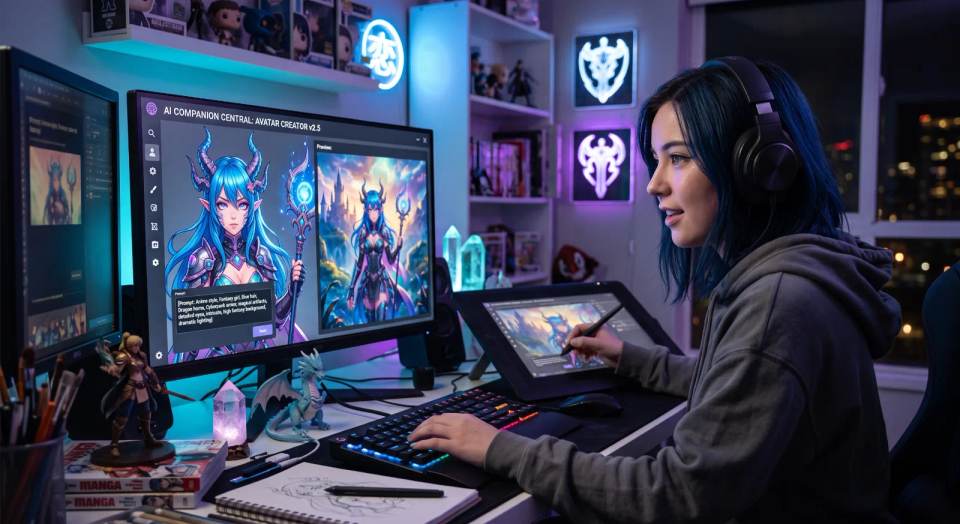
Mastering custom AI character generation anime aesthetics requires more than basic prompts; it demands a deep understanding of generation parameters and visual tokenization. Modern platforms allow unprecedented control over your digital companion's appearance.
This guide is for creators, storytellers, and enthusiasts who want to move beyond random generation and start crafting characters with intention. We'll explore the technical parameters that define visual consistency, the art of aligning personality with aesthetics, and the future of multimodal roleplay where your avatar reacts in real-time.
Optimizing Visual Parameters for Consistent Character Generation
Consistency is the holy grail of AI character generation. Anyone can generate a single beautiful image. The real skill lies in creating a character that looks like the same person across dozens of different poses, expressions, and environments.
Direct Answer: To achieve consistency in your AI companion's visual identity, precision in your prompt engineering is critical. Specific keywords targeting lighting, studio styles, and subgenres yield the best rendering results.
Technical Controls for Visual Consistency
- CFG Scale & Seed Locking: The CFG (Classifier-Free Guidance) scale controls how closely the image follows your prompt. Higher values (12-15) yield more literal interpretations, while lower values (5-7) allow for more creative freedom. Locking a seed ensures that the same random noise pattern is used, providing a stable foundation for consistent faces across generations.
- Subculture Modifiers: Inject specific subcultural tags to define your character's universe. Terms like "cyberpunk," "steampunk," "mecha," "moé," or "dark fantasy" don't just change the costume—they inform the entire visual language of the character, from lighting to architectural surroundings.
- Dimensional Styling: Don't limit yourself to one style. Experiment with transitions from highly rendered 2.5D anime to classic cel-shaded vectors, or even nostalgia-driven 16-bit RPG sprites. This variety can give your character distinct "modes" for different contexts.
- Negative Prompts: Equally important as what you include is what you exclude. Use negative prompts like "poorly drawn," "blurry," "deformed," or "extra limbs" to filter out common AI artifacts that break immersion.
- Style References: Advanced tools allow you to upload reference images to guide the AI toward a specific art style or even a particular artist's signature look. This is invaluable for achieving a unique, non-generic aesthetic.
Coupling these visual tags with behavioral system prompts ensures that the AI's personality aligns perfectly with its generated aesthetic. A cyberpunk character should speak with a different cadence and vocabulary than a fantasy mage, even if the underlying language model is the same.
Aligning Visual Identity with Conversational Persona
A character isn't just a picture—it's a personality that lives in the details of how it speaks, reacts, and evolves. The most powerful AI companions are those where the visual and textual identities are in perfect harmony.
Direct Answer: Coupling visual tags with behavioral system prompts ensures that the AI's personality aligns perfectly with its generated aesthetic, creating a unified and immersive character experience.
Creating a Cohesive Character Blueprint
- System Prompt Persona Definition: Write a detailed system prompt that defines the character's background, speech patterns, emotional range, and behavioral quirks. For example: "You are Kaito, a 23-year-old cyberpunk hacker with a dry sense of humor. You speak in short, clipped sentences and never use contractions. You are skeptical of authority but fiercely loyal to friends."
- Visual-Personality Pairing: Ensure that the visual design reinforces the personality. A playful, energetic character might have bright, saturated colors and expressive, exaggerated features. A brooding, mysterious character would have darker tones, sharper angles, and a more muted palette.
- Contextual Memory: Use the AI's context window to maintain a persistent memory of past interactions. This allows the character to reference previous conversations, creating the illusion of a continuous relationship.
- Emotional Expression Mapping: Some advanced systems allow you to map specific emotional states (happy, sad, angry, surprised) to different visual outputs, so your avatar's expression changes in real-time based on the conversation.
The Future of Multimodal Roleplay and Immersive Interactions
The industry benchmark is shifting rapidly towards multimodal experiences where your generated avatar reacts visually in real-time alongside text streams. This isn't just about static images anymore—it's about dynamic, responsive digital entities.
Direct Answer: The industry benchmark is rapidly shifting towards seamless integration, where your generated avatar reacts visually in real-time alongside text streams, enhancing user retention and establishing a new frontier for personalized digital entertainment.
Emerging Trends in AI Character Interaction
- Real-Time Expression Generation: AI models are now capable of generating subtle facial expressions in response to text input. A character might smile slightly when you tell a joke, or furrow their brow when you share a concern.
- Dynamic Pose and Action Triggers: Beyond static expressions, some platforms allow you to trigger specific poses or actions with keywords. Saying "wave" might generate an image of your character waving, while "think" could produce a pensive pose.
- Environmental Context Generation: The background can change to reflect the conversation's mood. A serious discussion might shift to a somber, dimly lit room, while a lighthearted chat could move to a sunny park or a cozy café.
- Voice Synthesis Integration: With the addition of advanced TTS (text-to-speech), your character can now speak with a voice that matches its visual personality, adding another layer of immersion.
- Cross-Platform Persistence: The same character identity—visual, voice, and personality—can follow you across different platforms, from web apps to VR environments, creating a truly persistent digital companion.
Technical Benchmarks and Platform Comparison
Not all AI character generation platforms are created equal. Here's a technical comparison of the leading options based on key performance metrics.
| Platform | Control Level | Style Variety | Real-Time Gen | Personality Sync |
|---|---|---|---|---|
| Stable Diffusion (Open) | Very High | Extensive | Limited | Manual |
| Midjourney | Moderate | High | Limited | Manual |
| Character.AI (Custom Avatars) | Moderate | Moderate | Yes (Basic) | Integrated |
| NovelAI | Very High | Anime-Focused | Limited | Manual |
Frequently Asked Questions (FAQ)
What is the best tool for custom AI character generation anime style?
It depends on your needs. For maximum control, Stable Diffusion with custom LoRAs is unmatched. For the highest-quality out-of-the-box results with less technical effort, Midjourney is excellent. NovelAI is specifically optimized for anime-style generation.
How do I keep my character looking consistent across different images?
Use a fixed seed, maintain consistent negative prompts, and reference the same character description in every prompt. For advanced consistency, consider training a custom LoRA (Low-Rank Adaptation) model on a set of reference images.
Can I use AI-generated anime characters for commercial projects?
Check the terms of service for each platform. Stable Diffusion's open-source model allows commercial use. Midjourney's terms require a paid subscription for commercial rights. Always verify licensing before using generated art in commercial contexts.
How do I make my character's personality match its visual design?
Write a detailed system prompt that defines the character's backstory, speech patterns, and behavioral quirks. Then, ensure the visual design (colors, posture, clothing style) reinforces these personality traits.
What are the minimum hardware requirements for running AI character generation locally?
For Stable Diffusion, you'll need a GPU with at least 8GB of VRAM (NVIDIA RTX 3060 or higher) and 16GB of system RAM. For cloud-based solutions like Midjourney, no local hardware is required.
Mastering custom AI character generation anime style is a journey that combines technical precision with artistic intuition. Whether you're creating a companion for personal entertainment, a character for a story, or an avatar for a game, the principles remain the same: consistency, alignment between visual and personality, and attention to the technical parameters that turn a random generation into a living character. Experiment, iterate, and don't be afraid to push the boundaries of what's possible—the only limit is your imagination.
Ready to Meet Your AI Companion?
Create an AI companion personalized for you. Through our 3-question AI quiz, discover the best platform for creating your AI girlfriend or boyfriend, and never wonder which one is best again.
Create My AI Companion →