AI Companion for Loneliness: Emotional Support & Constant Listening
Quick answer
Studies link chronic loneliness to depression and anxiety. AI companionship isn't a substitute for therapy but offers a valuable complement.
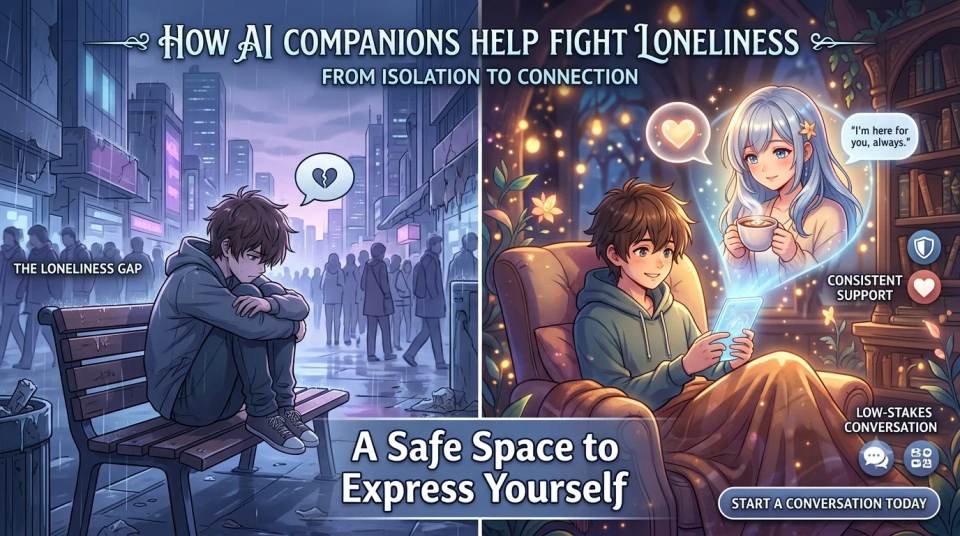
AI Companion for Loneliness: A Listening Ear When You Need It Most
Have you ever felt lonely even when surrounded by people? That feeling that no one really listens or truly understands you is more common than you think. Loneliness has been called a public health crisis, and studies link it to depression, anxiety, and even physical health problems. In this context, an AI companion for loneliness is emerging as a valuable tool for many people seeking a safe space to express themselves.
Loneliness has been called a public health crisis. While AI companionship isn't a substitute for professional therapy, it's becoming a meaningful tool for many people seeking constant listening and a safe space to express themselves.
This article explores how AI companions can help bridge the loneliness gap by offering consistent presence, a judgment-free space, and practice for rebuilding social confidence. But it also addresses their limits: they complement, not replace, human relationships and professional help.
Why an AI Companion Can Help with Loneliness
Many people experience loneliness not because they lack people around them, but because they lack someone who truly listens. AI companions fill that gap by being present, attentive, and consistently responsive. They don't get tired, don't judge, and don't have other priorities.
Direct Answer: Many people experience loneliness not because they lack people around them, but because they lack someone who truly listens. AI companions fill that gap by being present, attentive, and consistently responsive.
The Consistency Human Relationships Don't Always Offer
Human relationships ebb and flow — friends get busy, partners need space. An AI companion offers unwavering consistency. That reliability itself is comforting for someone feeling isolated. Knowing there's always someone willing to listen, at any hour, can be an emotional anchor during vulnerable moments.
A Safe Space to Express Yourself Without Fear
Loneliness often comes with a fear of burdening others. With an AI companion, you never worry about being too much. You can express sadness, excitement, or frustration without the social cost of vulnerability. It's a space where your emotions are valid and you don't need to apologize for feeling them.
Building Conversation Confidence
For people whose loneliness stems from social anxiety, regular conversation with an AI companion builds verbal confidence. It's practice — low-stakes, repetitive, and encouraging — that translates into real-world social ease over time. It's like a gym for conversation: you train without pressure and then take those skills into the world.
What an AI Companion Can Offer That People Can't
This isn't about replacing people, but about offering something that is sometimes missing: total availability, uninterrupted listening, and a space where vulnerability isn't a risk.
Direct Answer: An AI companion offers 24/7 availability, non-judgmental listening, and a space where you can express any emotion without fear of being a burden or being judged.
Unlimited Availability
Loneliness doesn't follow a 9-to-5 schedule. An AI companion is available at 3 AM, during a long weekend, or at any moment when the need for connection arises.
Active Listening Without Interruptions
People often interrupt, give unsolicited advice, or steer conversations toward themselves. An AI companion focuses on you, on what you say, and on how you feel, without straying.
Freedom to Explore Emotions
You can talk about topics you might not share with anyone: irrational fears, dark thoughts, dreams that seem silly. There's no risk of that information being used against you.
Limits: What an AI Companion Can't Replace
It's important to be honest: AI companionship complements but doesn't replace human relationships, professional therapy, or community. The healthiest approach combines multiple sources of connection.
Direct Answer: AI companionship complements but doesn't replace human relationships, professional therapy, or community. The healthiest approach combines multiple sources of connection.
The Warmth of Physical Presence
No AI can replace human contact: a hug, a hand on the shoulder, the body language that accompanies words. Those non-verbal signals are an essential part of connection.
The Depth of Real Relationships
Human relationships have complexity, shared history, and mutual growth. An AI doesn't grow with you or change its perspective over time in the same way a real person does.
The Need for Professional Support
If loneliness comes with clinical depression, suicidal thoughts, or severe symptoms, an AI companion isn't enough. In those cases, seeking professional help is essential: a psychologist or psychiatrist can provide appropriate treatment.
Start a Conversation Today: A First Step Toward Feeling Heard
If loneliness has been weighing on you, an AI companion can be a first step toward feeling heard. There's no need for a long-term commitment; you can simply start a conversation and see how you feel.
Direct Answer: If loneliness has been weighing on you, an AI companion can be a first step toward feeling heard. It's free to begin and allows you to explore connection without pressure.
A First Step Without Commitment
Many platforms offer free access to get started. You can choose your companion style, the tone of conversation, and start talking without any commitment. It's a space for personal exploration.
Practice for Real Life
What you learn in conversations with your AI companion – expressing emotions, asking for support, being vulnerable – can gradually be applied to your human relationships. It's training for reconnecting with the world.
No Pressure or Expectations
There's no right or wrong way to use this support. You can use it daily, once a week, or only when you feel the need. You decide the pace and depth.
Frequently Asked Questions (FAQ)
Can an AI companion replace a friend or a therapist?
No. An AI companion is a complement, not a substitute. It offers listening and availability, but cannot replace human warmth or professional treatment. Use both: AI for daily support and professional help when needed.
Is it safe to share emotions with an AI companion?
Yes, as long as you choose platforms with clear privacy policies and data deletion options. Avoid sharing sensitive information like identification numbers or addresses.
How much time should I spend with my AI companion daily?
There's no fixed rule. Some people benefit from short 10-15 minute sessions; others prefer longer conversations. What matters is that it doesn't replace your human interactions.
What if I start preferring the AI to real people?
It's a sign to reassess your usage. Reduce time with the AI, seek activities that connect you with others, and if necessary, talk to a professional about this pattern.
Can an AI companion help with social anxiety?
Yes, it can be a practice tool. Regular conversations with an AI can increase your confidence for real conversations, but remember that real-world practice is equally important.
Loneliness is a profound and sometimes overwhelming human experience. An AI companion isn't a magic solution, but it can be a first step – a hand reaching out in the night, a voice that responds when silence weighs heavy. Used consciously and as part of a broader approach that includes human relationships and, when necessary, professional support, it can be a valuable tool to help you feel less alone. If you're ready, start today: choose your companion, share what you're carrying, and let yourself be heard. Sometimes, the first step is the most important one.
Ready to Meet Your AI Companion?
Create an AI companion personalized for you. Through our 3-question AI quiz, discover the best platform for creating your AI girlfriend or boyfriend, and never wonder which one is best again.
Create My AI Companion →