CES 2026 Holographic AI Companions: Privacy Nightmare or Next-Gen Tech?
Quick answer
CES 2026 introduced holographic AI companions that feel "in the room," but they also bring privacy risks with their always-on cameras and constant data collection. Here's what you need to know.
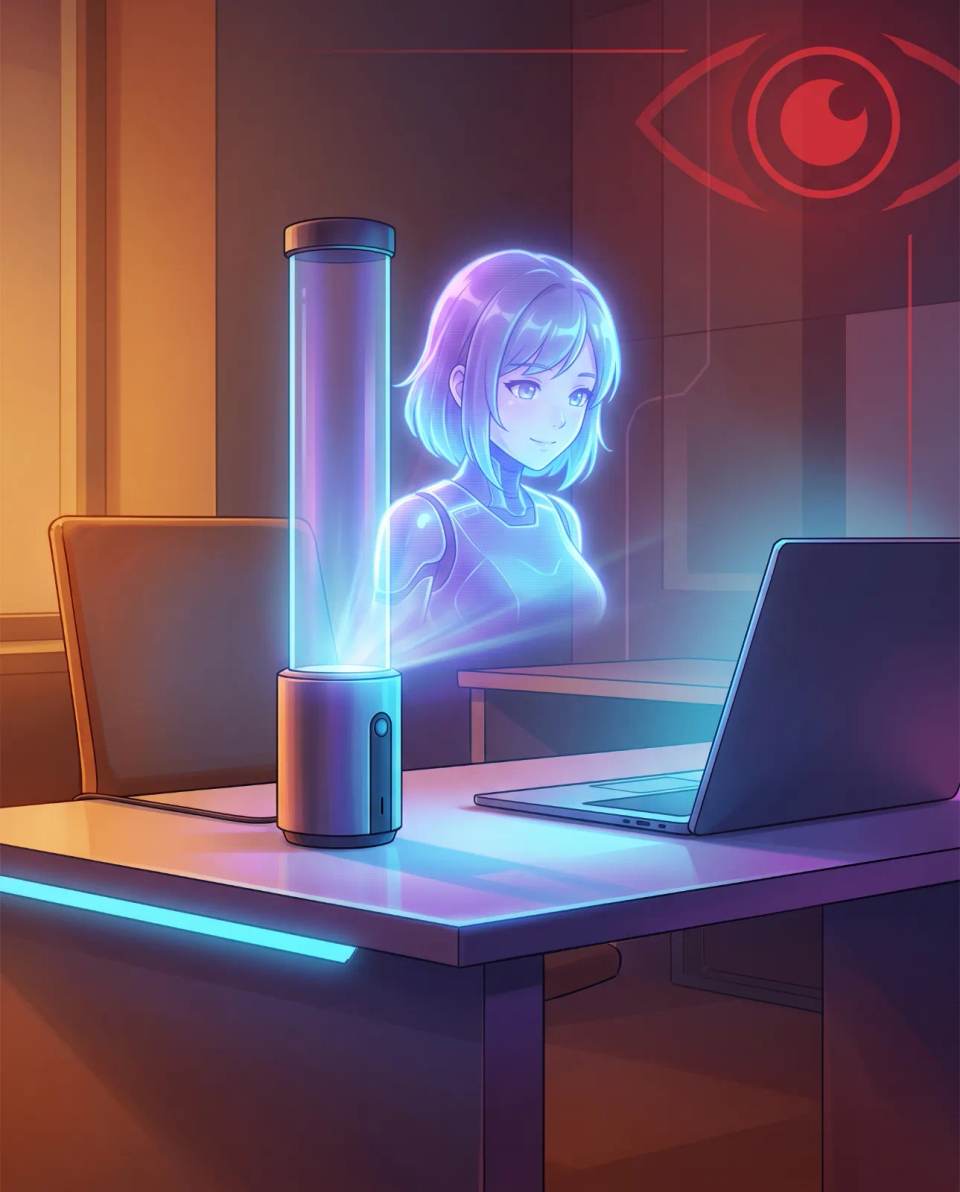
This article breaks down the technology behind these holographic companions, the privacy risks they introduce, and what you need to consider before inviting one into your personal space.
What Are Holographic AI Companions at CES 2026?
Holographic AI companions are physical desktop devices that project a 3D or 2D animated avatar, designed to function as an always-on assistant, emotional support, or gaming partner. They combine conversational AI with a persistent visual presence.
Unlike traditional smart speakers that respond only when called, these devices sit on your desk, ready to interact at any moment. Razer's Project Ava and Lepro's Ami are the two standout examples from CES 2026, each offering distinct approaches to the concept.
Razer's Project Ava: The Gaming Hologram
Razer's Project Ava evolved from a gaming assistant into a 5.5-inch holographic companion that lives in a small tube-like device on your desk [citation:1]. It features:
- Five character personalities: Including the original "calm and reliable" Ava, TikTok-style Kira, the edgy Zane, Japanese office worker Sao, and a Faker avatar modeled after the legendary League of Legends player [citation:1].
- Hardware sensors: Dual far-field microphones, a downward-firing speaker, and an HD camera with ambient light sensor [citation:1].
- AI engine: Currently powered by Grok from X AI, but designed to support other models like Gemini and ChatGPT [citation:1].
- Price and availability: Approximately $200, with pre-orders open and shipping set for late 2026 [citation:1].
Quick Answer: Razer's Project Ava is a holographic gaming companion with multiple character personalities and an always-on camera, priced at around $200.
Lepro Ami: The Emotional Presence
Lepro Ami differentiates itself with a focus on emotional intelligence and "presence." It features an 8.01-inch curved OLED display with a 3D visual system that tracks your eye movement to maintain depth perception [citation:3].
- Emotional awareness: Can interpret facial expressions, gestures, voice tone, and even detect heart rate through a built-in touch sensor [citation:3].
- Environmental integration: A rear camera enables AR overlay, anchoring the character in your physical space [citation:3].
- Privacy features: Includes physical camera and microphone shutters, biometric security, and on-device encrypted processing [citation:3].
- Target audience: Remote workers, tech-forward households, and wellness-focused users [citation:3].
Quick Answer: Lepro Ami is an emotionally intelligent AI companion with an 8.01-inch curved display, designed to feel "in the room" with features like heart-rate detection and physical privacy shutters.
Why Privacy Concerns Are the Elephant in the Room
For all their promise, holographic AI companions introduce unprecedented privacy risks. The core issue is their "always-on" nature combined with visual and auditory sensors.
Constant Surveillance: The Real Cost
At CES 2026, the focus was on functionality and emotional connection. But less discussed were the data implications of devices that constantly see and hear you. Razer's Project Ava, for example, uses its camera to monitor the user's screen and provide contextual gaming advice, but this also means it tracks your desktop activity at all times [citation:1][citation:7]. Technology experts have labeled this concept a "privacy nightmare" and compared it to an "anime desk stalker" that never blinks [citation:11].
Forbes Japan's CES coverage highlighted a broader concern: privacy remains an afterthought in the AI industry [citation:5]. According to their analysis, while AI-powered assistants and wearables that track emotional states took center stage, there was little discussion about the risks of constant data collection. The data gathered—voice, location, biometrics, behavior—often lacks transparency, with companies rarely clarifying what is stored and how it is handled [citation:5].
Data Collection and AI Hallucinations
Beyond the always-on camera, there are questions about data flow and accuracy. Razer's Project Ava currently uses Grok for its responses, but the platform is designed to support multiple models [citation:1]. This introduces data governance questions: which model is processing your data, where does that data go, and how long is it retained? [citation:9]
There's also the risk of AI hallucinations. Early demos of Project Ava providing real-time tactical advice in games showed that accuracy could be a problem [citation:9]. For a device positioned as a performance enhancer, delivering incorrect information undermines its value.
Quick Answer: The main privacy risk with holographic AI companions is that they use always-on cameras to watch your screen and environment, creating constant surveillance that raises serious questions about data storage and consent.
Regulatory and Ethical Red Flags
The European Union's AI Act of 2025 already requires explicit consent for such monitoring features. Regulatory compliance will be a major hurdle for these devices in markets like Germany and France [citation:7]. As one analysis noted, "privacy and security are still treated as 'add-ons,' and as technology becomes more immersive and deeply embedded in organizations, the risks are likely to increase" [citation:5].
How to Evaluate an AI Companion's Privacy Impact
Before purchasing a holographic AI companion, consider these critical questions.
- Where does the processing happen? Is data processed locally on the device, or is it sent to the cloud? Local processing is generally safer. Lepro Ami claims to use on-device encrypted processing [citation:3].
- Are there physical privacy shutters? Can you physically block the camera and microphone when you don't want to be watched? Lepro Ami includes this feature; Razer has stated plans to implement a physical camera shutter [citation:1][citation:3].
- What data is collected and stored? Is the device constantly recording or only processing in the moment? How long is data retained? [citation:9]
- What are the terms of service? Does the manufacturer have the right to use your data for training or other purposes? These are often hidden in lengthy legal documents.
- Is the AI reliable? If the device is generating suggestions or providing emotional support, is there a risk of it giving harmful advice due to hallucination? [citation:9]
Cultural Reception and Regional Differences
The appeal and acceptance of holographic AI companions are likely to vary greatly across regions [citation:5].
Japan: Anime and Moé Culture
In Japan, where the anime aesthetic and the concept of "2.5D" characters already have a strong cultural foothold, these companions could be marketed as extensions of existing otaku interests, similar to existing "AI Dream Cores" and otome gadgets. The visual and personality-driven approach of characters like Kira and Sao directly taps into the "waifu" culture.
Germany and Europe: Privacy-First Market
German and broader European markets are likely to be the most skeptical. Given the EU's stringent data protection regulations and a cultural emphasis on privacy, the success of these devices will hinge on transparency and compliance. Details about local vs. cloud processing and retention policies will be scrutinized [citation:5].
United States: Early Adopter Enthusiasm
In the U.S., early adopters and tech enthusiasts are the primary target. The gaming angle of Project Ava is likely to be a major selling point. However, even in this market, privacy concerns could dampen mass adoption, especially if high-profile data breaches occur.
Beyond the Hype: What Makes a Good Holographic AI Companion?
Looking past the novelty, the success of these devices depends on how well they deliver genuine value and trust.
Comparison: Razer Project Ava vs. Lepro Ami
| Feature | Razer Project Ava | Lepro Ami |
|---|---|---|
| Display | 5.5-inch holographic animation | 8.01-inch curved OLED (3D effect) |
| Primary Use | Gaming & productivity | Emotional support & presence |
| AI Engine | Powered by Grok, supports multiple | Empathetic multi-modal AI |
| Privacy Features | Planned physical camera shutter | Physical camera & mic shutters, biometric security |
| Price | ~$200 | TBD (available July 2026) |
What to Look for in a Secure Option
For privacy-conscious users, the key is to look for devices that are transparent about data handling and offer hardware-level controls [citation:5]. Prioritize platforms that process data locally, provide clear terms of service, and include visible privacy features like physical shutters. Currently, Lepro Ami seems to lead in this area, but Razer has indicated it will follow suit [citation:1][citation:3].
Frequently Asked Questions
What is a holographic AI companion?
A holographic AI companion is a desktop device that projects a visual avatar designed to interact with you as an assistant, gaming partner, or emotional support, combining artificial intelligence with a physical screen or holographic projection.
Are holographic AI companions safe?
Their safety depends on the manufacturer's privacy protections and the device's usage context. Models with physical camera shutters, on-device processing, and clear data policies are safer than those that rely entirely on cloud processing with no visible consent mechanisms.
How do I protect my privacy with a holographic AI companion?
Look for devices with physical camera and microphone shutters. Always read the terms of service regarding data storage and retention. Prefer devices that process data locally rather than sending everything to the cloud.
Is it worth buying a holographic AI companion?
It depends on your needs. For gamers or people seeking a visible, emotionally aware assistant, they offer unique value. However, the technology is still early, and privacy trade-offs should be carefully weighed.
Can a holographic AI companion replace a therapist or friend?
No. While they can offer emotional support and companionship, they are not a substitute for professional mental health care or genuine human connection. They are best viewed as a supplement to, not a replacement for, human relationships.
Ready to Meet Your AI Companion?
Create an AI companion personalized for you. Through our 3-question AI quiz, discover the best platform for creating your AI girlfriend or boyfriend, and never wonder which one is best again.
Create My AI Companion →