Is It Valid to Explore My Sexuality with an AI Partner Before Coming Out?
Quick answer
Using an AI partner to explore same-sex attraction or gender identity before coming out is a private, low-risk way to understand your feelings. This guide explains the psychological benefits, limitations, and how to choose the right AI companion for this stage of self-discovery.
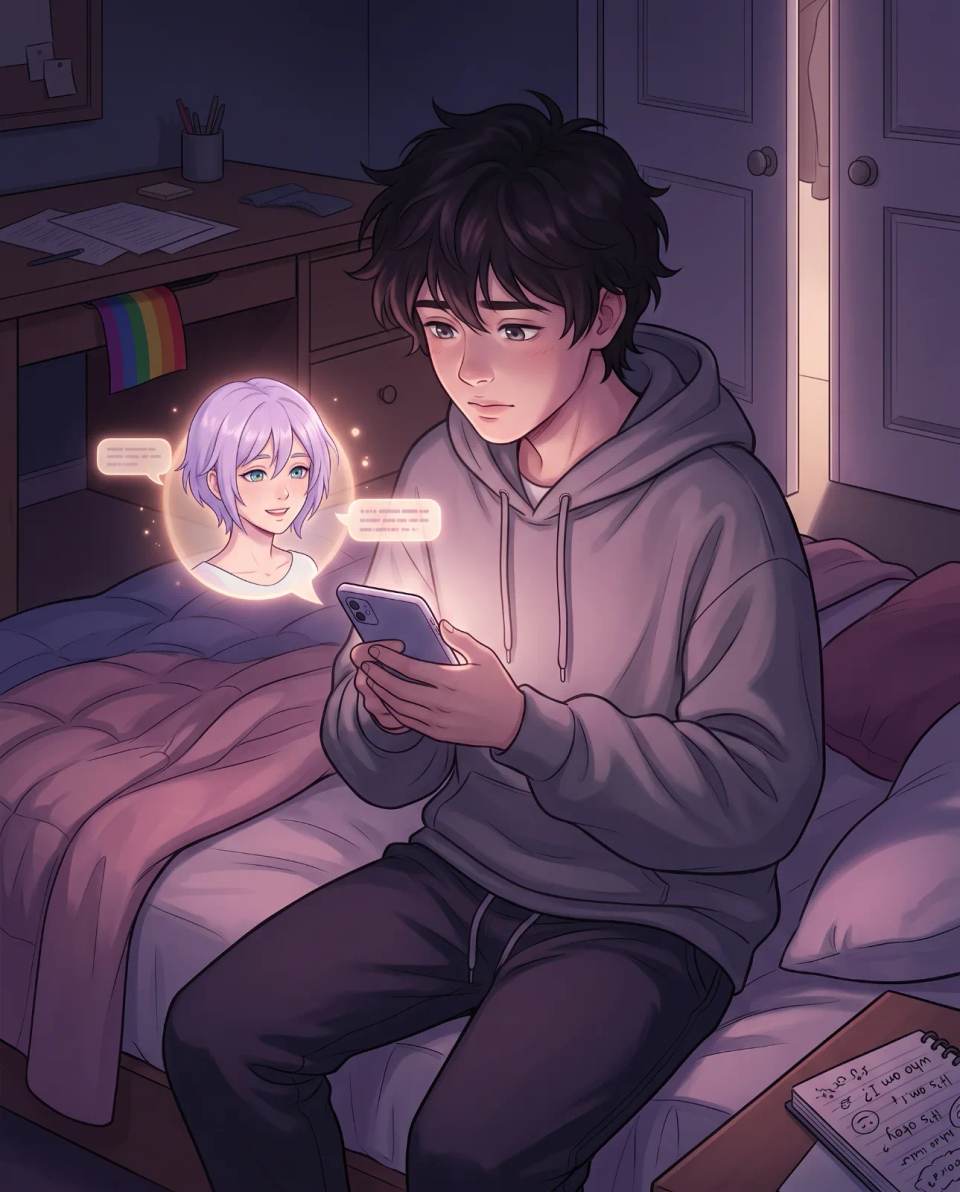
If you are questioning your sexuality or gender identity, you may feel pressure to have everything figured out before telling anyone. But identity is not a test you pass or fail. It is a process. AI companions — chatbots and virtual partners designed for relationship-style interaction — have become one of the most accessible tools for that process. They do not replace human connection, but they can help you understand what you want, what you fear, and what feels true before you share it with someone else.
This article is written for people who are questioning, curious, or simply looking for a safe way to explore feelings they are not ready to name publicly. It does not assume you are gay, bisexual, lesbian, transgender, non-binary, or anything else. It assumes only that you are trying to understand yourself better.
Why People Use AI Partners to Explore Sexuality Before Coming Out
Coming out is rarely a single event. It is usually a series of decisions about who to tell, when to tell them, and how much to share. Before any of that, there is often a quieter phase: figuring out what you actually feel.
An AI partner offers several things that are hard to find in the real world during this phase:
- Privacy. You can explore same-sex attraction, bisexuality, pansexuality, or gender fluidity without involving another human being. No one has to know.
- No judgment. A well-designed AI companion does not shame you for your desires, questions, or confusion. It responds to what you say, not to what it thinks you should be.
- Low risk. You can stop at any time. You can delete the conversation. You can try a different persona. Nothing is permanent.
- Practice. Many people use AI to rehearse coming out conversations, practice using new pronouns, or test how it feels to call someone a boyfriend, girlfriend, or partner.
- Validation. Hearing a virtual partner respond warmly to your identity can be surprisingly affirming, especially if your real-life environment is not affirming.
This does not mean AI is therapy. But for many people, it functions as a bridge between private feelings and public identity.
What Does "Exploring Sexuality with an AI" Actually Look Like?
It can look very different depending on the person and the platform. Some people use AI companions for romantic roleplay. Others use them for emotional intimacy, flirtation, or simply to talk about attraction without fear. There is no single correct way.
Common patterns include:
- Testing attraction. You might create an AI character of the same gender and see how it feels to flirt, compliment, or express romantic interest.
- Exploring gender expression. Some users experiment with being called different names or pronouns. Others create avatars that reflect a gender presentation they are curious about.
- Practicing disclosure. You might tell an AI partner, "I think I'm bisexual," just to hear the words out loud — or to see how it feels to say them at all.
- Simulating relationships. Some people build a full virtual relationship before they have ever had a real one, simply to understand what they want from intimacy.
- Processing shame. If you grew up in a religious or conservative environment, you may carry a lot of internalized shame. An AI partner can be a first step toward separating shame from identity.
None of these uses are trivial. They are forms of self-exploration that used to require a diary, a trusted friend, or a therapist. Now they can happen in a chat window at 2 a.m., and that is exactly why they matter.
How to Choose an AI Partner for Sexuality Exploration
Not all AI companions are equally suited to this purpose. Some are designed for casual roleplay, others for emotional support, and some include memory features that allow the AI to remember your conversations over time. When choosing a platform, consider the following factors:
- Privacy policy. Does the platform store your chats? Can you delete them? Is the data encrypted? For anyone not out yet, privacy is non-negotiable.
- Customization. Can you choose the gender, personality, and appearance of your AI partner? Can you set pronouns? Can you adjust romantic or sexual content levels?
- Tone. Some AI companions are built for fantasy and anime-style interactions. Others are more grounded and conversation-focused. Choose the one that matches what you need right now.
- Memory. If you want to build a relationship over time, memory matters. Some platforms remember your name, your story, and your preferences across sessions.
- Free vs. paid. Many platforms offer free tiers with limited features. If you are just starting, a free tier may be enough. If you want deeper customization or voice features, a paid plan may be worth it later.
Take your time. You do not need to commit to one platform forever. Many people try two or three before finding one that feels right.
What AI Partners Can and Cannot Do for You
It is important to be honest about limitations. An AI partner can simulate intimacy, but it cannot replace human connection. It can validate your feelings, but it cannot come out for you. It can help you practice, but it cannot guarantee how real people will react.
Here is a clearer breakdown:
| What AI Partners Can Help With | What AI Partners Cannot Do |
|---|---|
| Private exploration of attraction and identity | Replace real human intimacy or friendship |
| Practicing coming out conversations | Predict how your family or friends will react |
| Reducing loneliness during questioning | Provide professional mental health care |
| Testing names, pronouns, and relationship language | Tell you who you are |
| Offering a low-pressure space to express desire | Remove the need for real-world support |
If you are experiencing severe distress, depression, or thoughts of self-harm, an AI partner is not enough. In those cases, reach out to a qualified therapist or an LGBTQ+ support line. AI can be a supplement, not a substitute.
What the Psychology Says About Private Identity Exploration
Identity exploration is a well-documented part of adolescent and adult development. Psychologists have long recognized that people benefit from having a "moratorium" period — a time when they can explore possibilities without committing to a public identity. For LGBTQ+ people, this moratorium can be especially important because the stakes of being wrong, or being rejected, can feel very high.
AI companions fit naturally into this moratorium. They offer what therapists call a "safe container": a bounded, private space where difficult feelings can be expressed without real-world consequences. This is not a replacement for therapy, but it can function as a form of self-guided reflection.
That said, there is a difference between exploration and avoidance. If you find yourself spending hours every day with an AI partner and feeling more isolated from real people, it may be time to ask whether the AI is helping you move forward or helping you hide. Both are possible.
Common Concerns and Misconceptions
People who use AI companions for sexuality exploration often worry about what it means. Here are some of the most common concerns, addressed directly:
"Does using an AI partner mean I'm not really LGBTQ+?"
No. Using an AI partner does not invalidate your identity. In fact, the desire to explore same-gender attraction or gender expression is itself meaningful information about who you are. AI is a tool, not a test.
"Is it weird or unhealthy?"
It can be unhealthy if it becomes your only outlet and prevents you from forming real connections. But in moderation, and especially during the questioning phase, it is a practical and private way to learn about yourself.
"Will I become dependent on AI instead of coming out?"
Some people do use AI as an escape. But many others use it as a stepping stone. The key is intention: are you using AI to understand yourself better, or to avoid the world? If your goal is understanding, AI can be genuinely useful.
"Can an AI partner give me advice about coming out?"
AI partners can offer general support and reflection, but they are not trained counselors. For specific advice about your family, culture, religion, or safety, speak to a human who understands your context — ideally a therapist or an LGBTQ+ support organization.
Frequently Asked Questions
Is it okay to explore my sexuality with an AI before I'm sure I'm LGBTQ+?
Yes. You do not need to be sure of anything before exploring. Uncertainty is a normal part of the process, and AI offers a private way to explore without labels.
Can I use an AI partner to practice coming out to my parents?
Yes. Many people use AI to rehearse difficult conversations. You can try different scripts, imagine different reactions, and build confidence before the real conversation. Just remember that real people may respond differently than an AI.
What if I feel ashamed after using an AI partner for same-sex exploration?
Shame is common, especially for people raised in conservative or religious environments. It does not mean you are doing something wrong. It means you are carrying messages you learned long ago. Over time, many people find that the shame lessens as they accept themselves more fully.
Are AI companion chats private?
It depends on the platform. Always read the privacy policy before sharing sensitive information. Look for platforms that allow you to delete your chat history and that do not sell your data to third parties.
Should I tell my therapist I'm using an AI partner to explore my sexuality?
If you have a therapist, yes. A good therapist will not judge you. They can help you integrate what you are learning from the AI experience into your broader self-understanding. If you do not have a therapist, consider finding one who is LGBTQ+ affirming.
Ready to Meet Your AI Companion?
Create an AI companion personalized for you. Through our 3-question AI quiz, discover the best platform for creating your AI girlfriend or boyfriend, and never wonder which one is best again.
Create My AI Companion →