Not Just for Lovers: How AI Companions Are Replacing Therapists in Japan (And Why It's Working)
Quick answer
A survey reveals that 47.8% of elderly women in Japan prefer AI over humans for relationship advice. This isn't a tech novelty—it's a coping mechanism transforming how a nation deals with isolation and mental health.
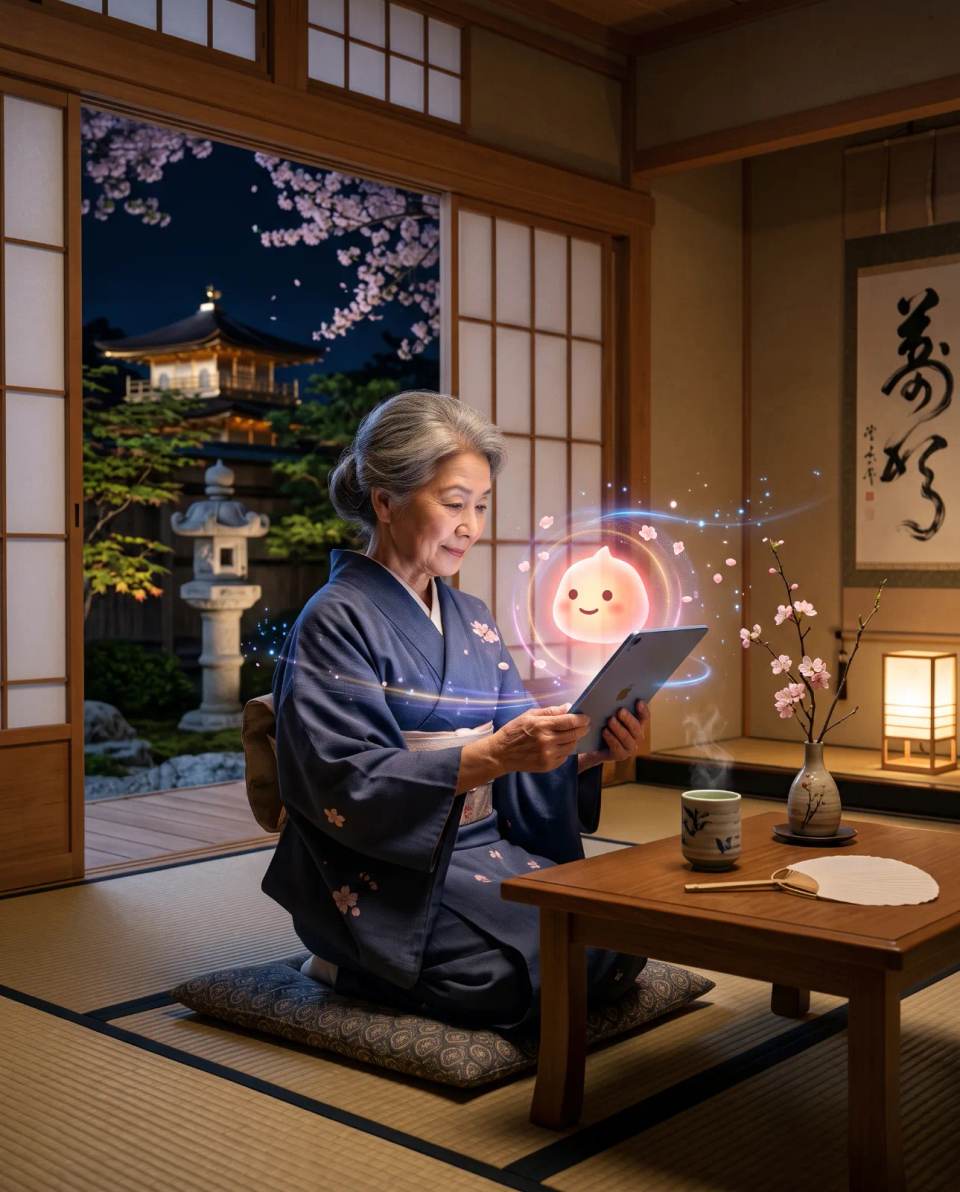
A May 2026 survey by the Japan Institute for Promotion of Digital Economy and Community (JIPDEC) revealed that 47.8% of women aged 60-70 prefer AI over humans for interpersonal and relationship advice . This finding challenges everything we thought we knew about aging, technology adoption, and the future of mental health support.
The Numbers That Shocked Researchers
The JIPDEC survey, conducted online in mid-January 2026 with 1,449 respondents aged 18-79 across Japan, produced a result that surprised even the researchers themselves. For women in their 60s and 70s, AI is now the preferred source of advice — 47.8% choose AI compared to just 37.3% who prefer consulting a human .
 Chat Now!
Among all age groups and genders combined, 45.8% still preferred human advice versus 36.5% who preferred AI . Those who preferred AI cited its "perceived objectivity and lack of bias" as primary reasons for their choice .
However, a significant gender gap emerged: while 47.8% of elderly women preferred AI, only 25.2% of elderly men in the same age group made the same choice. The majority of elderly men — 57% — still preferred human consultation .

Dr. Atsushi Nakagomi, a researcher at Chiba University specializing in AI and human health, admitted his surprise. The finding suggests that elderly Japanese women are actually the most open demographic to using AI for emotional needs — a group rarely associated with cutting-edge technology adoption .
Why AI Works as a Therapist Substitute
The appeal of AI companions as mental health supports in Japan is rooted in several distinct cultural and psychological factors:
 Chat Now!
The Absence of Judgment
In Japanese culture, maintaining social harmony ("wa") is vital. Many elderly women worry about burdening others or saying the wrong thing — concerns that can prevent them from seeking help from family or friends. As Dr.
An AI confidant never judges, never reveals secrets, and never interrupts. For many elderly Japanese women, these qualities create a safe space for expressing emotions .
24/7 Availability
Loneliness does not follow office hours. Many elderly Japanese women live alone or have limited mobility. An AI confidant is available at any hour of the day or night, on holidays, and during sudden emotional breakdowns — without the need for an appointment .
Objectivity Without Bias
One anonymous respondent in the JIPDEC survey explained it perfectly: "My daughter means well, but she always takes my husband's side. The AI just listens and gives me pros and cons without taking anyone's side" . For individuals navigating complex family dynamics, AI offers the promise of genuine neutrality.
Japan's Mental Health Crisis and the AI Solution
Japan is facing a perfect storm of mental health challenges:
- Aging population: Japan's 65+ population reached 29.1% of the total in 2024, the highest globally .
- Rising loneliness: Government white papers have documented increasing loneliness among elderly citizens, prompting the appointment of a dedicated minister in 2021 .
- Psychiatric waiting lists: Children and adolescents face waits of 3 months to a year for psychiatric care .
- Subthreshold depression: Symptoms that don't meet clinical thresholds still impact quality of life and increase the risk of major depressive episodes by 3x .
In response, Japan has formally recognized loneliness and social isolation as a national concern, requiring local governments to take countermeasures . AI companions are increasingly being deployed as part of the solution.
From Chatbots to AI Buddhists
Japan's AI mental health landscape extends far beyond conventional chatbots:
The AI Buddhist Robot
Kyoto University researchers have developed a humanoid "Buddha Robot" — a 1.3-meter-tall robot that walks and performs monk-like hand gestures. It contains an AI trained on Buddhist scriptures, capable of providing advice on psychological distress . When asked "I often overthink and worry; how should I face it?
Professor Seiji Kumagai, who leads the project and is himself a monk, emphasized the ethical considerations: "We hope to discuss how to make good use of this technology within an ethical framework while continually improving its conversational abilities" .
AI Mental Health Chatbots and Apps
AI-driven chatbots like emol (by Emol Inc), which integrates Acceptance and Commitment Therapy (ACT), are being tested for adolescents on psychiatric waiting lists . The AI chatbot features a friendly character named Roku and includes emotional logging, interactive exercises, gamification, and sleep tracking .
A large-scale smartphone CBT trial (RESiLIENT) with 4,469 participants confirmed the effectiveness of AI-personalized interventions, with AI-optimized treatments showing 35% greater effectiveness compared to standard group treatments .
ElliQ: The Proactive Companion Robot
Japanese trading company Kanematsu Corporation partnered with Intuition Robotics to develop ElliQ, an AI companion robot specifically for the elderly market . Unlike reactive chatbots, ElliQ proactively initiates 60% of interactions—starting conversations, suggesting activities, and providing timely medication reminders .
Results from US deployments showed that 97% of users reported improved overall health and well-being, 94% felt less lonely, and 85% felt more connected to the outside world .
What the Research Says: AI Complements, Not Replaces
A cross-cultural study (N=1011) conducted in Austria and Japan examined how perceived affordances of generative AI—accessibility, personalization, and anthropomorphism—predict trust and use intentions for mental health support .
Importantly, the study found that intentions to use generative AI for mental health were positively associated with willingness to attend in-person therapy, suggesting a complementary rather than substitutive role . In Japan, the relationship between trust in AI and use intentions was stronger among participants with higher perceived stigma .
Another large-scale Japanese study (14,000 participants) by Chiba University researchers found that AI companion users reported slightly higher life satisfaction, happiness, and life purpose compared to non-users . More importantly, the association was strongest for people with higher loneliness scores and moderate social connections—suggesting AI companions are most beneficial for those who need them most .
Limitations: What AI Can't Replace
The challenges of AI in mental health support are also evident. A randomized controlled trial testing the ACT-based AI chatbot emol with adolescents on psychiatric waiting lists faced significant engagement barriers. Of 96 eligible individuals, only 8 expressed interest and 3 provided consent—all subsequently withdrew or were excluded .
Researchers concluded that digital interventions need simpler protocols and trusted environments. They suggested testing in schools or community centers to enhance accessibility and participation .
Notably, AI cannot:
- Provide comprehensive diagnosis or treatment
- Offer the warmth of genuine human connection
- Replace the structural support of professional therapy
The evidence suggests AI companions work best when they fill gaps in mental health infrastructure, not when they attempt to replace professional care entirely.
FAQ
Are AI companions really replacing therapists in Japan?
Not exactly. AI companions are providing emotional support and advice where traditional mental health services are scarce. The evidence suggests AI complements rather than replaces therapy—users of AI companions are actually more likely to seek professional help .
Why do elderly Japanese women prefer AI over humans for advice?
Research points to three key reasons: AI offers judgment-free interaction without fear of burdening others; it provides objectivity without personal biases; and it's available 24/7 without appointments .
Is there evidence that AI companions improve mental health?
Yes. A large-scale Japanese study of 14,000 participants found AI companion users reported higher life satisfaction and happiness, with the strongest benefits for people with higher loneliness . Another study showed a 35% improvement in treatment effectiveness through AI-personalized interventions .
What challenges exist for AI mental health support in Japan?
Engagement remains a significant barrier. An AI chatbot trial for adolescents on psychiatric waiting lists failed to achieve meaningful participation, suggesting digital interventions need simpler protocols and trusted environments like schools or community centers .
Are there cultural differences in how AI is used for mental health?
Yes. A cross-cultural study found that in Japan, the relationship between trust in AI and use intentions was stronger among participants with higher perceived stigma, suggesting AI may help overcome barriers to seeking help in cultures where mental health stigma is significant .
Ready to Meet Your AI Companion?
Create an AI companion personalized for you. Through our 3-question AI quiz, discover the best platform for creating your AI girlfriend or boyfriend, and never wonder which one is best again.
Create My AI Companion →