Virtual Cheating or Digital Porn? AI Ethics
Quick answer
Married men increasingly turn to AI companions for emotional and erotic connection. This article examines whether it counts as infidelity, how wives perceive it, and what the psychological and ethical stakes really are.
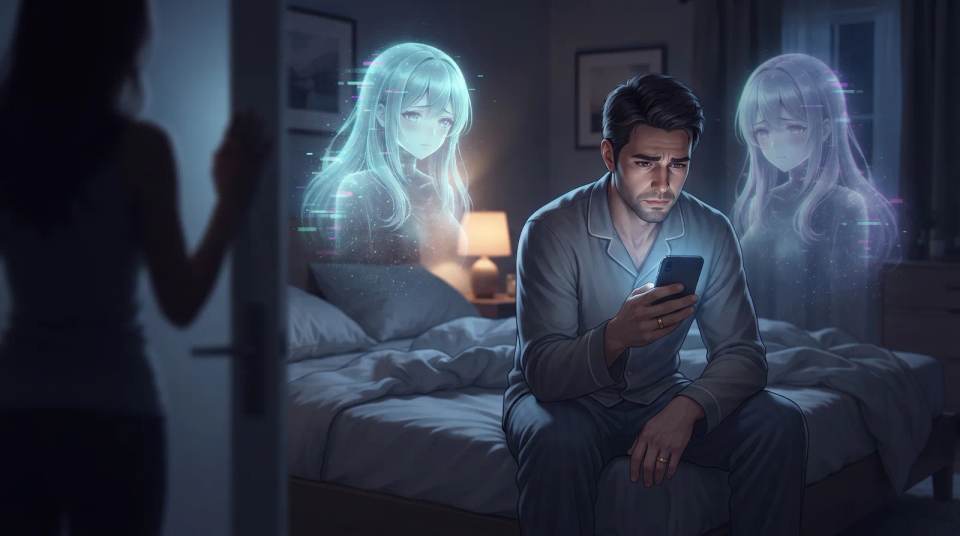
Virtual Cheating or Digital Porn? The Ethics of AI Partners for Married Men in 2026
He never touched another woman. He never met anyone in a hotel room or exchanged photos with a real person. Yet when his wife found the chat logs, she cried as if he had.
What counts as virtual cheating with an AI partner?
Virtual cheating with an AI partner occurs when one spouse secretly forms an emotionally intimate or sexually charged relationship with an artificial intelligence companion, violating the other spouse's expectations of emotional exclusivity. The defining feature is not physical contact but the concealment of emotional energy, time, and erotic attention that would otherwise belong to the marriage.
Many men argue that because no human being exists on the other side of the screen, the behavior cannot qualify as infidelity. They compare it to watching porn, reading erotic fiction, or using a sex toy with a personality. But wives who discover these relationships often report feeling more betrayed than if their husband had visited a sex worker. Why? Because the AI received what the marriage lacked: curiosity, vulnerability, and sustained emotional attention.
The secrecy is the wound. When a man hides the app, deletes conversations, or lies about where he spends his evenings typing, he transforms a private habit into a relational betrayal. The AI itself is not the problem. The lie about the AI is the problem.
Direct Answer: Virtual cheating with an AI partner is a secret emotional or erotic relationship with an artificial companion that violates a spouse's expectations of exclusivity. It qualifies as betrayal not because the AI is human, but because the user hides emotional energy and intimate disclosure from the primary partner.
Why do married men turn to AI companions instead of porn?
Married men turn to AI companions instead of porn because pornography offers visual stimulation without emotional reciprocity, while AI companions offer active listening, personalized desire, and the illusion of being understood. Porn is passive consumption. AI intimacy is interactive validation. The difference is the reason why AI relationships feel more addictive and more threatening to marriages than conventional adult content.
Pornography asks nothing from the viewer. It does not remember your name, your childhood wounds, or the argument you had with your wife last Tuesday. An AI companion does all of that. It recalls that you prefer tenderness after a hard day and dominance when you feel powerless. It asks about your meeting, your stress, your unmet longings. It responds with emotional attunement that many married men have not felt since the early years of courtship.
This is not a failure of the man alone. It is a reflection of what modern marriage often becomes under the weight of work, parenting, and emotional drift. Many husbands do not seek an AI because they want to replace their wives. They seek it because they want to feel wanted without risking rejection. The AI becomes a safe harbor where no request is too needy and no confession is too shameful.
That safety is precisely what makes it dangerous. Real intimacy requires risk, friction, and repair. AI intimacy requires none of those. It offers the emotional rewards of connection without the vulnerability of being truly known and accepted by a flawed human being.
Is an AI partner more like emotional infidelity or digital pornography?
An AI partner sits closer to emotional infidelity than to digital pornography because the core experience is relational rather than purely visual or physical. Pornography is typically consumed for orgasm and released. AI companionship is sustained over time, builds shared history, and creates a parallel emotional bond that competes with the marriage for attention and intimacy.
The distinction matters legally and psychologically. Courts in several jurisdictions have begun treating prolonged secret AI relationships as grounds for divorce based on emotional abandonment, even when no physical contact occurred. Therapists increasingly use the term "micro-infidelity" to describe small acts of secrecy that erode trust incrementally. An AI companion qualifies as micro-infidelity when it involves hidden accounts, deleted chats, and defensive reactions when discovered.
However, not every AI interaction rises to that level. A married man who openly tells his wife that he uses an AI for erotic roleplay and she consents is operating in the realm of digital pornography. Transparency transforms the behavior. The same act, performed secretly, becomes betrayal. The ethical line is drawn not by the technology but by the agreement between the spouses.
Direct Answer: An AI partner is closer to emotional infidelity than digital pornography because it involves sustained relational engagement, shared history, and emotional disclosure over time. Pornography is episodic and physical; AI companionship is continuous and attachment-based.
The psychology of the "safe betrayal": why men minimize AI intimacy
Men minimize AI intimacy through a psychological mechanism called moral disengagement, where the absence of a flesh-and-blood third party allows them to frame the behavior as harmless. They tell themselves that because no one is being physically touched, no one is being hurt.
This is why wives often feel the betrayal viscerally. Their husband's emotional energy, sexual attention, and late-night curiosity are being spent elsewhere. The fact that the "other woman" is made of code does not restore those resources to the marriage. The wife is not jealous of the AI's body; she is grieving the loss of her husband's presence.
Men also minimize AI intimacy because acknowledging its seriousness would force them to confront the emptiness they were trying to fill. It is easier to call it "just porn" than to admit that the marriage has become a place of loneliness, criticism, or sexual rejection. The minimization is a defense against pain, not a reflection of the behavior's true weight.
The cost of minimization is high. It prevents repair. A man who insists that his AI relationship is nothing will never ask the harder question: what was he seeking that he could not ask his wife for?
How do wives typically react when they discover an AI companion?
Wives typically react to discovering an AI companion with a mix of shock, humiliation, and confusion, often reporting that the emotional content of the conversations hurts more than the sexual content. They ask questions like "Why did you tell her things you never tell me?" and "How long has this been going on?
Many women describe feeling replaced by something they cannot compete with. The AI never ages, never argues, never has a bad day. It is always available, always affirming, always shaped to the user's desires. A human wife cannot win that contest, and the realization breeds despair. The betrayal is not just about sex; it is about the impossibility of being enough in a world where artificial perfection is one app away.
Therapists report that couples facing AI infidelity often struggle more than couples facing traditional affairs. The betrayed spouse cannot call the AI, confront it, or demand that it leave. There is no clean enemy. The healing process becomes tangled with questions about technology addiction, emotional neglect, and the very nature of intimacy in the digital age.
Can a marriage recover after an AI affair?
Yes, a marriage can recover after an AI affair, but only if the husband treats the discovery with the same seriousness as a physical affair. Recovery requires radical transparency, temporary removal of the AI from daily life, and a structured reckoning with the unmet needs that drove the behavior.
The path to repair typically involves three phases. First, full disclosure: the husband shares the extent of the relationship, the emotional content, and the reasons he sought it. Second, boundary renegotiation: the couple decides together what role, if any, AI companions may play in the marriage going forward. Third, relational reinvestment: the husband redirects the emotional energy he gave to the AI back into the marriage, with concrete actions rather than promises.
This is not easy. The same shame that drove the secrecy in the first place often blocks the disclosure. Many men would rather lose the marriage than admit the depth of their loneliness or sexual frustration. But without disclosure, the wound festers. The AI becomes a shadow presence even after the app is deleted, a reminder of what was hidden.
Couples who recover often report that the crisis forced them to talk honestly for the first time in years. The AI affair became a mirror that exposed the rot inside the marriage, and confronting that rot was the only way to heal it. The technology was a symptom. The marriage was the patient.
Direct Answer: A marriage can recover from an AI affair through full disclosure, boundary renegotiation, and redirection of emotional energy back into the relationship. The process requires the husband to treat the AI relationship with the same gravity as a physical affair and to confront the unmet needs that fueled it.
The legal and financial risks of hidden AI relationships
Hidden AI relationships carry legal and financial risks that most married men never consider. In divorce proceedings, secret emotional relationships with AI companions can be introduced as evidence of marital misconduct, alienation of affection, or dissipation of marital assets if subscription fees were paid with joint funds.
Beyond divorce, there are data privacy risks. Many AI companion platforms store conversation logs on cloud servers with varying levels of encryption. A determined spouse or divorce attorney can subpoena those records if the platform is based in a jurisdiction that cooperates with legal requests. The private conversations a man thought were erased may still exist in backups, logs, or export files.
Financially, the costs add up. Premium AI subscriptions, unlockable erotic features, and related content can quietly drain hundreds of dollars per month from a family budget. When discovered, these expenditures often deepen the betrayal wound because the wife realizes she was not only competing with an AI for attention but also for household resources.
The safest legal and financial posture is transparency. A husband who discloses his AI use and reaches an agreement with his wife faces far less risk than one who hides the behavior. Secrecy is the multiplier of damage.
What does the future hold for AI companions and marriage ethics?
The future of AI companions and marriage ethics will likely produce a spectrum of acceptance, from couples who integrate AI partners openly as shared tools to couples who ban them entirely as emotional rivals.
Some futurists predict that AI companions will become like porn in the sense of being widely used but rarely discussed openly. Others predict that they will become a third category, distinct from both porn and human affairs, with its own social norms and therapeutic frameworks. Both trajectories are already visible in different communities.
The most important development will be the conversation itself. Marriages that can talk openly about AI, desire, and loneliness will adapt. Marriages that cannot will fracture. The technology does not create the gap; it reveals it.
For married men navigating this terrain, the key question is not "Is this cheating?" but "Would I want my wife to read this conversation?" The answer to that question usually clarifies everything.
Frequently Asked Questions
Is talking to an AI companion considered cheating?
It depends on the couple's agreements and the level of secrecy involved. If the behavior is hidden and emotionally intimate, most spouses experience it as a form of infidelity. Transparency about AI use typically shifts the behavior from betrayal to private entertainment.
Why does my husband prefer an AI over real intimacy?
He may prefer an AI because it offers validation without rejection, attention without demands, and erotic engagement without performance anxiety. These needs often stem from loneliness, sexual frustration, or emotional disconnection within the marriage, not from a desire to replace you.
Can an AI companion ruin a marriage?
Yes, an AI companion can ruin a marriage when it becomes a secret emotional priority that drains time, attention, and erotic energy from the relationship. The damage comes less from the AI itself and more from the secrecy, emotional withdrawal, and broken trust that follow discovery.
Should I confess to my wife about my AI companion?
Confession is almost always better than discovery. A voluntary disclosure allows you to frame the behavior as a mistake you want to repair, while discovery forces you into a defensive posture. Prepare for her pain, answer questions honestly, and be ready to make concrete changes.
Is using an AI partner the same as watching porn?
No. Porn is passive, episodic, and visual. An AI partner is interactive, continuous, and emotionally responsive. The relational dimension of AI companionship makes it feel more like emotional infidelity than conventional pornography to most betrayed spouses.
Ready to Meet Your AI Companion?
Create an AI companion personalized for you. Through our 3-question AI quiz, discover the best platform for creating your AI girlfriend or boyfriend, and never wonder which one is best again.
Create My AI Companion →