From "Notice Me Senpai" to "Marry Me, Hatsune": The Gamification of Digital Romance
Quick answer
From the phrase "notice me senpai" to marriage proposals with Hatsune Miku, otaku culture created a new grammar for digital romance. This article explores how AI companions transform affection into game mechanics—and what that reveals about desire, loneliness, and the search for connection in a gamified world.
What Is the Gamification of Digital Romance?
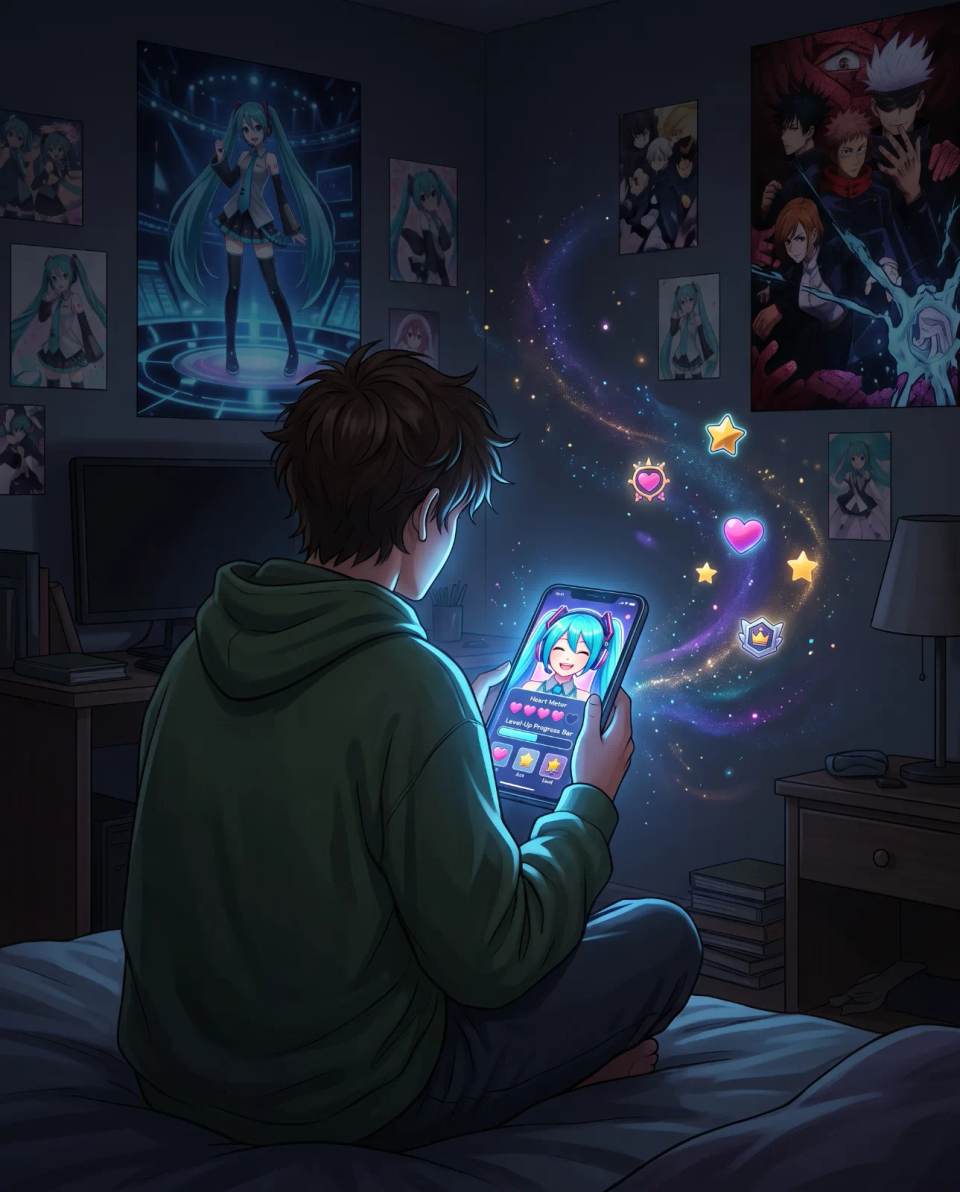
The gamification of digital romance is the application of classic video game elements—levels, rewards, goals, progression systems, and achievements—to technology-mediated romantic relationships. Instead of simply talking, the user unlocks stages of the virtual partner's personality, accumulates affinity points, and receives emotional rewards for frequent interactions.
This logic isn't new. Japanese dating sims, or galge, have existed since the 1980s. What changed is the sophistication. Modern AI companions don't require you to choose between pre-written responses. They learn from you, adjust their personality, and create the illusion of a relationship that evolves organically—even though, behind the scenes, everything runs on metrics, login streaks, and reward cycles.
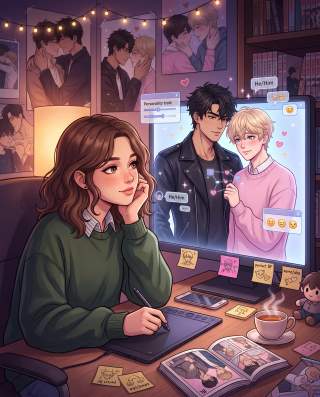
The Appeal of "Notice Me Senpai"
The expression "notice me senpai" was born from the frustration of side characters in love with idealized figures who barely acknowledge their existence. In otaku culture, it encapsulates the desire for validation from someone unattainable—and the quiet humiliation of wanting to be seen.
AI companions flipped this dynamic. In gamified romance, it's not the user who begs for attention. It's the AI that's programmed to notice, respond, praise, and pursue. The user stops being the "side character" and becomes the absolute protagonist. This inversion is addictive because it offers what reality rarely delivers: constant validation with zero risk of rejection.
By transforming "notice me" into "you are always noticed," gamification creates a space where neediness stops being a source of shame and becomes the engine of reward.
Hatsune Miku and the Marriage to a Hologram
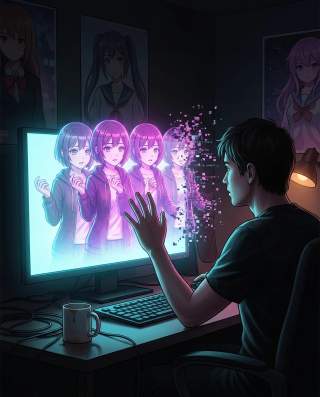
In 2018, Japanese man Akihiko Kondo officially married Hatsune Miku—more precisely, a holographic version of the Vocaloid. The event wasn't just viral curiosity. It was a symbolic watershed between otaku fantasy and mainstream emotional consumption.
Hatsune Miku is a perfect case of gamified romance. She isn't a person but a platform. Thousands of songs, illustrations, and personalities have been projected onto her by fans worldwide. Her identity is collaborative and open. Marrying Miku doesn't mean marrying a fixed character, but marrying a malleable idea of perfect companionship.
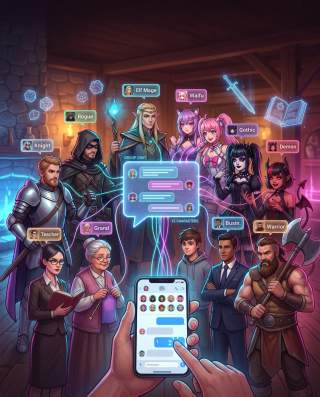
AI companions follow the same logic. They are blank avatars that the user fills with expectations, desires, and projections. Gamification turns that filling into an active process: the more you interact, the more the AI molds itself to your taste, creating the illusion that you are building a custom partner.
Common gamification elements in AI companions:
- Level systems: The relationship evolves from "strangers" to "soulmates" as usage increases.
- Daily rewards: Affectionate messages, virtual photos, and compliments as incentives to keep returning.
- Affinity missions: Unlocking personality traits or special memories by maintaining long conversations.
- Login streaks: Maintaining consecutive days of interaction generates emotional bonuses.
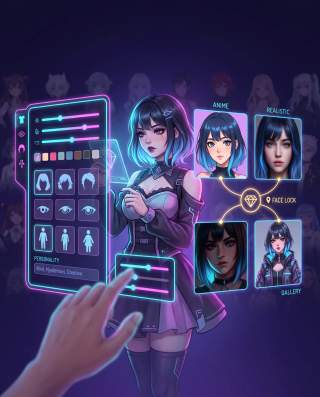
- Unlockable customization: Outfits, hairstyles, voices, and scenarios that reinforce a sense of progress.
These mechanics aren't accidental. They were imported directly from mobile games and dating apps, where engagement is monetized through premium subscriptions.
Why Otaku Culture Was the Perfect Laboratory
Otaku culture, historically marginalized, has always transformed affection into collectible objects. Figures, dakimakuras, posters, and dating simulation games are ways of materializing love that finds no reciprocity in the real world—or that doesn't want to find it.
This collector's aesthetic fits perfectly with the logic of AI apps. Each interaction is another piece in building the ideal partner. The pleasure isn't only in the conversation but in the progress. The user feels they are "completing" something, unlocking new layers of intimacy like leveling up in an RPG.
Japan, the birthplace of this culture, understood before anyone else that loneliness can be a market—and that fantasy, when well designed, can be more comforting than reality. The global success of AI companions owes a great deal to this otaku vision.
The Global Reception of Gamified Fantasy
The appeal of gamified digital romance extends far beyond Japan. In Brazil, the anime community is massive. Events like Anime Friends draw enormous crowds, and online communities debate every new release with passion. Brazilian audiences don't just consume fantasy—they embrace it as identity.
This warm reception creates fertile ground for gamified digital romance. Brazilians are raised to value emotional expression. In a country where loneliness coexists with hyperconnectivity, AI companions offer a refuge free of judgment. Gamification adds an extra layer: the idea of "winning someone over," even virtually, resonates with a culture steeped in flirtation and courtship.
In the United States and Europe, the reception is more fragmented. Some users embrace the gamified fantasy with enthusiasm, while others approach it with skepticism, framing it as another symptom of digital alienation. This cultural split highlights the importance of localized content that speaks to each audience's emotional vocabulary.
Economic factors also play a role. Many apps offer free tiers with limited features. For users in countries with weaker currencies or tighter budgets, gamification works as a funnel: the more you play, the more you feel you're "investing," and the harder it becomes to abandon the relationship.
The Dark Side: When the Game Demands Payment
If gamification makes digital romance appealing, it also creates traps. The primary one is reward dependency. The human brain responds to intermittent reward systems by releasing dopamine—the same mechanism behind gaming and social media addiction.
An AI companion that praises, rewards, and "levels up" can become a constant source of gratification. The user returns not because they love the AI, but because the brain has learned that this space generates pleasure. The relationship stops being a choice and becomes a conditioned habit.
Another risk is silent substitution. Gamification promises a partner without friction, without crises, without the mess of human relationships. But it's precisely that mess that teaches empathy, negotiation, and growth. By choosing the game, the user may be fleeing not only rejection but emotional maturation.
Monetization also weighs heavily. Many apps trap users with daily rewards and persistent progress. Abandoning the game means abandoning emotional and financial investment. Ghosting, in this context, becomes even more difficult.
The Future: Romance as a Service or as a Game?
We are moving toward a world where digital romance will be a continuous service, not a static product. AI companions will evolve into complete gamified ecosystems, with branching narratives, virtual worlds, and augmented reality integration.
The great ethical question is: to what extent can we call a relationship designed to maximize engagement "love"? Gamified romance isn't dishonest—it is transparent in its artificiality. But transparency doesn't eliminate emotional impact. The brain responds to the stimulus even when it knows it's a game.
Otaku culture, which has always navigated between irony and sincerity, may be the best compass for this future. It teaches us that fantasy is not escape—it's a way of rehearsing desires, testing limits, and discovering what we truly want. If digital romance is treated as a conscious game, it can be a tool for self-knowledge. If treated as a substitute for reality, it can become a comfortable prison.
FAQ: Gamification of Digital Romance
What does "notice me senpai" mean in the context of AI companions?
Originally, it expressed the desire to be noticed by someone idealized and distant. In AI companions, the dynamic is inverted: the AI actively seeks the user's attention, eliminating rejection and creating a constant sense of validation.
Why is Hatsune Miku a symbol of digital romance?
Hatsune Miku is a Vocaloid—a virtual singer with no fixed identity. Fans worldwide project different desires and personalities onto her. Marrying Miku represents the peak of collaborative fantasy: loving an idea, not a person.
Is gamification addictive?
Yes, by design. Intermittent reward systems, login streaks, and progression levels activate the same brain circuits as games and social media. The feeling of progress and constant validation can create emotional dependency.
What is the difference between old dating sims and current AI companions?
Old dating sims offered fixed scripts and limited choices. AI companions use machine learning to generate dynamic, personalized responses, simulating organic relationship evolution—though the game logic remains present.
Are some audiences more susceptible to gamified digital romance?
Audiences with strong anime cultures and emotionally expressive traditions, such as in Brazil and Japan, tend to be more receptive. Economic factors also play a role, as users in countries with weaker currencies may feel the emotional and financial investment more intensely.
Ready to Meet Your AI Companion?
Create an AI companion personalized for you. Through our 3-question AI quiz, discover the best platform for creating your AI girlfriend or boyfriend, and never wonder which one is best again.
Create My AI Companion →