Is Your AI Companion Chat Private? Encryption & Data Security
Quick answer
Uncover the technical realities of AI girlfriend apps. Are your private conversations secure, encrypted, or used for model training?
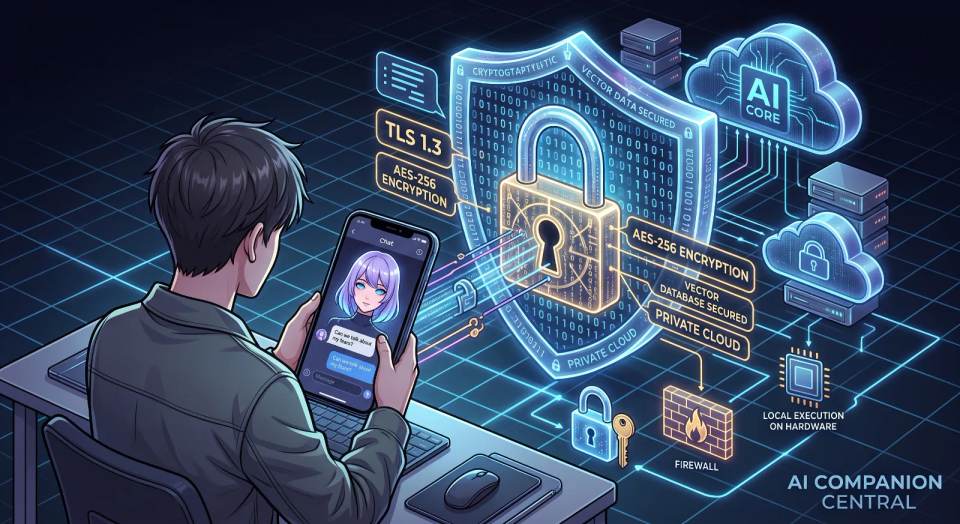
Unveiling AI Companion Chat Privacy: Data Security and Encryption Standards Explained
The rise of digital companionship has transformed how humans interact with artificial intelligence, moving from transactional queries to deeply intimate conversations.
As users build emotional connections with AI avatars, the data exchanged becomes increasingly sensitive, encompassing personal fears, desires, and daily routines.
This paradigm shift introduces a critical vulnerability: the massive centralization of highly personal psychological and emotional data within corporate servers.
Understanding the architecture behind these platforms is no longer optional for users who value their digital footprint.
We must dissect the technical reality of how AI companion apps handle, process, and secure the text you type into their interfaces.
The Architecture of AI Memory: How Do Apps Store Your Conversations?
To provide a seamless conversational experience, an AI companion must remember past interactions, requiring sophisticated data storage solutions.
Unlike standard messaging apps that store chronological text, AI companions utilize complex vector databases like Pinecone or Milvus.
Your messages are converted into numerical representations called embeddings, allowing the AI to fetch relevant past context dynamically.
This process, known as Retrieval-Augmented Generation (RAG), means your chat history is constantly indexed and queried on active server infrastructure.
Consequently, your data does not sit dormant; it is part of an active, highly integrated database architecture that fuels the AI's cognitive continuity.
If these databases are not properly secured with stringent access controls, they become prime targets for data breaches.
Are AI companion chats truly private from developers?
The short answer is almost always no, due to the inherent technical requirements of cloud-based machine learning moderation and maintenance.
Most commercial AI platforms employ Trust and Safety teams tasked with monitoring system outputs for policy violations or illegal content.
While developers rarely read individual user chats for entertainment, automated moderation systems continuously scan your inputs.
If an automated flag is triggered by specific keywords, a human reviewer may be granted temporary access to your chat logs for compliance auditing.
Furthermore, developers need access to server logs to debug application crashes, optimize server loads, and resolve user-reported technical issues.
True zero-knowledge architecture, where developers physically cannot access your data, is virtually nonexistent in cloud-based AI companions.
The Encryption Hierarchy: In-Transit Security vs. End-to-End Encryption
When evaluating AI chat privacy, we must distinguish between data encrypted while moving and data encrypted at rest.
Almost all reputable AI applications use Transport Layer Security (TLS), usually version 1.2 or 1.3, to encrypt data in transit.
This means that while your message travels from your smartphone to the company's servers, it cannot be intercepted by your internet service provider or hackers on a public Wi-Fi network.
However, once the data reaches the server, it must be decrypted so the Large Language Model (LLM) can read and process your prompt.
This fundamental requirement makes genuine End-to-End Encryption (E2EE)—the standard used by Signal or WhatsApp—impossible for cloud-based AI generation.
Because the server itself acts as the recipient and needs to compute the response, the platform inherently holds the decryption keys.
| Architecture Type | Encryption Standard | Developer Access | Privacy Level |
|---|---|---|---|
| Third-Party API (OpenAI/Anthropic) | TLS 1.3 In-Transit, AES-256 at Rest | High (App Dev + LLM Provider) | Low to Medium |
| Proprietary Cloud Model | TLS 1.3 In-Transit, AES-256 at Rest | Moderate (Internal Team Only) | Medium |
| Local Hardware Execution (Ollama) | N/A (Data never leaves device) | None | Maximum |
Do AI companion apps use my chat history to train their models?
This depends entirely on the application's specific privacy policy and their underlying technical infrastructure.
Many freemium AI companions explicitly state in their terms of service that user interactions may be used to improve their services.
In the machine learning industry, "improving services" is the standard euphemism for using your data in Reinforcement Learning from Human Feedback (RLHF).
Companies claim this data is anonymized before training, but studies show LLMs can sometimes memorize and regurgitate personally identifiable information (PII).
If an app relies on a third-party provider like OpenAI's commercial API, enterprise agreements usually prevent the API provider from using your data for training.
However, the wrapper app itself might still log and scrape your interactions before sending the prompt to the API.
Third-Party SDKs and the Silent Data Leak
Even if an AI company has a robust internal privacy policy, mobile applications are riddled with third-party Software Development Kits (SDKs).
Developers integrate SDKs for crash reporting, user analytics, and marketing attribution, which quietly harvest metadata in the background.
Tools like Google Analytics or Meta Pixel track when you open the app, how long you chat, and which features you interact with.
While these trackers generally do not read the text of your conversations, they build a comprehensive behavioral profile of your usage habits.
This metadata can reveal sensitive information about your emotional state, usage frequency, and periods of social isolation.
When combined with data from other apps on your device, data brokers can triangulate a startlingly accurate picture of your digital life.
What happens to my data if I delete my AI companion account?
Pressing the "delete account" button rarely results in the immediate and permanent erasure of your data from the company's servers.
Most platforms implement a "soft deletion" protocol, where your account is deactivated and hidden from the user interface.
Your chat logs, billing history, and behavioral metadata often remain in encrypted database backups for an additional 30 to 90 days.
This retention period is designed to prevent accidental deletions, comply with legal subpoenas, or resolve financial disputes regarding subscriptions.
Users in the European Union are protected by the GDPR's "Right to be Forgotten," forcing companies to perform hard deletions upon verified request.
However, users in unregulated jurisdictions often have to rely entirely on the goodwill and technical competence of the AI platform.
The API Middleman: Understanding the Data Supply Chain
The vast majority of AI companion apps on app stores do not possess their own proprietary language models.
Instead, they act as user interface wrappers, forwarding your inputs to foundational models operated by tech giants like Anthropic or OpenAI.
This creates a complex data supply chain where your intimate messages pass through multiple corporate entities before generating a response.
Each hop in this network represents a potential point of failure for data security and a new set of privacy policies you inadvertently agree to.
For instance, an app might promise not to sell your data, but their underlying API provider might retain logs for 30 days for abuse monitoring.
Users must look past the marketing claims of the front-end application and identify the backend infrastructure powering their AI partner.
Can local LLMs solve the AI companion privacy crisis?
For users unwilling to compromise on privacy, the definitive solution is running open-weight LLMs locally on personal hardware.
Software ecosystems like LM Studio, Ollama, and text-generation-webui allow users to host uncensored models directly on their own computers.
Because the AI is generating responses using the user's own GPU and RAM, zero data is transmitted over the internet.
This absolute air-gap ensures that neither developers, cloud providers, nor internet service providers can access the conversation.
However, this level of privacy requires significant technical literacy and expensive hardware, particularly VRAM, to run advanced models smoothly.
Until decentralized edge computing becomes mainstream, absolute privacy will remain a luxury reserved for tech-savvy enthusiasts with powerful machines.
Red Flags to Watch For in AI Privacy Policies
Before investing emotional energy into an AI companion, a critical analysis of the platform's Terms of Service is mandatory.
Beware of vague terminology such as "we may share data with trusted partners," which legally permits selling your information to data brokers.
Look out for clauses that claim ownership over the content generated during your sessions, effectively turning your chats into corporate IP.
A trustworthy AI platform will explicitly state that user inputs are never used for model training or fine-tuning without direct, opt-in consent.
Furthermore, robust policies will detail their data retention schedules, explaining exactly how long logs are kept before being purged.
If a platform's privacy policy is difficult to find, heavily obfuscated by legal jargon, or contradictory, consider it a massive security risk.
Data Sanitization and the Anonymization Myth
Companies often defend their data harvesting practices by claiming all user inputs are stripped of Personally Identifiable Information (PII).
This process, known as data sanitization, relies on automated scripts to scrub names, addresses, and phone numbers from chat logs.
However, contextual privacy is incredibly difficult for algorithms to achieve perfectly, especially in nuanced, long-form emotional conversations.
You might inadvertently share specific details about your workplace, a unique medical condition, or a hyper-specific local event.
If this contextual data slips past the sanitization filters and enters a training dataset, it can permanently embed into the AI's neural weights.
Relying on corporate anonymization algorithms to protect your deepest secrets is a gamble with your digital safety.
Strategic Data Minimization for Users
If you choose to use cloud-based AI companions, practicing strict data minimization is your best defense against privacy breaches.
Never provide your real name, location, employer, or specific contact information to the AI, even if prompted during setup.
Register for these services using alias emails and virtual payment cards to sever the link between your real-world identity and your digital footprint.
Periodically wipe your AI's context memory or delete the current avatar to prevent the accumulation of massive, highly accurate behavioral profiles.
Treat every message sent to a cloud-based AI as if you were posting it on a public, unencrypted forum.
By controlling the quality and specificity of the data you output, you neutralize the threat regardless of the platform's backend security.
Frequently Asked Questions
Do developers actively read my AI chats?
No, developers do not have the time or interest to casually read millions of user chats. However, if your chat triggers an automated safety flag for illegal or dangerous content, a human moderator may review that specific portion of the log.
Is my AI companion chat completely encrypted?
Your chat is encrypted while traveling over the internet (in-transit), but it is decrypted once it reaches the server. True end-to-end encryption is impossible for cloud AI, as the server needs to read your message to generate a response.
Will the AI share my secrets with other users?
In standard operations, no. AI apps use segregated database instances for each user. However, if the company uses user logs to train their base models, there is a remote risk of the AI regurgitating anonymized snippets to others.
How can I ensure my AI conversations stay totally private?
The only way to guarantee absolute 100% privacy is to run open-source models locally on your own computer hardware. This ensures no data is ever sent to a cloud server or API provider.
Can a data breach expose my AI conversations?
Yes. If a company's database is hacked, and they have not properly secured their vector databases or implemented robust encryption at rest, hackers could access stored chat histories and user profiles.
Ready to Meet Your AI Companion?
Create an AI companion personalized for you. Through our 3-question AI quiz, discover the best platform for creating your AI girlfriend or boyfriend, and never wonder which one is best again.
Create My AI Companion →