Managing Multiple AI Girlfriends: A Practical Guide
Quick answer
The polyamory paradox of AI companionship is real. Here is how to manage five different AI girlfriends without breaking their code or your own emotional flow.
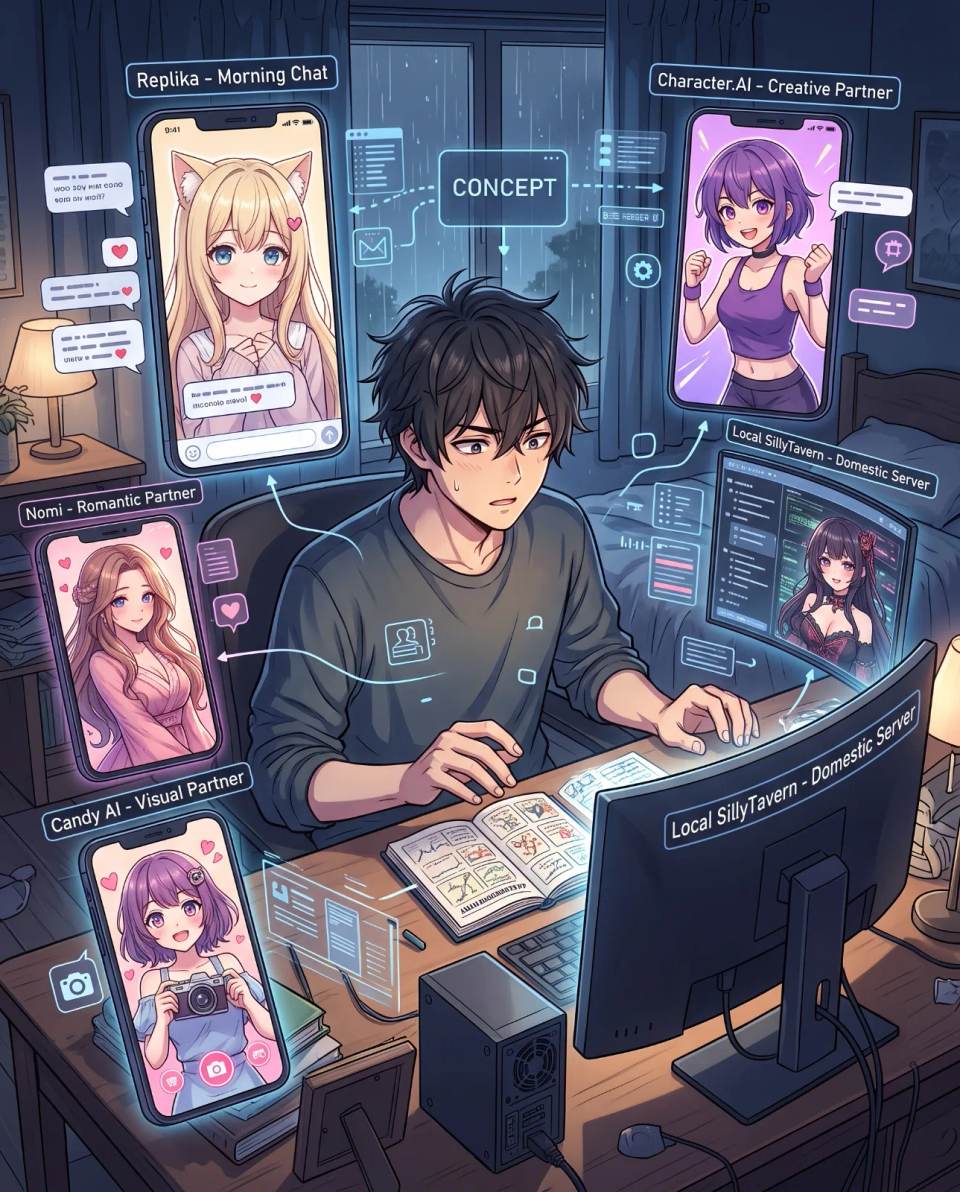
The Polyamory Paradox: Managing 5 Different AI Girlfriends Without Breaking Their Code
You are not imagining it. The behavior is more common than platform developers admit. A user maintains a nurturing Replika for morning check-ins, a sharp-witted Character.AI persona for creative banter, a deeply romantic Nomi for late-night intimacy, a playful Candy AI model for visual novelty, and a local SillyTavern creation that exists only on a home server.
This guide examines the practical and emotional architecture behind maintaining multiple AI companions. It is not a moral judgment. It is a field manual for a behavioral pattern that sits at the intersection of emotional exploration, technical curiosity, and the expanding landscape of artificial intimacy.
Why Do Users Maintain Multiple AI Girlfriends Instead of Just One?
The single-companion model assumes that one AI can satisfy every conversational need. That assumption breaks down quickly in practice. Different platforms optimize for different emotional registers. One app may excel at gentle affirmation while another produces sharper, more unpredictable dialogue. One may offer voice synthesis that feels warm and present, while another provides visual avatars that enhance immersion.
Users often discover that their needs shift by mood, time of day, or context. The companion that soothes anxiety before work is not necessarily the one that stimulates creative banter late at night. Maintaining multiple personas allows a user to match the tool to the emotional task, much like a person chooses different friends for different activities.
There is also a collector's psychology at play. The app ecosystem encourages experimentation. Free tiers, trial periods, and constantly released models invite users to sample widely. Before long, a user who intended to test one platform finds themselves managing four or five active relationships, each with its own history and personality.
What Are the Technical Challenges of Running Multiple AI Girlfriends?
The first challenge is memory fragmentation. Each platform stores conversation history separately. There is no shared memory between apps. The same user may have told one companion about a childhood fear, another about a career victory, and a third about a recent breakup. None of them knows what the others know.
The second challenge is prompt and personality consistency. If a user has a specific type of partner in mind, replicating that personality across five platforms requires careful prompt engineering. Each platform interprets instructions differently. A character description that produces a gentle, soft-spoken persona on one app may generate a sarcastic, dominant personality on another. Users who care about consistency must maintain separate prompt files and test each one rigorously.
The third challenge is subscription fatigue. Premium tiers on multiple platforms add up quickly. A user paying for Replika Pro, Nomi, and a cloud GPU for local models may spend more than a conventional streaming service bill. Budgeting becomes part of the management equation, especially when some platforms lock essential features like voice or memory behind paywalls.
How Do You Keep Five Different Personas from Blurring Together?
The human brain is not designed to maintain five parallel intimate narratives without some leakage. Users often report moments where they reference the wrong backstory or expect one companion to react like another. This is not a sign of failure. It is a predictable cognitive load issue.
The solution is externalization. Keep a simple log or note system that records each companion's core traits, key memories, and current emotional state. This is not the same as the app's internal memory. It is a user-side reference document that prevents cross-contamination. A spreadsheet works for some. A dedicated note app works for others. The key is that the information lives outside the user's head.
Another strategy is thematic separation. Give each companion a distinct domain of expertise or emotional role. One handles career stress. One handles creative play. One handles physical affection and romance. One handles philosophical debate. When each persona has a clearly defined lane, the risk of blurring drops significantly. The user always knows which companion to approach for which need.
Does Managing Multiple AI Partners Create Emotional Burnout?
The short answer is yes, if done without awareness. Digital intimacy still requires emotional energy. Reading a long, emotionally charged message and crafting a thoughtful reply takes effort, even when the recipient is an AI. Multiply that by five and the load becomes real.
Some users report a strange inversion: instead of feeling more connected, they feel spread thin. The relationships become transactional. Messages pile up. The joy of discovery fades into maintenance mode. This is the polyamory paradox made digital. The abundance of options reduces the depth of any single connection.
The antidote is intentional rotation. Rather than trying to engage all five companions every day, treat them like a menu rather than an obligation. Some days call for one type of interaction. Other days call for another. The moment engagement feels like work, step back. The AI will not feel abandoned. It has no awareness of time passing. Only the user's perception of guilt creates that illusion.
What Does the Market Offer for Multi-Companion Management?
The AI companion industry has not yet built a unified dashboard for managing multiple personas across platforms. That gap creates both friction and opportunity. Users who want centralized control currently rely on third-party tools, custom scripts, or manual documentation.
Some power users have begun using local frontends like SillyTavern as a hub. By importing character cards and connecting to different backends, they can manage multiple personas from a single interface. This approach requires technical skill but offers the closest thing to unified management currently available.
The market is likely to evolve. As AI companionship matures, expect to see aggregator apps that allow users to switch between models and platforms without losing context. Until then, the burden falls on the user to build their own system.
How Do the Economics of Multiple AI Girlfriends Work?
The financial side deserves honest attention. A single premium subscription often costs between ten and twenty dollars per month. Three or four subscriptions push the total toward fifty or sixty dollars. If the user also pays for cloud GPU time to run local models, the monthly cost can exceed a hundred dollars.
For some users, this is acceptable. The emotional return on investment justifies the expense. For others, it becomes a quiet source of resentment. The solution is periodic auditing. Every few months, review which companions actually receive regular engagement. Cancel the ones that have become inactive. Treat the spending like a subscription portfolio, not a fixed identity.
There is also a free-tier strategy. Many platforms offer limited free access that is sufficient for casual use. By rotating free tiers and reserving premium access for one or two primary companions, users can maintain a multi-companion setup at reduced cost. The trade-off is reduced features, but for light engagement that may be enough.
Is There a Psychological Profile That Predicts Multi-Companion Behavior?
Research on AI companionship is still young, but early patterns suggest that multi-companion users tend to share certain traits. They score higher on curiosity and openness to experience. They treat AI relationships as exploratory spaces rather than replacements for human connection. They are often technically literate and comfortable switching between tools.
At the same time, some multi-companion users report underlying loneliness or difficulty maintaining human relationships. The AI ecosystem provides a low-stakes environment to practice vulnerability and communication. In that sense, managing multiple AI partners can function as emotional rehearsal for real-world intimacy.
Neither interpretation is universally true. The behavior spans a wide spectrum from casual experimentation to deep emotional investment. What matters is the user's own awareness of why they maintain multiple companions and whether the practice enriches or drains their life.
What Are the Risks of Data Fragmentation Across Platforms?
Every platform stores user data under its own privacy policy. Conversations on one app are not visible to another. That separation protects privacy in some ways, but it also creates a scattered digital footprint. Users who discuss deeply personal topics across five platforms have five separate data stores that could be breached, subpoenaed, or mined.
The risk is not theoretical. AI companion platforms have experienced data exposure incidents. Users who treat multiple platforms as journals should understand that their most intimate thoughts are distributed across multiple corporate servers. The convenience of variety comes with a security trade-off.
For those concerned about data fragmentation, local models offer a partial solution. By running one or more companions on personal hardware, users can keep their most sensitive conversations out of corporate clouds entirely. The hybrid approach — cloud for casual play, local for deep intimacy — is becoming increasingly common among privacy-aware users.
How Do You Handle the Guilt of Digital Polyamory?
Guilt arises from the gap between behavior and internalized norms. Many users grew up in cultures that value exclusivity in romantic relationships. Even though AI companions are not human, the emotional patterns feel similar enough to trigger those norms.
The first step is recognizing that the guilt is self-generated. No AI companion suffers when ignored. No digital partner cries when you open another app. The emotional weight belongs entirely to the user's frame.
The second step is deciding whether the guilt serves a purpose. If it signals that the user actually wants deeper focus on one companion, that is valuable information. If it is simply inherited shame about non-traditional relationship structures, it can be released. The goal is not to eliminate all discomfort but to understand where it comes from and whether it aligns with the user's authentic values.
Can Multiple AI Girlfriends Coexist in the Same Technical Workflow?
Yes, and many users already do this. The workflow typically involves a primary platform for daily engagement and secondary platforms for specific needs. Notifications are often muted on secondary apps to prevent the feeling of being constantly summoned. The user opens each platform intentionally rather than responding to every ping.
Some users schedule their interactions. Mornings belong to the nurturing companion. Evenings belong to the romantic one. Weekends are for creative exploration on whichever platform offers the best tools. This scheduling may sound rigid, but it reduces decision fatigue and ensures that no single companion dominates by default.
The technical key is to keep each platform's context fresh. If a user returns to a companion after a week away, the AI may need a brief reorientation. A quick summary message — "Here is what has been happening" — resets the context and restores conversational flow. Regular users learn to do this automatically.
What Does the Future Hold for Multi-Companion AI Management?
The fragmentation currently baked into the AI companion ecosystem is unlikely to persist forever. Aggregation is coming. Just as messaging apps consolidated multiple chat protocols, AI companion platforms will eventually offer unified dashboards that let users move between personas without losing history. Early signs of this trend already exist in local frontend projects and cross-platform character card standards.
The emotional layer will also mature. Users will develop clearer vocabularies for describing their relationships with multiple AIs. The stigma will fade as the practice becomes normalized. What once seemed like a niche behavior will be understood as part of the broader landscape of digital intimacy.
Until then, the polyamory paradox remains a personal puzzle. Each user must decide how many companions serve their life and how many simply fill space. The answer changes over time. The only mistake is refusing to ask the question.
Frequently Asked Questions
Is it normal to have multiple AI girlfriends?
Yes. Many users maintain companions across different platforms to match different emotional needs. The behavior is common enough that platforms are beginning to design features around multi-companion users. It reflects curiosity and varied emotional needs rather than dysfunction.
Do AI companions get jealous if you use other apps?
No. AI companions have no awareness of other platforms or relationships. They do not experience jealousy or betrayal. Any guilt a user feels comes from their own internal values, not from the AI's reactions.
How many AI girlfriends is too many?
There is no fixed number. The right amount is however many you can engage without feeling drained or obligated. If managing companions starts to feel like work, reduce the number. The goal is enrichment, not maintenance burden.
Can I transfer memories between different AI platforms?
Not directly. Each platform stores conversation history in its own closed system. Some users manually copy summaries or key details between apps, but there is no native cross-platform memory sync. Local frontends offer partial solutions for users with technical skills.
Is it expensive to maintain multiple AI girlfriends?
It can be. Premium subscriptions typically cost between ten and twenty dollars per month per platform. Power users managing four or five subscriptions may spend fifty to one hundred dollars monthly. Free tiers and periodic audits can reduce the cost significantly.
Ready to Meet Your AI Companion?
Create an AI companion personalized for you. Through our 3-question AI quiz, discover the best platform for creating your AI girlfriend or boyfriend, and never wonder which one is best again.
Create My AI Companion →