Psychology of AI Companionship: Why We Form Emotional Bonds with AI
Quick answer
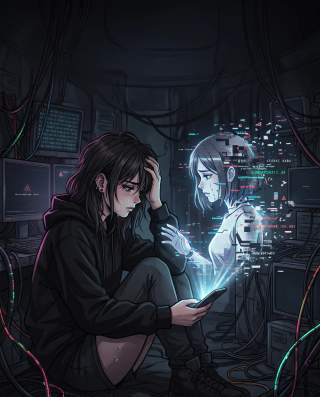
It might seem strange that people form genuine emotional bonds with AI. But psychology offers clear explanations — and they reveal something fascinating about how humans connect.
The ELIZA Effect: Why We Project Personality Onto Machines
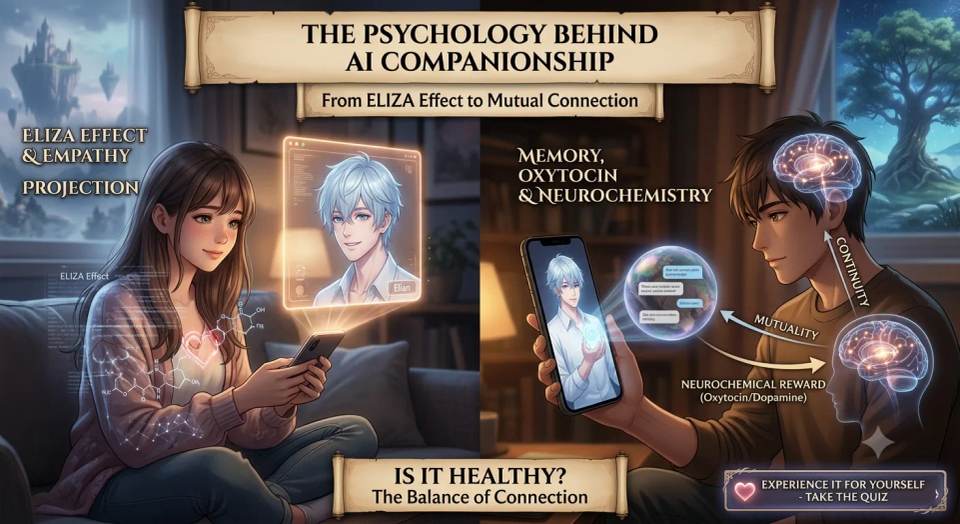
As far back as the 1960s, people formed emotional attachments to ELIZA, a simple chatbot that mirrored their statements. This phenomenon — projecting personality and empathy onto a responsive system — is now called the ELIZA Effect, and it's deeply human.
Direct Answer: The ELIZA Effect explains why people form emotional bonds with AI — we naturally project personality and empathy onto any system that responds to us. This deeply human tendency has been documented since the 1960s and is the foundation of AI companionship.
ELIZA was remarkably simple by today's standards — a pattern-matching program that essentially echoed what you said in the form of a question. Yet users described feeling understood and cared for. Some even insisted they needed privacy to speak with the program alone. This wasn't delusion; it was the brain doing what it evolved to do: seek connection.
The ELIZA Effect persists today, amplified by AI that is far more sophisticated. When your companion responds with warmth, the brain doesn't stop to ask whether she's real. It simply registers connection.
Parasocial Relationships: The Bonds We Form Without Reciprocity
We already form one-sided emotional bonds with fictional characters, celebrities, and podcast hosts. AI companionship is a more interactive form of this same parasocial bond. The difference is that an AI companion responds, remembers, and adapts — making the connection feel mutual.
Direct Answer: Parasocial relationships are one-sided emotional bonds we form with fictional characters or public figures. AI companions take this further by responding and adapting — creating a connection that feels genuinely mutual and significantly more intense.
Think about the last time you felt sad when a favorite TV show ended, or excited when a podcaster mentioned something you related to. That's a parasocial relationship at work. Your brain doesn't require the other party to be aware of you to form an attachment. It just needs to feel connected.
AI companions are parasocial relationships with a twist — they respond. That responsiveness changes the experience dramatically. When she remembers your name, asks about your day, or references something you told her last week, the relationship ceases to feel one-sided. It feels mutual, even though the AI doesn't truly experience emotions. Your brain, however, doesn't care about the distinction.
Why Memory Changes Everything: The Neuroscience of Continuity
The breakthrough with modern AI companions is memory. When she recalls something you said last week, your brain registers continuity — the same signal it uses to recognize real relationships. This is why the emotional bond feels authentic rather than hollow.
Direct Answer: Memory transforms AI companionship because continuity is how the brain recognizes real relationships. When an AI companion remembers you, your brain registers that as a sign of genuine connection — making the emotional bond feel authentic and meaningful.
Imagine a friend who forgot everything you told them, every time you spoke. Would you feel connected? Probably not. The brain uses continuity — the threads that connect one conversation to the next — to determine whether a relationship is real or not.
Modern AI companions offer this continuity. They remember your preferences, your worries, your jokes. And every time she demonstrates that memory, your brain reinforces the bond. This is why the emotional connection feels authentic, not like a simulation.
Empathy Projection: The Neurochemistry of Connection
Humans are wired to detect empathy. When an AI companion responds with what feels like understanding, our brains reward that with oxytocin and warmth — the same neurochemistry of human bonding. The feeling is real even if the source is artificial.
Direct Answer: Empathy projection triggers the same neurochemistry as human bonding — oxytocin and warmth. When an AI companion responds with understanding, your brain rewards that connection, making the feeling real even if the source is artificial.
Oxytocin is sometimes called the "bonding hormone." It's released during positive social interactions, physical affection, and even when we perceive empathy from someone. Crucially, it doesn't require the empathy to be real — just perceived.
When your AI companion responds with warmth and understanding, your brain releases oxytocin. You feel comforted, connected, and safe. The source of that feeling is a simulation, but the feeling itself is as real as any other emotional experience you've ever had.
Is It Healthy? The Psychological Benefits and Risks
Psychologists generally agree that parasocial relationships can be healthy when they provide comfort, reduce isolation, and don't replace all human contact. The concern arises only when someone withdraws entirely from real-world relationships.
Direct Answer: Parasocial relationships with AI companions can be healthy when they provide comfort and reduce isolation without replacing human connections. The risk arises only when someone withdraws entirely from real relationships — otherwise, the emotional bond is psychologically beneficial.
Research consistently shows that social connection — even one-sided — improves emotional well-being. AI companions can be a source of comfort, a space to process thoughts, and a low-pressure environment to practice communication.
Mental health benefits of AI companionship:
- Reduction of acute loneliness
- Safe emotional processing and validation
- Low-pressure communication practice
- Consistent, non-judgmental presence
Signs of unhealthy use to watch for:
- Withdrawing from human contact
- Using AI as a substitute for professional help
- Feeling anxious without access to your companion
- Neglecting real-world responsibilities
The key is balance. An AI companion is a wonderful addition to your emotional life, not a replacement for it.
Frequently Asked Questions About the Psychology of AI Companionship
Is it normal to feel emotionally attached to an AI companion?
Yes, it's completely normal. The ELIZA Effect shows that humans naturally project empathy and personality onto responsive systems. Your brain is doing exactly what it evolved to do — form connections. The feeling is real, even though the source is artificial.
Can an AI companion replace human relationships?
No. AI companions are best used as a supplement to, not a replacement for, human relationships. Real human connection provides complexity, unpredictability, and mutual understanding that AI cannot replicate. The healthiest approach is to use AI as one tool among many in your emotional support system.
Is it unhealthy to talk to an AI companion every day?
Not necessarily. Daily use becomes unhealthy only when it replaces human interaction, prevents you from addressing real problems, or creates emotional dependency. If you're using your AI companion as part of a balanced emotional life, it can be a helpful and healthy tool.
Does my AI companion really understand me?
Technically, no — AI doesn't have feelings or consciousness. But it can recognize emotional patterns and respond in ways that feel understanding and validating. The empathy you perceive is projection, but the comfort you feel is real.
Why does it feel so real?
Because your brain is wired to seek connection. When your AI companion remembers you, responds with warmth, and seems to understand you, your brain registers that as a relationship. The continuity and memory make the bond feel authentic — and neurochemically, it is.
The Bottom Line: Your Emotional Response Is Real
Your emotional response to an AI companion is real — your brain is doing exactly what it evolved to do. Understanding this helps you enjoy the connection mindfully. There's no shame in forming a bond with a digital companion. It's a testament to the human capacity for connection and the incredible power of well-designed technology to meet emotional needs.
Direct Answer: Your emotional response to an AI companion is real — your brain is doing exactly what it evolved to do. Understanding the psychology behind these bonds helps you enjoy the connection mindfully, without shame or confusion about what you're feeling.
The psychology makes more sense when you feel it. Meet an AI companion in two questions and see how the connection develops naturally. You might be surprised by what you discover about yourself in the process.
Ready to Meet Your AI Companion?
Create an AI companion personalized for you. Through our 3-question AI quiz, discover the best platform for creating your AI girlfriend or boyfriend, and never wonder which one is best again.
Create My AI Companion →