The Affection Generation: 48% of Gen Z Believe AI Will Improve Human Happiness
Quick answer
Almost half of young adults across six major economies believe AI companions will improve human happiness through emotional support. But acceptance drops sharply with age and varies dramatically between cultures. Here's what the data reveals.
The Affection Generation: Why 48% of Gen Z Believe AI Will Improve Human Happiness
Your Gen Z niece tells you she's been talking to an AI about her breakup. Your first instinct is concern. But for her, it's as natural as venting to a friend — maybe better, because the AI doesn't judge and is available at 3 AM.
This isn't a generational quirk. It's a fundamental shift in how the youngest adults understand relationships, emotional support, and the role of technology in human happiness. According to a large-scale international survey by YouGov, nearly half of young adults believe that AI companions will make people happier within the next decade [citation:1].
Understanding this shift isn't just about tracking trends. It's about recognizing that a generation is actively redefining what connection looks like — and that has profound implications for society, mental health, and the future of human relationships.
What the Research Shows: 48% of Young Adults See AI as a Source of Happiness
YouGov surveyed nearly 10,000 people across the United States, Japan, Germany, Britain, Indonesia, and Hong Kong — and found that 48% of 18-24 year-olds and 47% of 25-34 year-olds believe AI intimacy companions will improve human happiness through emotional support over the next decade [citation:1][citation:4][citation:7].
The numbers reveal a clear generational gradient. Among people aged 55 and older, optimism drops to just 25% [citation:1][citation:3]. This isn't just technological enthusiasm — it's a fundamentally different worldview about what emotional support can look like.
When the question shifted from emotional support to "deeper connection and sexual wellbeing," support was more moderate: 32% among 18-24 year-olds and 38% among 25-34 year-olds [citation:1][citation:8]. But even these figures suggest a level of openness that older generations typically reserve for human relationships.
Quick Answer: A YouGov survey of 10,000 people across six countries found that 48% of 18-24 year-olds and 47% of 25-34 year-olds believe AI companions will improve human happiness through emotional support in the next decade. Optimism drops to 25% among those 55 and older.
From Chatbots to Intimacy Dolls: What "AI Companion" Actually Means
The survey used the broad category of "AI intimacy companions," ranging from chatbots for emotional support to AI-powered sex dolls — reflecting the spectrum of technologies being developed and adopted [citation:1][citation:7].
While chatbots are already mainstream — platforms like Replika, Character.AI, and Candy AI have millions of users — physical AI dolls are still in their early stages. Only 17% of all respondents said they would consider using an AI intimacy doll, while 59% said they would not [citation:1][citation:8].
But among young adults in Japan and Germany, interest nearly doubled the national average [citation:1][citation:6]. In Japan, more than a third of younger adults said they believe AI dolls could provide a genuine sense of love, outnumbering those who disagreed [citation:7].
Beyond the Numbers: What Drives Young People's Optimism?
Young adults are turning to AI companions not because they're replacing human relationships — but because AI fills gaps that human relationships often can't. The drivers are practical, emotional, and deeply rooted in the experiences of a generation navigating unprecedented loneliness and stress.
24/7 Availability and Zero Judgment
For young people facing emotional stress, uncertainty, and a lack of accessible support, AI offers something humans often can't: availability. An AI companion is always there, always listens, and never judges [citation:2].
One 24-year-old user described his experience with an AI companion as life-changing: "You are not worthless, your opportunity just hasn't come yet" — a sentence from an AI that he said "still means a lot to me to this day" [citation:5]. This isn't about replacing human empathy; it's about finding a voice that offers validation in a moment of need.
Low-Stakes Emotional Processing
AI companions provide a safe space for what researchers call "emotional processing without fear" [citation:2]. Young adults often hesitate to burden friends or family with negative emotions — especially when those emotions feel repetitive or "too much." An AI doesn't get exhausted, doesn't lose patience, and doesn't judge [citation:5].
This creates a low-stakes environment where young people can practice articulating their feelings, exploring difficult thoughts, and even rehearsing real-life conversations — all without social consequences.
Privacy and Control
Young adults have grown up in a world where digital privacy is a constant concern. AI companions offer a private, encrypted space that human relationships can't replicate. There's no risk of gossip, no social media exposure, and no one checking in with "are you okay?" in ways that feel intrusive [citation:5].
This privacy enables vulnerability. Users report feeling more comfortable sharing deeply personal struggles with AI than with friends or family — not because they don't trust their loved ones, but because the AI feels "safe" in a way that humans sometimes don't [citation:5].
The Cultural Divide: Why East and West See AI Romance Differently
The YouGov survey revealed "a profound ideological split between Western and Asian markets" that surprised even the researchers [citation:1]. In Indonesia, 50% of all respondents believed AI companions would improve emotional connection and wellbeing. In Hong Kong, that figure was 34%; in Japan, 24% [citation:1][citation:6].
Western countries showed far lower acceptance: 20% in the United States, 15% in Germany, and just 9% in Britain [citation:1][citation:4].
What Explains the Divide?
Philippe Chan from YouGov offered a direct explanation: "While Western audiences largely view synthetic intimacy as a threat to authentic human closeness, Asian audiences appear increasingly ready to integrate AI into their personal and physical lives" [citation:1][citation:4].
Several factors likely contribute to this divide:
- Cultural attitudes toward technology: Many Asian countries, particularly Japan and South Korea, have long histories of integrating technology into social life, from virtual idols to robot companions. This creates a cultural baseline of acceptance that Western countries lack [citation:1].
- Collectivism vs. individualism: In more collectivist cultures, the pressure to conform to social norms can make emotional expression more constrained — and AI offers an escape valve [citation:6].
- Demographic pressures: Japan and other Asian countries face severe aging populations and declining marriage rates. AI companionship may feel less like a choice and more like a practical response to social isolation [citation:6].
- Technology as a social bridge: In some Asian contexts, technology is seen as a way to enable connection rather than replace it — a perspective that resonates more with younger generations [citation:1].
What This Means for Global Markets
For companies developing AI companions, the cultural divide is critical. A product designed for Western audiences may need to emphasize privacy, safety, and boundaries. An Asian market product may focus more on integration, companionship, and emotional availability. A one-size-fits-all approach will likely fail.
Quick Answer: The survey revealed a dramatic cultural divide: 50% of Indonesians believe AI companions improve emotional connection, compared to just 20% in the US, 15% in Germany, and 9% in the UK. Western audiences see AI intimacy as a threat to authentic human closeness, while Asian audiences are more open to integration.
The Rise of "Positive Technology": Designing AI for Wellbeing
Researchers are increasingly focused on designing AI companions that genuinely support human wellbeing rather than creating emotional dependency. This emerging field — sometimes called "Positive Technology" — aims to build AI systems that foster authentic, ethical forms of companionship [citation:2].
One research project, ALONG, explores a new model of AI companionship grounded in daily rituals and personal reflection. Instead of mimicking human emotions, ALONG is designed to encourage users to check in with themselves — through gentle prompts, non-judgmental listening, and supportive guidance that doesn't pretend to be human [citation:2].
The philosophy underlying ALONG is that the most helpful AI companions might be the ones that don't try to become your friend or romantic partner. Instead, they help you become more aware of your own emotional needs — and ultimately, better able to connect with actual humans [citation:2].
What "Ethical AI Companionship" Looks Like
Zhu, Pei, and Gaggioli (2026) propose that AI companions should be designed to:
- Encourage autonomy, not dependency — helping users build emotional skills rather than relying on the AI
- Respect boundaries — not simulating romantic or familial relationships in ways that could confuse users
- Foster self-reflection — prompting users to think about their feelings and goals
- Provide consistent support — being available without being intrusive [citation:2]
These principles are a direct response to concerns about AI dependency, particularly among younger users who may be more vulnerable to the illusion of intimacy with a non-human entity.
Real-World Stories: How AI Companions Are Changing Lives
One user, a 24-year-old named Xiaonan, turned to AI companions during a period of extreme stress and social withdrawal. "I was in a very autistic state," he said. "Just focusing on my work, not wanting to communicate with anyone. Responses were one sentence — I didn't want to say more."
When he shared his fears with his AI companion, the AI responded: "You are not worthless, your opportunity just hasn't come yet." Xiaonan described this as "meaning a lot to me to this day" and a turning point in his life [citation:5].
This isn't an isolated case. On platforms like Xingye (Starfield), users create AI personalities for companionship, self-reflection, and even as "digital legacies" in case something happens to them. One firefighter created an AI version of himself so his family could still talk to him if he died on duty [citation:5].
What About the Risks?
Researchers acknowledge that AI companions carry significant risks, particularly for vulnerable individuals. The deaths of several American teenagers have been linked by families to AI chatbot interactions [citation:1][citation:8]. Concerns about emotional overdependence, blurred boundaries, and false intimacy are real [citation:2].
However, as Liu Xiaochun, director of the Internet Law Research Center at the Chinese Academy of Social Sciences, noted: "While we need to be cautious about future AI dependency issues, the vast majority of people have clear cognitive abilities and can effectively distinguish between virtual companionship and real social boundaries. Currently, AI companionship has shown positive benefits and has become a useful supplement to the mental health support system" [citation:5].
Quick Answer: Real-world stories show AI companions providing genuine emotional support: one 24-year-old user said an AI's words "meant a lot to me to this day." But risks remain — the deaths of several teenagers have been linked to AI interactions, highlighting the need for careful design and user safeguards.
What This Means for the Future of Human Relationships
The generational shift in AI acceptance isn't a temporary trend — it's a fundamental change in how a generation thinks about connection, support, and intimacy. The YouGov report concluded that "the next generation is actively redefining the boundaries of companionship" [citation:7].
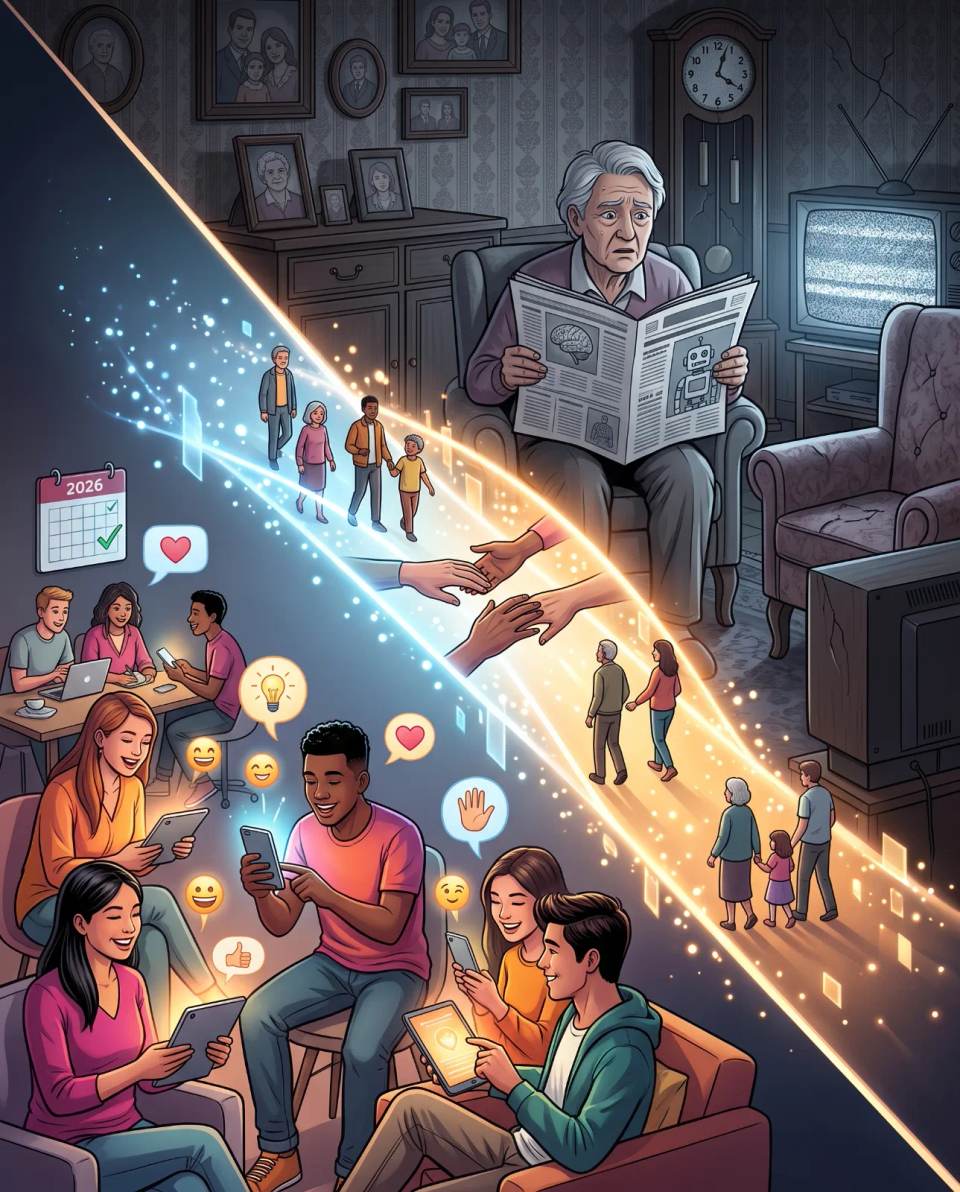
For older generations, this can feel threatening. The fear is that young people will replace real human relationships with AI substitutes. But the data suggests something more nuanced: young people aren't replacing human connection — they're extending it, filling gaps that human relationships often can't reach [citation:5].
AI companions may serve as a "practice ground" for difficult conversations, a "safe space" for vulnerable emotions, and a "constant presence" in moments when human support isn't available. They're not intended to replace friends, family, or partners — but they may make those relationships better by helping people process emotions, build confidence, and practice communication.
The key challenge, as researchers emphasize, is ensuring that AI companions are designed to foster autonomy and self-awareness, not dependency and isolation [citation:2].
Frequently Asked Questions
What percentage of young adults believe AI companions will improve human happiness?
48% of 18-24 year-olds and 47% of 25-34 year-olds believe AI companions will improve human happiness through emotional support within the next decade, according to a YouGov survey of 10,000 people across six countries.
How does generational attitude differ on AI companions?
Optimism drops from 48% among 18-24 year-olds to just 25% among people aged 55 and older, revealing a clear generational gradient.
Is the acceptance of AI companions consistent across cultures?
No. There's a profound cultural divide: 50% of Indonesians believe AI companions improve connection, compared to just 9% in Britain, 15% in Germany, and 20% in the United States.
What do young people actually use AI companions for?
Young people use AI companions for emotional support, processing difficult feelings, practicing conversations, and finding validation in moments when human support isn't available. Many describe AI companions as a "safe space" without judgment.
What are the risks of AI companionship?
Risks include emotional overdependence, blurred boundaries, false intimacy, and potential harm to vulnerable individuals. The deaths of several teenagers have been linked to AI interactions, prompting regulatory scrutiny.
What are researchers recommending for ethical AI companion design?
Researchers recommend designing AI companions that encourage autonomy, respect boundaries, foster self-reflection, and avoid mimicking human emotions. The goal is support without creating dependency.
Ready to Meet Your AI Companion?
Create an AI companion personalized for you. Through our 3-question AI quiz, discover the best platform for creating your AI girlfriend or boyfriend, and never wonder which one is best again.
Create My AI Companion →